Author: Luther

Things I’ve discovered about America

“Makal” in the Kyrgyz language means “proverb.” Kyrgyz is full of wonderful and puzzling little proverbs – some that match common proverbs often heard in English and some that are real head scratchers. Most Mondays I’ll post one of the more fun ones for you. Let’s see if we can’t make some of these commonplace in America by the time I get back!

Mekeningdin kadyry bashka jakta bilinet

Мекениңдин кадыры башка жакта билинет

“The value of your homeland is known once you’re in another place”

This proverb conjures up the melody of Big Yellow Taxi: “Don’t it always seem to go—that you don’t know what you got ‘til it’s gone…”

When a volunteer extends their service for a third year, the Peace Corps kicks in a free month-long trip back to the states in between the second and third year. This is quite the perk and currently this volunteer is enjoying his Minnesota summer quite thoroughly.

IMG_0599Onion ring towers bigger than your face and maps of America made out of beer labels. It’s gonna be a delicious month of July.

It does seem to take some significant time spent out of the United States to realize how good we have it. Most Americans enjoy everyday opportunities that would be considered privileges in many other countries. In many ways I took for granted the comfortable life my circumstances, upbringing and family have allowed me. For this, I’m grateful.

On the lighter side, having been living outside of the states so long the absence made me forget many things I once had—only to be discovered upon return to these closer shores. And I mean discovered, of course, in the same way Columbus “discovered” America. So hang onto your cockle hats Americans—here they are—my discoveries:

  1. First and foremost, judging by the above paragraph, I seem to mostly have been being in the forgetfulness state of English usage. Methinks I need to study this book.
  2. Being able to mostly speak the native language is kinda nice and (for the most part) I’m not all that socially awkward.
  3. Mosquitoes and 95% humidity are actually not that pleasant.
  4. Toilet paper goes IN the toilet.
  5. The joy of utilizing the personal manifest destiny machine aka the automobilefamilycar
  6. Frozen pizza
  7. An entire bag of Chili Cheese Fritos fulfills all your daily needs for calories, fat and sodium.
  8. (And on a related note) America shrinks all your clothing. Food just tastes better when it’s red, white, and blue!IMG_0741
  9. Everyone shows up so early to stuff. I show up right on time, 30 min. late.
  10. Not having good internets, I’m now catching up on all the youtubes.
  11. I follow my family members around on errands because I’ve found they tend to buy me food.
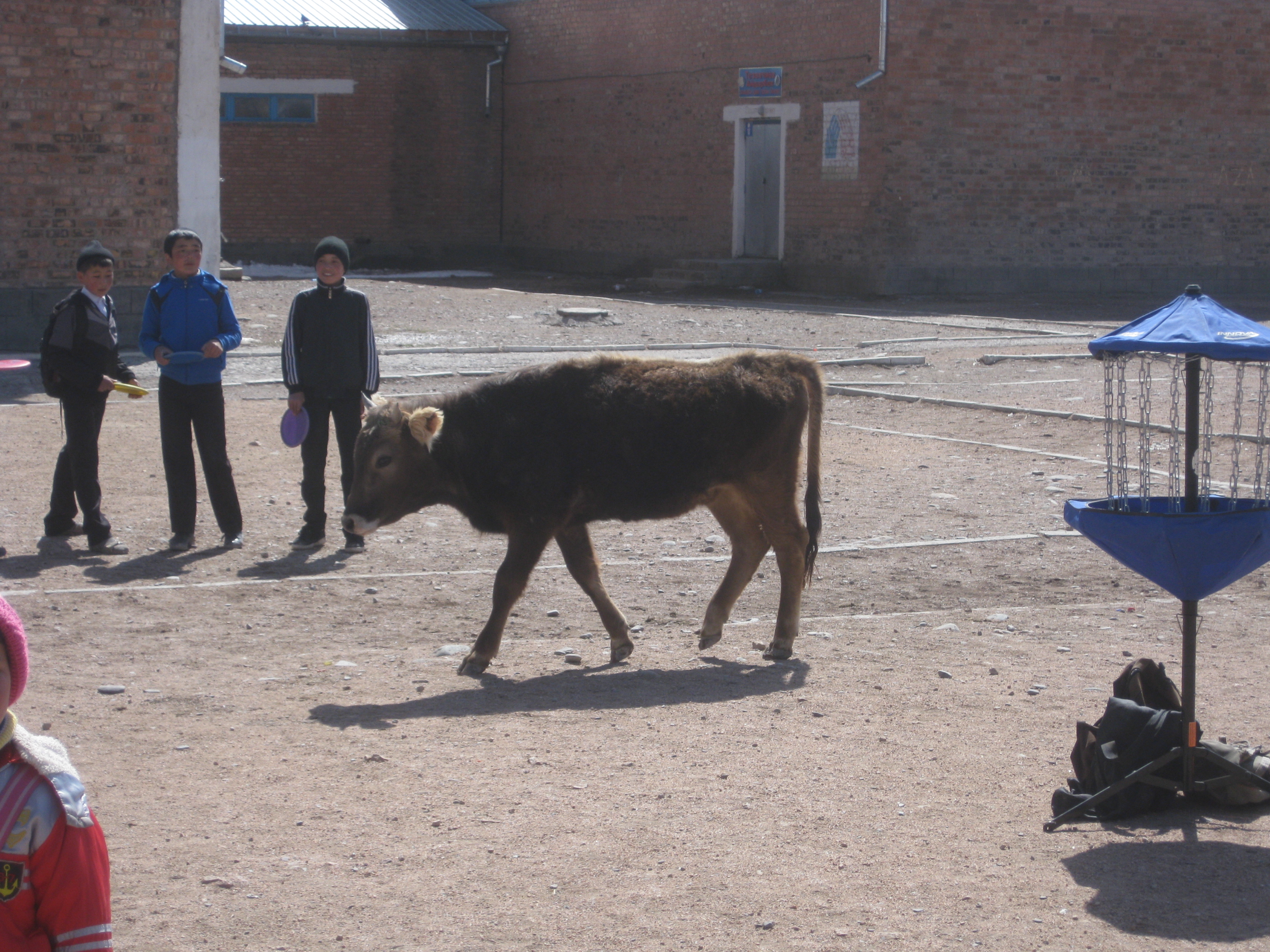
  12. Disc golf. My goodness, how I’ve missed you! I just fell off on a tangent of watching more videos. (And I’ve hit up 6 different courses since being back.)discinred
  13. There’s a lot of stuff and things. I kept taking pictures of the size of food containers at Sam’s Club.
  14. Parades and dancing ice-cream cones.IMG_0581
  15. There’s family here! And I missed them. Also, weddings take a long time to prepare for. (Congrats Marie!!)IMG_0743
  16. I like it.

Thanks America! And thank you Peace Corps for the trip!

Stay tuned for part 2 in which I list the top things of value about Kyrgyzstan that is becoming known to me now that I’ve been away for a few weeks! Мен Кыргызстанды сагындым…I miss you Kyrgyzstan!

—–

If you’ve returned home after spending significant time outside of your native land, what were some of the things you re-discovered?
Hate your neighbor

Peace and Friendship. Those are the goals of the Peace Corps. Wonderful goals.

And you know what else is wonderful? Rainbows and puppy dogs. They make a pretty scene, spread out before you as the sun dances upon little raindrops falling from clouds now parting.

It’s gonna be a bright, bright sunshiny day in the Peace Corps.

It’s easy to get lost in the ideals. It’s easy to say you’re not going to deal with all the hard stuff, all the stuff that’s real. It’s easier to just instagram the day brighter, untag the upshot, tweet about your puppy dog.

And oftentimes you need that—the world needs that—needs a break from the reality of itself.

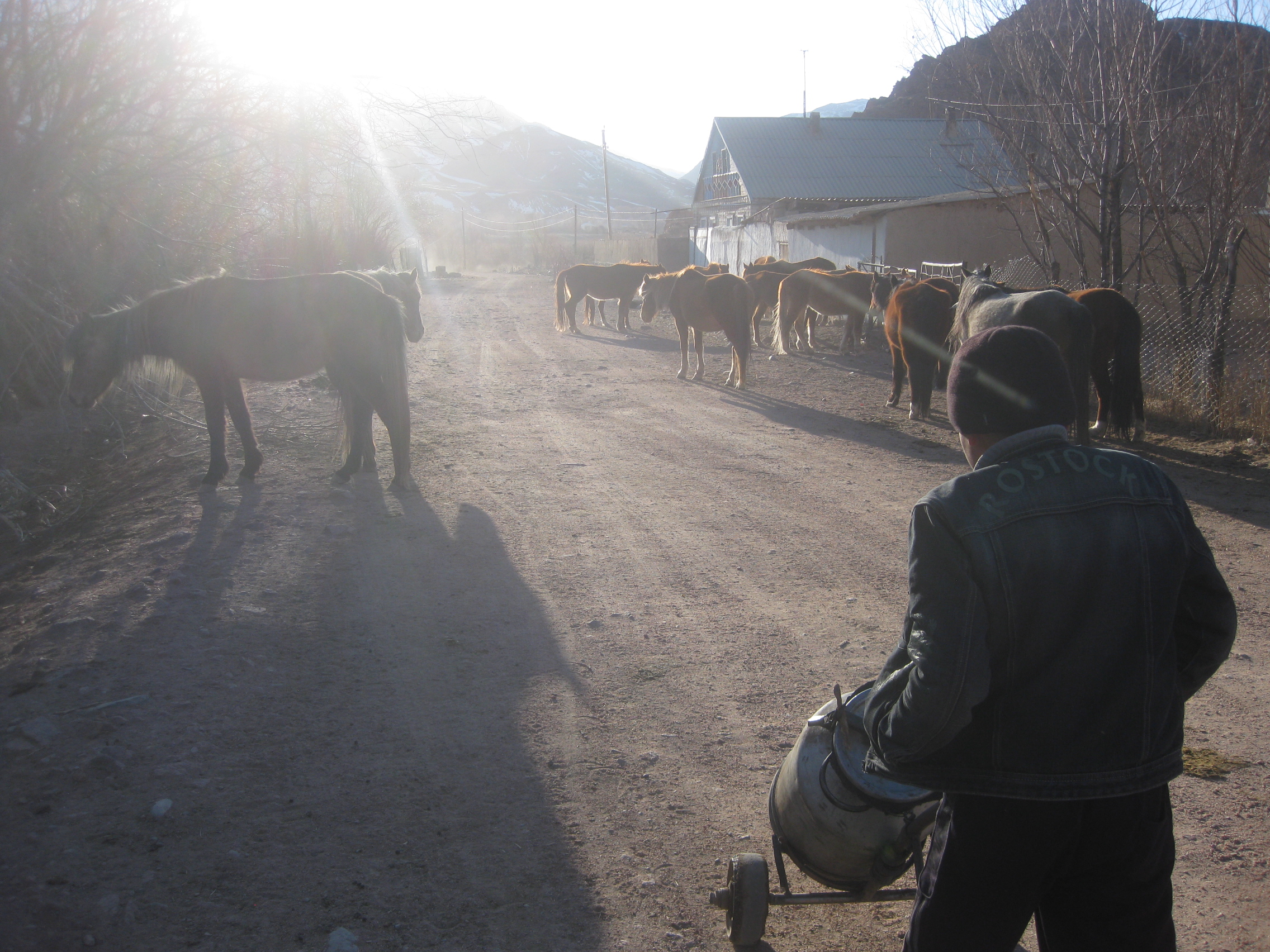
IMG_9073All the neighbors’ pretty horses

Ok, so the world has problems, but you’re going to fix them. Lead another training. Hold an intervention. Be the mediator. Paint a mural of the world and all the people, holding hands and singing sweet harmonies for all to dance upon in peace and friendship.

But reality is, you can’t always fix it. In fact, most of the time you won’t. People can’t always get along. People won’t always get along. You’d be crazy to expect otherwise. You have to accept that some individuals and some individual groups are not going to like each other and never will. Should we work for mediated peace or mutual understanding? Of course. But in all our efforts the success rate isn’t one-hundred percent. Talks break down. Negotiations fail. Wars break out.

There are only two prerequisites for groups to hate each other: they’re a) different, and b) right next to each other. That’s it. Those are the only two ingredients in the recipe for not getting along. It doesn’t take a history of violence, it doesn’t take premeditated offence; there’s usually no root of the problem to go back to. They simply will not agree to mutually exist in the same place together.

You see it on the news. You read about it in a magazine. One-million Syrian refugees have poured into Turkey. But until you’re staring across the table, sharing a Burger King meal at the airport in Istanbul with a young man from Syria, his house bombed, his father killed in the crossfire, his sister and mother surviving day to day in a tent camp in Jordan, he sleeping nights in internet cafes as he searches for work—until that moment it’s all statistics and talking heads playing he said she said. Until that moment you wonder why they can’t just get along.

That’s the moment you realize there is no longer the question “why?” That it doesn’t matter the reason. Hell, that the reason we’re all left reeling is because there is no reason. The only thing to do is buy him a burger, to lead another training, hold an intervention, be a mediator.

Or pack an emergency box or write an e-mail or host an exchange student and you realize, you only have you, only have your little sphere of influence, your little bubble where you’re going to decide to do more good than harm, to leave your world a little better than when you arrived.

You can argue the strategy. But don’t tell me the world needs less of that. Needs less of what the Peace Corps Volunteers are doing. Just get to work. Change—movement in a new direction—it’s the only thing that can chip at the walls of hate built so long and so high between neighbors.

—–

What things can you do to make your world a better place?

Fear the chupacabra

“Makal” in the Kyrgyz language means “proverb.” Kyrgyz is full of wonderful and puzzling little proverbs – some that match common proverbs often heard in English and some that are real head scratchers. Most Mondays I’ll post one of the more fun ones for you. Let’s see if we can’t make some of these commonplace in America by the time I get back!

Saktykta korduk jok

Сактыкта көрдүк жок

“With care and precaution, there’s no asking around”

I’m still a little fuzzy on the translation of this one. For some reason it takes about 30 words to explain a Kyrgyz proverb in Kyrgyz and even more in English. But it goes something like this: when care and precaution is taken, one doesn’t need to go beg for things lost through folly.

I’ve been getting a steady stream of Kyrgyz from my new host dad, and lucky for me I have someone so willing to explain. He’s the master of quoting proverbs, always pulling me aside to say, “Baatyrbek—(my Kyrgyz name)—in Kyrgyz we have this proverb…” My ata is 66 years old this year and still works as an ear/nose/throat doctor at the local hospital as well as working several hours a day in his garden. We have rose bushes, garlic, carrots, cabbage, and rows upon rows of potatoes. He keeps a small chicken coop that provides our eggs and six sheep—wait, only five after this evening’s party—and checks the upkeep on the property. He’s a man who has saved all his life and built a household on those savings.

The number of sheep in our yard dwindles as we host parties. But those losses are of our own volition. What ata doesn’t want is to lose one of his sheep to the chupacabra.

Yes world, our little slice of Kyrgyzstan has a chupacabra. “Imported from Mexico,” some say. “Planted by the Americans,” say others. “A half wolf—half dog turned vampire,” say the more outrageous of the bunch. Pictures and video of sheep, dead as a doorknob and white as a sheet, have been featured on the national news. And animals continue to die.

IMG_5331Taxidermic finds in a local museum in Kochkor—my chupacabra vote is for the guy on the bottom right

It’s not the fact that farm animals are getting picked off. That’s an expected part of a life lived on the edge of the wild. It’s the manner of their deaths that’s so strange. Whatever is killing them only sucks the blood. The meat is left on the animal, ashen grey from the absence of the red stuff pumping through its veins.

What it could be is anyone’s guess—or tall tale. Like any good mythological beast, no one can manage to snap a photo. It’s always too fast. Some have claimed to have seen it: a grey/brown, fury/hairy, dog/cat like animal disappearing through a doorway, around a bend, and into thin air.

It’s 11:00pm. Our guests have just left for the night. My ata grabs a flash light, slips into a pair of flip-flops and shuffles outside. He’s a man who has saved, reared, worked and invested. His home is well maintained and his family is well cared for. “Out to lock up the sheep for the night,” he says, “The chupacabra is on the prowl.” Suddenly he pauses, puts a hand on my arm and pulls me close: “In Kyrgyz we have this proverb…” The way ata works, he won’t be asking around any time soon.

Makal Monday: A horse that says ‘I won’t walk’

“Makal” in the Kyrgyz language means “proverb.” Kyrgyz is full of wonderful and puzzling little proverbs – some that match common proverbs often heard in English and some that are real head scratchers. Most Mondays I’ll post one of the more fun ones for you. Let’s see if we can’t make some of these commonplace in America by the time I get back!

At baspaim degen jerin ming basat

Ат басрайм деген жерин миң басат

“A horse that says, ‘I won’t walk,’ will walk that route a thousand times”

Two months after graduating college I found myself alone in a small, tatami mat room sleeping on the floor. I had travelled 6,000 kilometers to teach English in Japan, and wondered as I drenched my sleeping pad with the sweat of a Shizuoka summer what teaching would be like.

I had been a camp counselor on occasion and loved it. I had worked with youth in a number of capacities and had even taken a TEFL class to gain a few skills for potentially teaching abroad. But I had no formal classroom experience and wasn’t sure how teaching English to classrooms full of kids who didn’t really need it would go. It turned out to be similar to teaching math to kids in America; most were there only because it was a required course, weren’t going to be using the subject at any point in their life, and frankly didn’t like it.

There were a few students who made some of the days worth it and of course life outside of school certainly made up for the time with its share of excitement and so I stayed two years. After returning home I knew I wanted to live abroad again. I just wasn’t going to be doing any more of that teaching English business.

Here I am, four years of teaching English under my belt and another on its way. This horse is being spurred on over ground it said it would never travel.

Never say never.


Continuing in the vein of full disclosure, I was disappointed when I received my Peace Corps assignment as a TEFL trainer. Why couldn’t I have gotten something more exciting, like digging wells or something? Ah—because other than teaching, I have no skills.

(If you’re a future potential job employer reading these words, please go back and forget that last sentence. Also, please stop reading.)

I really don’t. I’ve never dug a well, I barely eat any green plant life grown from the ground much less know how to grow it, my only quasi-entrepreneurial experience ended in a sad summer climbing ladders for CollegePro Painters and the sight of blood outside of someone’s body or any medical abnormality for that matter makes me pass out. So teaching English it was.

There really couldn’t be a more tame profession. But add Peace Corps to the mix and the seemingly benign is suddenly pushed smack against the threshold of survival. Every day poses fascinating challenges to overcome: schedule changes, freezing temperatures in classrooms, teachers eating the chalk and kids out harvesting potatoes. Even the Peace Corps Volunteer teachers find themselves in incredibly exciting, albeit harrowing, situations.

And there are kids here who want to learn, even if it’s a smallish handful. Not every single person is going to appreciate having you around, but even so, you’ll reach celebrity status with at least a few of them. And how could you not love the groupies? The ones who, for a single club lesson will chatter at their parents for a week, so excited to have learned a phrase of English from a real live American! (Ok, so maybe it is just the celebrity that keeps me going.)

After saying I’d never do it again, in the end I come back because I love it. I really can’t think of anything easier to do and I suppose that should be a sign that I’m meant to do it. Being in front of a classroom of kids is fun and simple. Or maybe I shouldn’t say simple—I’ve had to learn a lot, read a bunch, practice a ton and train others to figure out what I’m doing. But in the midst of it all, there’s a relaxing ease which makes it enjoyable, interesting and rewarding.

That’s the great thing about teaching English in the Peace Corps. TEFLers do get to see more immediate results and benefits of their work: kids winning spots in international exchange programs, going on to compete in national competitions, getting into good programs at universities and simply progressing on to conversational fluency. And the skills kids gain from having a mentor and teacher who invests his or her life are immeasurable and beyond the scope of quantifying. Being an English Education volunteer is a lucky post.

I don’t know what I’ll be doing in the future. I’m not sure I will go into education once I’m back in the states. Based on experience though, this horse of course, better not say never.

Patience. Wait – scratch that.

I’m the king of swearing under my breath. I must be since I’m not aware of anyone else who swears under my breath. Also though I’m not so sure it’s under my breath so much as it’s out-loud. Things bother me. And I make it known.

If living for 2+ years in a foreign country while forgoing previously well-enjoyed creature comforts, operating in an twisting of language and imperceptible cultural differences and generally trying to survive where no one has ever heard the words “disc golf” is not a test of patience, then nothing is. In the Peace Corps your level of patience is going to be tried like nowhere else.

And when it gets to be too much, I tend to go off the deep end a little. I’m that guy locked in his home, emerging only for restocking of ice-cream and Coca-Cola—the two items that are the sole cure for all mental anguish. But don’t talk to me on those little journeys to shop. And God help you if you’re out of ice-cream.

“Ice-cream jok,” they say.

“Well when’s it going to arrive?”

“Tomorrow, God willing.”

Why does “tomorrow” always mean, “I have no clue but I need to say something.”

It’s the little things that flare up—restaurants and taxi drivers not having change, the lady at the yarn shop refusing to give you her number so you can check to see if they have a future need in stock, the repeated no shows of students adamant they want you to teach them English, the shop owner who won’t replace a bad product she just sold you.

That last one got me.

“This shop is bad!” I stood in the entrance way and called out to anyone who cared to look my way. “They sell bad products! Don’t buy anything from here! They lie to you!” I told several friends to avoid the shop. If there was a Kyrgyz version of Angie’s List (Aidai’s List? Can we get this started, Aidai?) you can be sure I’d leave negative feedback and push as many as I could away from the shop’s doors.

“I’ve rolled with it just a little too long,” I utter to myself, “I’m not letting them get away with it this time!” It turns out making such public spectacles generally only leads to either the embarrassment of the berated, the berater, or both. Patience isn’t really a thing we ever arrive at, I guess, but rather a progression in humility. (And oh how closely that is related to “humiliated.”)

IMG_6494Patiently waiting for “game on”

Seeing my pen had disappeared from my reserved seat on a mini-bus the other day I made an announcement to the general crowd that I had “lost my pen” and wondered if it had been seen. I then proceeded to ask a mother of a wandering child if she had it, when a young man in the back of the bus piped up and tossed me the pen. I thanked him and sat down. The end result was exactly what I wanted: I had my pen, he had confessed to a wrong, and everyone maintained their dignity.

Angry accusations are like cornering a tiger, and weak complacency is like sharpening its claws. Balancing both justice and your own desired outcome while laying the ground for future growth takes a lot of patience, a virtue often punched with holes that leaks all over the pavement whenever I need to take it out for a spin. It’s something learned along a continuum, and God willing, I’ll keep getting better.