Author: Luther

Support the individual

Part 2 of ‘Change is complicated’

How many children would you bear for a gold medal?

I can bear being alone in a room with two or three for a couple hours. But that’s not the kind of “bearing” I mean. In the Kyrgyz Republic, a woman is presented with the medal “Hero Mother” for having and raising 10 or more children. That’s right. Ten. (I can’t even count that high before I lose my patience.) It’s a national practice dating back to 1944 when the Soviet Union began officially honoring and supporting women who made this incredible contribution to the state. Kyrgyzstan officially resumed the order in 1996.
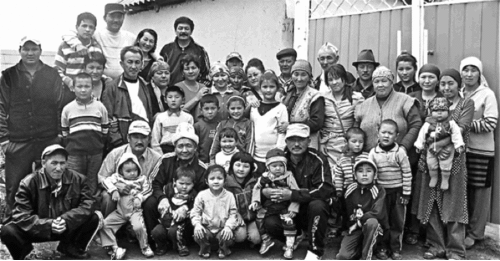
imageThis Kyrgyz family has gone platinum

For a mother this award isn’t a singular event; it’s the culmination of decades of daily effort in raising a child. What incredible responsibility to raise children to love their communities and work for the betterment of their nation! It is to each of our honor to support these families so each individual has the opportunity to learn how to pursue justice and effect changes to deeply broken systems.

We often complain about these systems—poor schools, corrupt courts, tampered elections—in a way that paints them as separate, detached forces floating above our heads for which we are not responsible and have no ability to change. But we cannot acquiesce the situation nor abandon our wills; for, these broken systems are the conglomerate result of individual decisions and actions.

What does this mean?

Steadily influence one person at a time. Verbally and publicly encourage and reward earnest effort and right behavior. Create laws and economic conditions which support entrepreneurs and small businesses. Award positions based on merit in an open and competitive process. Lead by example and with integrity.

Our influence as volunteers is truly very little when pushed up against systems, but to individuals our kind of work can have incredible impact. The work is not hopeless, though it might look that way. The problem is people—but because this is true—the solution is people as well.

We were sitting around our last cups of tea the other week when my friend’s mother started talking about her brother. He had been a top regional public lawyer in Kyrgyzstan, moving up through the ranks through his intelligence and hard work. Since he didn’t exact bribes, he lived a modest life within the means of his small government salary. But his integrity soon got him in trouble. At this level, when the next round of promotions came he found his position priced at $16,000. Without a savings account fed by accumulated bribe money, he was out of the running and out of a job.

I pray his honest labor was not in vain. These are the individuals we must support and uphold. This is the character we must develop in each child being raised. And God willing, when the future looks back and honors its heroes, it will honor this man and the people who sacrifice thusly as heroes of the highest order.
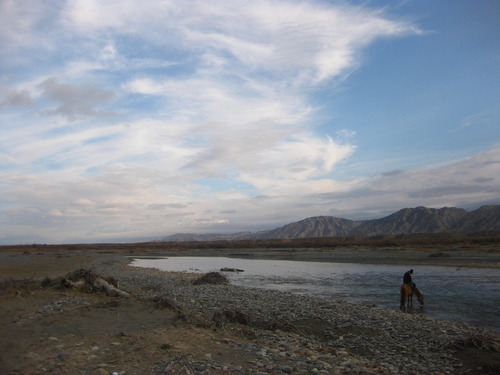
Change is complicated

There are many things in Kyrgyzstan that need to change. This shouldn’t be a surprise to anyone. We are invited to be here by the government because of what we can offer in making the country a little better place. Where I’m stuck, however, is in what that definition of “little” means.

Along my search, let me share an anecdote as example:

Take the English teacher who is inflating grades or changing scores on his students’ tests to make him look better. It would seem at first glance that this is a very morally corrupt man and he has issues that need to be righted. Cut and dry. After all, he’s hurting his students’ motivation to study. When they know it doesn’t matter what scores they get on the test because they will pass regardless, most students lose interest in exerting any kind of effort.

So you approach the teacher and tell him what he’s doing is wrong and that he is detrimentally affecting his students’ futures. You’re going to make your mark: he’s going to change. But you’re not ready for his answer. He tells you he would love to grade fairly, and it makes him angry to inflate the grades, but if he doesn’t he will 1. Get yelled at by the parents of his students and he has to live next door to some of them 2. The parents will complain to the director that he is a bad teacher and the director will take the parents’ side and 3. The director will himself give him a hard time and possibly even fire him if he doesn’t report good grades.

So you feel sorry for him and your incensed rage and moral compass guide you to the next level. You approach the director and tell him what he’s doing is wrong and that he needs to support his teachers in a united front against all that opposes the forward progress of knowledge. But you’re floored by his response when he tells you that he can’t let anyone in the school fail because if he does the superintendent will yell at him and he could possibly get fired and then how would he feed his family? Not to mention all the teachers who are older than him who would call the superintendent themselves to make up lies about him if he tried to tell them how to run their classrooms.

So you realize the problem lies with the school district. You march right up to the superintendent’s office and you demand a meeting. You tell him directly that he can’t force all schools to allow every student to pass because this is hurting the quality of education and is greatly affecting attendance at your school, especially among upperclassmen. He needs to do the right thing. But once again your righteous indignation is turned on its head—he tells you that if there are any failures in his district he will look really bad compared to all the other districts who are just passing kids through and then someone from the ministry of education will come down, chew him out and put someone else in charge who will take orders.

At this point you’re wondering how far up the ladder you need to go. There are so many obstacles at every level that getting a teacher to grade fairly might require an official decree from the president of the country and enforcement by the executive branch.

Other countries have succeeded in doing this, including the former Soviet Republic, Georgia. The Rose Revolution in 2003 saw massive sweeping changes executed by strong leadership that led to a significant rise in quality of life for everyday Georgians. Corruption wasn’t tolerated on any level and within a matter of a couple years, citizens were enjoying higher salaries, a competent and helpful police force, and fair chances for more people to get a higher education. It took strong, unified leaders with an unwavering sight on their vision to turn things around.

But this is really, really hard to do. It requires a perfect storm of people with the same vision all falling into place at once. Unfortunately for our hapless English teacher, if he tries to stand up and do the right thing on his own he will be quickly swallowed up in a system outside of his—and any other individual’s—control.

I wish I as an individual could change the whole country—stand up and give that rising speech—and suddenly everything would turn on its corrupted heels and march towards fairness and justice. I care about this country and the direction it’s headed because I live here—Kyrgyzstan is my home—and what happens affects my students and my host families and my friends. They’re the victims of these broken systems. Yet a strange fact remains: the same people who are the victims are the ones who are responsible; they’re all so interconnected it’s like a knotted ball where if you pull on just one loose end, the whole thing only becomes more tightly tangled.

Where do we, as Peace Corps Volunteers, fit with trying to help untangle the knot? If we stand up and say something it could be our job as well that’s pulled out from under us to be replaced with a plane ticket back home. Or we could just be noise that’s dissipated by local winds less sympathetic to a foreign voice. Or we could offend our friends with harsh words when our only intent was to help.

So do we just try and do the “little” things? Keep our heads down, teach our classes, give our trainings, lead our camps and hope that something somewhere rubs off on the right people who will stand up and be that change? Are those little things actually the big things that will someday tip the scales?

It’s something I don’t have an answer to. I wish I could be more directly involved. Maybe it’s my job to inspire the voices rather than be the voice. Yet that is complicated too.

imageKyrgyzstan – a country of vast potential

Wash your hands

When I was little and would use the facilities so to speak, I would wash my hands with soap if it was #2 or simply rinse them a bit for #1. Those were the standard operating procedures for Little Luth. I never really thought about the science behind why hands needed to be clean or how one methodically went about ensuring they were so.

Now my hygiene habits weren’t particularly worse than anyone else around me on a typical day back in the states, but they probably weren’t as clinically sterile as they could have been. How often did I rub my hands on my pants and then take a bite of a sandwich or open the door of a Chipotle before enjoying a burrito? (Mmm…burrito…wait, what are we talking about again? Oh yes.)

In the past year and a half my hand-washing habits had gotten worse. Even now I’m sitting in my house, a head cold and nervous it might be hep A since a bout has been going around my village lately picking off one student after another. The opportunities for hand-washing are greatly decreased here due to lack of running water and hand-washing stations posted around plus the cultural habit of shaking every man’s hand no matter how soon you need to be eating something. That’s one more incentive to ‘get it right’ when you do have the chance.

A health volunteer friend of mine, Tori, came out to my village earlier this winter to do a couple of health lessons for my students, one being hand-washing for the adorable second and third graders. Or at least I considered them to be adorable until my counterpart decided it was a good idea to stuff 90 of them into a classroom for the lesson. It’s easy to have a less gracious view of 90 little snots all talking at once and shoving each other to get as close as possible to the front of the room.

imageSaving the world, one pair of hands at a time

I listened to her lesson in between breaking up fights and rerouting attention and realized, “Wow. I’m learning something.” There’s a kind of technique to hand-washing that goes beyond just letting water run over your hands. I was especially impressed by the double fingernail scrub (picture a row of choir kids singing with their hands clasped in front of them) and the thumb wash (picture milking a cow). I was going to be so much healthier from her on out, and a lot more happy each time I washed my hands singing the full ABCs before I walked away.

The neatest thing about the training though was how memorable it was. To this day I still wash my hands differently because of that training. And this is what any of our trainings focus on: behavior change. Just how you can get someone to change risky behavior for healthier behavior is a tricky task set before volunteers on a daily basis.

So thank you Tori! My hands have never felt so clean, nor have I had so much fun washing!

Health volunteers are doing amazing things and are making a big difference in communities around the world. Remember to thank a Health Peace Corps Volunteer the next time you see one!

Bread tastes better when you bake it yourself

One of the great benefits of living with a host family is having food. It’s an even greater benefit for the volunteer who lives far from any kind of substantial food market and so doesn’t have to be responsible for the slaughtering for all his own meals.

Despite our hitherto “I-live-here-you-feed-me” agreement, my host parents took a trip to the big city for a few days so it was up to my 16-year-old brother and me to cook food and generally fend for ourselves. How the whole house didn’t descend into Lord of the Flies was a miracle, and counted up there was the fact that dinner appeared on the table at regular intervals. It didn’t even resemble a raw pig on a stake, most of the time.

imageA Peace Corps volunteer’s last supper. No pork on this table.

I’m a fairly good cook when I feel like cooking, namely when starvation is the other option, and I follow a mean recipe. There’s something about making bread, however, that a recipe doesn’t tell you and that’s the secret ingredient of love. You have to romance the dough, with a sweet-water bath and full body massage with oil.

The bread I tried to make that day, however, wasn’t feelin’ the love. I got a slap on the face in the form of ten little hockey pucks of hardened flour. Being, again, the only option between us and starvation, I took a bite. My host brother took off for the neighbor’s.

She cut me deep, that bread, (no, I mean literally—she was really hard) and it was a long time until I had the confidence to put myself on the line for another.

I got the chance some months later now living on my own. This time I wasn’t going to fail and laid it on thick with the charm, sweets and tush patting. How she could have turned out to be a spoiled little fruit cake is impossible to tell, and I’m sure there was no connection. Anyway, I ended up passing her off on a friend who was apparently more desperate than I.

If love can be reduced to a fortune cookie, and I think we can all agree that it can, the third time is the charm and the secret is in the second rise. You let her think the romance is on, then you introduce that walnut seed of doubt, working it in then finishing with a redeeming spin of honey. If my first bread was a date at McDonald’s, this one was a full day at the spa followed by dinner at something French sounding.

I don’t think I have to tell you what the best part of that date was though. That bread hung around for breakfast, if you know what I mean.

Bread just tastes better when you make it yourself. (And I think now is a good time to drop the love metaphors.) It’s enjoying something that you labored over and saw through from inception ‘til the delicious end. And even if that end was bitter, it’s still something to know that you did it yourself.

Lesson learned. Now I wonder if the host ‘rents still have a room available.

How to count

Counting here starts with the most important word of all: Beer. If this wasn’t a sign Kyrgyz was going to be the most awesomest language ever, I’d never drink another Jiboe again.

Each day in PST language classes, we learned to count as we learned to take baby steps in the culture.

beer…

eki…

ooch…

One, two, three days in training…one, two, three trainees sleeping…one, two, three sessions on diarrhea…one, two, three months to go ‘til school starts…one, two months to our Close of Service conference…one, two, WHAT?!?

Somehow I skipped a few numbers in there. How did time go so fast? Life during training seems like a whole different lifetime. But that’s the funny thing with numbers and time. It seems so long ago, but feels like it went by so fast.

So as I begin to count down the days, how do I make the days count?

Math instruction for the village kid — falling asleep has never been so easy

I’m wanting to extend for a third year, but even if my request is approved, I’ll still be leaving this village. Forever. It’s a shot in the gut, realizing that. It gives me that scrambling sense, the one where I’m told I can keep as much as I can hold and so I’m grabbing at everything, stacking it up in my arms, stuffing things in my pockets and they’re tumbling down, hitting the floor, slipping through my fingers.

I think about each of the “lasts.” The last hike up the red hill in town. The last dinner at my friend Maksat’s. The last time I’ll see these familiar mountains as they slip away in the rear view mirror.

It can’t end. It won’t. I still know these people, this valley. I’ve sewn my life into these hills and it will stretch and maybe even tear a bit but I will always be part of this and it will always be part of me.

I told my family when I was leaving the states that it wasn’t a forever goodbye. “You guys make this seem like you’re mourning my funeral. I’m not dying you know. And it’s just Kyrgyzstan. I’m not climbing in a rocket for the moon.”

Maybe fifty years ago the Peace Corps was like that, where you might as well have been serving on the moon, helping the mooninites improve their cheese production or something. Where volunteers sort of just disappeared into the countryside for two years, a letter occasionally wriggling its way loose and inching towards America, reassuring its recipients that the volunteer was still alive two months before.

Now we have cell phones and skype and facebook and tumblr and a thousand other little gadgets and applications where we connect and stay in touch. We use those to connect back home in the states, but really they’re for connecting to wherever home is.

So in counting down, I never reach zero. Because I’m not in a rocket ship for the moon, I’m on the same planet, looking up at that same orb above our heads. And while our views may be from different angles, I’ll always know we’re just a phone number away.