Culture

That’s, I guess, some of your beeswax

“How much money do you make?”

“What’s your religion?”

“What are you?”

Are these questions between intimate lovers, or between you and the man who just sat down next to you on the bus? The answer: Well, it depends where you are.

I get into these kinds of conversations all the time. People always seem to ask the exact same questions in the exact same order. It’s not that my Kyrgyz is great but that I’m fantastic at repeating a set of syllabic mumblings over and over again. I can even feel some of these conversations coming on and just hit the auto-pilot on my tongue and let it do the work. It usually begins when I’m standing outside with a man I’ve just met waiting for something. His face gets this look, he turns and spits, and then opens his mouth…

Here it comes.

Local: Are you married?

I friggin’ knew it.

Me: No.

Local: When are you getting married?

Me: I don’t have a girlfriend.

And now for a blank stare and repeating of the question.

Local: … no, I mean, when are you getting married?

(In Kyrgyzstan, men often pick a wedding day first and a bride second.)

Me: Only God knows. Cue the laughter.

Local: (Laughs) Maybe you will take one of our girls back to America? (More smiles)

Me: (Mouths Maybe you will take one of our girls back to America at the exact same time as Local is speaking) We’ll see.


Sometimes I mess with the answers, just to shake the question fatigue.


Local: America is wonderful, yes? Much better than Kyrgyzstan…

Me: No, they’re just different. I like Kyrgyzstan.

Local: But, America, life is so much better there, right?

Me: It depends. Life in Kyrgyzstan can be great.

Local: Ah, but American life must be wonderful.

Me: … Actually, all the streets in America are made of gold. If you get hungry, you can take a shovel and dig up a little bit of the road and go buy yourself a hamburger.

Local: …

Me: …

Local: … (lights cigarette)

I feel like I’m reliving the movie Groundhog Day whenever I have these conversations. They go exactly the same every time, down to the punctuation, and I’m now rolling somewhere in the 300’s of times I’ve been through these.

And it’s not just because I’m a foreigner that I get asked personal questions. My Kyrgyz friends say they too are often asked some of these, and I’ve been on many a mini-bus ride where the young men are asked by the older women if they are married, if yes, how many children they have, etc. It’s just kind of a Kyrgyz thing. Since there are few Kyrgyz people in a small country I suppose it’s a way of figuring out how you know each other, since fun connections do pop up in these conversations almost as a rule. Family relationships and belonging are important here.
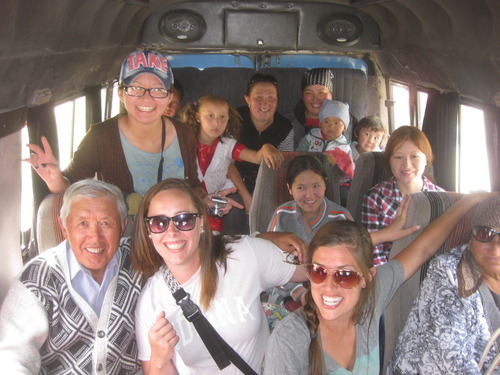
image On the upside, a mini-bus is a great place to make new friends

In America it’s the weather. We’re constantly making pointless observations to strangers about the activity in the sky—or not even the current activity but the potential of it to act a certain way at an unforeseen point in the future.


“Looks like rain.”

“Yep. Glad I have an umbrella.”

“Yep.”


My grandpa is one such exemplary American, always commenting on his thermometer in his mini-van if it gains or loses even a degree. I asked him why people talk about the weather so much. He said, “It’s the one thing we all have in common.”

America, it is said, is the great salad bowl and it can often be difficult to find commonalities between pepper flakes and a slice of tomato. But here in the Peace Corps in Kyrgyzstan, personal questions are the common ground.

Be affectionate

This spring marks 8 years since I’ve been in love. It was that kind of love that awakened the butterflies in my tummy and lifted my feet to the clouds. I was hers and she was mine and as long as we stayed off that ground called reality, we could dance on those clouds indefinitely.

Indefinitely turned out to be 5 months.

Neither of us made long term commitments or true gestures of service toward each other. Mostly we just enjoyed making out or holding hands in the car. Ok, so maybe it wasn’t love. But the affection sure was nice.

But affection is not just for those (in my case) rare and deep relationships. Affection is a life need as much as air or water and without it we wither, we wilt and we die.

I first felt this in my time in Japan, discovering stretches of months where I hadn’t hugged anyone or even shook a man’s hand. Now with five months behind me of living on my own in Kyrgyzstan I’m starting again to feel the ground about me become parched and cracked.

I’d be good to learn to be more affectionate and open to closeness like most Kyrgyz people show so well. I don’t know if it’s a deep-seated piece of Kyrgyz culture or if it simply stems from situations where 40 people are squeezed together in a van, but here people seem to wear their personal-space bubbles like body suits. Touching is ok.

People lean in when sharing pictures on a cell phone, brush your knee as you sit cross-legged around a meal of plov, and stroke your arm in condolence. You can see young female friends walking down the street hand-in-hand or guys in their 20s with an arm around each other’s shoulders as they walk. Handshakes sometimes last for an entire conversation and won’t end until one is pulling the other towards home for some tea. Neighbor kids playing in the street look out for each other too, and if one falls, an older kid will be quick with a kiss to make it all better. Even the more manly young men will at least head-butt upon meeting a friend.

And sometimes affection just falls in your lap
Butting heads is not quite the same sensation as holding hands with a cute little butterfly whisperer, but it definitely shows you you’re loved. And that’s the good and right meaning of affection—that others feel close to you and desire to be close enough even to touch. So as I learn how much it means to me, I’m working on being affectionate to others as well. That means showing up at the door and returning that tiny and grimy, snot-smeared hug when I’m back from a weekend away. It means leaning on arms at story time and true bear hugs of reckless abandon that say I’m all-in. By being affectionate, we give each other that wonderful opportunity to grow and blossom, surrounded by flowery friends, in a well-watered and beautiful garden of life.

The second cup of tea is the hottest

Kat!” He waved his arms and shouted. The horse feigned left then took off in a single-horse stampede to the edge of the river.

Bleen…!” rolled down from the chorus of men now hovering outside the yard.

This one was an ahzoh – a fighter – and I have never seen so much trouble and effort for a horse slaughter. Even after the blood stopped flowing and her head lay folded back against her neck, I could see her nostrils flair and her hooves push softly against the jumble of rope about her legs.

Before, we had been inside pushing cups of tea down the line of women to be refilled. I took a sip and almost yanked the cup back – I burned my lip on the second cup.

When we had first approached the house a group of young men stood huddled in the driveway. “Arty kairyluu bolsun,” I nodded to each man, the standard phrase of respect for funerals. “May this be behind you.” As we walked past the yurt a thin wail escaped the layers of wool draped across its roof. Ropes from the top of the tunduk hung, suspending rocks to keep the wind from blowing it away.

I had been standing, chatting with my landlord’s wife when she got the news. A student came up to her and said he died last night. She and my landlord were guests at his house yesterday.

The winter chills almost everything, inside and out. The small, bowl-like chynys used for serving tea lose their heat to the winter air and suck it back greedily as they’re filled for the first time.

Eng bir chyny ich,” she says, “Drink just one more.” I’m full but politely accept the offer. It passes the somber time spent supporting friends and neighbors who have lost a father. I pass my cup back down the line, the lip exchanging the brushes of fingers for others.

People are the same everywhere. They’re just different.

There was a knock at the door.

Bang bang bang

I decided to ignore it. I had come home from school not feeling very well and so had slipped into bed for a couple hours of afternoon rest. The door was locked to keep any neighbors or friends from just wandering in as they occasionally do so I could have a couple uninterrupted hours.

There was another knock at the door, this time combined with callings of my name.

Bang bang bang “Lu-ter!” Bang bang bang. “Luuu-ter!”

It was my landlord, who lives in the adjacent house on the property.

“Ignore him,” I thought naively, “That’s the best way to make him go away.” Unfortunately, it only served as a challenge.

There were several yanks on the door, the loose deadbolt rattling in its locked position. More knocking. Then the phone started to ring. I let it ring through. It rang again. I let it ring through again. It rang twice more before there was a reprieve in ringing and knocking.

“Thank God. He’s finally learned I don’t want to go to the door.” But it was just the eye of the storm. Moments later he returned with his son who, while my landlord began a barrage of knocks on the front door, walked around the side of my house and launched an attack on the window. It was too much. I waved my white flag.

“WHAT?!?” I screamed from my bed.

“Lu-ter,” my landlord said in a cheery voice, “Come drink tea!”

I was furious.

“Is my house on fire?” I yelled back.

“What?”

“Is. My. House. On. Fire?”

“…No…”

“Then leave me the hell alone and stop knocking!”

“Lu-ter – just come open the door.”

“No! I will not open the door!”

“Why?”

“I want to rest! Why is that so difficult to understand?”

“Ok, ok, just asking…” He walked away.

By this point I was so irritated I couldn’t get to sleep. Why didn’t he understand that when nobody answers the door, it means they don’t want to and aren’t going to? Doesn’t he know how rude it is to knock more than 2 or 3 times?

Doesn’t Luther know how rude it is not to answer the door when someone is knocking?

I didn’t get why my landlord wouldn’t stop knocking. My landlord didn’t get why I wouldn’t answer.

The difficulties in living and working cross-culturally are in our expectations. Growing up in one particular culture, we are conditioned to expect certain behaviors from people in specific situations. And when people don’t behave as we expect, we get frustrated, annoyed, confused or upset.

I came in knowing there would be cultural differences, but I didn’t think about how difficult it was going to be to draw the line between what makes us all the same as humans and what separates us by our cultural habits. It’s not so easy to know if your landlord is simply knocking because it’s the culturally friendly thing to do, or if he is inherently rude. Just what is it about human beings that makes us the same? What are the universal truths about our species? What are the behaviors we should expect out of any person, anywhere?”

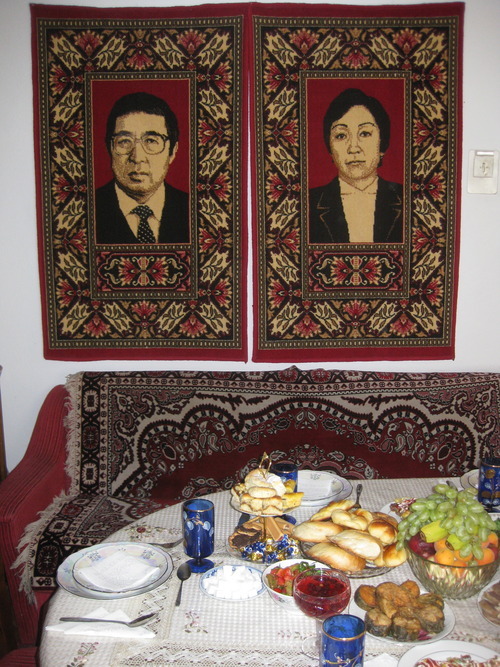
imageEveryone wants to be immortalized…in carpet.

I believe it comes down to God’s truths laid out in the Bible. God’s truths cross all cultures and all of history, laying out the expectation that we are to respond in service and honor and worship of Him by doing things like pursuing justice, taking care of widows and orphans, being honest and showing one another grace.

But just how this plays out in our behaviors isn’t always clear. Being raised in one environment makes it very difficult to separate out truth from behavior. Kyrgyz and Americans are both hospitable, but a Kyrgyz person will show this by force serving you multiple cups of tea beyond your bursting point while Americans will tell you to “help yourself.” Americans and Kyrgyz will want you to eat well so Americans will feed you a portion from each section of the food pyramid while a Kyrgyz person will watch in eager expectation as you try to swallow the lump of pure-fat-sheep-butt in a breadless sheep-liver sandwich. Americans and Kyrgyz respect the elder generation and so Americans will create opportunities for elders to continue to take control of their own lives while grown Kyrgyz children will make space in their already small homes to provide for all the needs of their elderly parents.

Our intentions are often exactly the same because as humans we’re following one, collective gut in how we should treat people. But, while what our gut tells us may be the same, what our gut tells us to do can be oh, so different.

How to count

Counting here starts with the most important word of all: Beer. If this wasn’t a sign Kyrgyz was going to be the most awesomest language ever, I’d never drink another Jiboe again.

Each day in PST language classes, we learned to count as we learned to take baby steps in the culture.

beer…

eki…

ooch…

One, two, three days in training…one, two, three trainees sleeping…one, two, three sessions on diarrhea…one, two, three months to go ‘til school starts…one, two months to our Close of Service conference…one, two, WHAT?!?

Somehow I skipped a few numbers in there. How did time go so fast? Life during training seems like a whole different lifetime. But that’s the funny thing with numbers and time. It seems so long ago, but feels like it went by so fast.

So as I begin to count down the days, how do I make the days count?

Math instruction for the village kid — falling asleep has never been so easy

I’m wanting to extend for a third year, but even if my request is approved, I’ll still be leaving this village. Forever. It’s a shot in the gut, realizing that. It gives me that scrambling sense, the one where I’m told I can keep as much as I can hold and so I’m grabbing at everything, stacking it up in my arms, stuffing things in my pockets and they’re tumbling down, hitting the floor, slipping through my fingers.

I think about each of the “lasts.” The last hike up the red hill in town. The last dinner at my friend Maksat’s. The last time I’ll see these familiar mountains as they slip away in the rear view mirror.

It can’t end. It won’t. I still know these people, this valley. I’ve sewn my life into these hills and it will stretch and maybe even tear a bit but I will always be part of this and it will always be part of me.

I told my family when I was leaving the states that it wasn’t a forever goodbye. “You guys make this seem like you’re mourning my funeral. I’m not dying you know. And it’s just Kyrgyzstan. I’m not climbing in a rocket for the moon.”

Maybe fifty years ago the Peace Corps was like that, where you might as well have been serving on the moon, helping the mooninites improve their cheese production or something. Where volunteers sort of just disappeared into the countryside for two years, a letter occasionally wriggling its way loose and inching towards America, reassuring its recipients that the volunteer was still alive two months before.

Now we have cell phones and skype and facebook and tumblr and a thousand other little gadgets and applications where we connect and stay in touch. We use those to connect back home in the states, but really they’re for connecting to wherever home is.

So in counting down, I never reach zero. Because I’m not in a rocket ship for the moon, I’m on the same planet, looking up at that same orb above our heads. And while our views may be from different angles, I’ll always know we’re just a phone number away.