Discussion

9 Myths and Misconceptions about the Peace Corps

The newsfeeds of today are proof enough that anyone with a MacBook, a latte and a half-baked opinion can be an expert on pretty much anything. Including, apparently, a government agency program which they have never researched, never applied for, nor ever served with.

Comments under online articles relating to the Peace Corps are awash with misinformed statements and stereotyped assertions that claim unassailable conclusions about everything from its effectiveness to its worth.

Yesterday Peace Corps rolled out their complete overhaul of the application process. And with that announcement comes once again the enlightened comments in the newsfeeds.

The following is a list of myths compiled and summarized from the comments under this recent Washington Post article about the new changes in how people apply for Peace Corps service.

Myth #1: Volunteers are over-privileged, upper-class white kids.

Fact: While only one-quarter of volunteers are minorities, the Peace Corps has begun an initiative to encourage more to apply including hiring 20 new staff for the Peace Corps’ diversity office to recruit more minorities.

The vast majority of volunteers work hard, humbly serving while growing their own skills in order to meet the needs of their local communities in challenging environments. Volunteers learn a new language, engage a new culture, and learn to thrive away from their old support systems.

Myth #2: Volunteers are just looking for a 2-year vacation.

Fact: How many people do you know who vacation in tiny villages in developing countries? Usually when one goes on vacation, they try to do less work in a more comfortable environment, not the opposite.

Volunteers also give up 2 years of salary potential—that’s 2 years of building up 401Ks, or saving for a house. It is true that volunteers receive $275 for each month served, though this “resettlement allowance” is often quickly used as volunteers search for paying jobs after finishing service.

Myth #3: Volunteers force their presence upon communities that don’t really want the volunteer around.

Fact: Peace Corps Volunteers are invited by the countries and communities in which they serve. Volunteers work directly with counterparts who had to apply and be accepted to host a volunteer in their organizations and communities.

Myth #4: The Peace Corps is a very expensive program and the benefits don’t match the costs.

Fact: The 2014 budget for the Peace Corps is only $379 million. That’s it. Guess what the Department of Defense’s budget is? $495 billion. That’s 1,300 times bigger. If the DoD had the budget of the Peace Corps, it would entirely deplete its annual funds before 7:00 am on January 1st.

At under $400 million per year, or around $50,000 per volunteer, the Peace Corps has huge ROI when it comes to grassroots diplomacy. Even if there were zero technical benefits for served local communities (which is not true), the relational and image benefits make it a no-brainer for the government.

Myth #5: Volunteers spend all their time on the internet and texting other volunteers.

Fact: Volunteers use technology for best practices. Fact: 2014 is not 1961. More students in my village have smart phones than running water in their homes. Technology changes and volunteers must keep up with the technology around them in order to implement best practices and reach as many people as possible.

One really cool Peace Corps Volunteer initiated project that came out of a Central American country was setting up a system where locals could text reproductive health questions to be answered discreetly by informed professionals. This effective model is now being implemented by other posts around the world.

Volunteers today should correspond with their organizations and local counterparts by e-mail, Facebook and text because the locals are using such technology and it allows volunteers to collaborate and be more effective in their work. 

Myth #6: The Peace Corps isn’t doing its job—just look at how effective they were in Ukraine.

Fact: The goals of the Peace Corps are “1) To help the people of interested countries in meeting their need for trained men and women 2) To help promote a better understanding of Americans on the part of the peoples served and 3) To help promote a better understanding of other peoples on the part of Americans.”

No where does it include the goal of host country government reform. Peace Corps Volunteers do not work for the Foreign Service. Peace Corps volunteers do not work for USAID. Volunteers work relationally to promote better understanding, while sharing their professional skills.

Myth #7: Applicants and Volunteers should be in command of administrative processes. After all, the volunteer exists to be served.

Fact: I’ll just include the whole comment here because it’s quite revealing. It’s posted by a “Chuckludlam” which appears to be the same volunteer who sued the Peace Corps.

“The Peace Corps changes to the application process are all about process. The problem at the Peace Corps is all about substance.

Now applicants can choose where they will serve. Fine. But the Peace Corps has fought to deprive the applicants of the information they need to make this choice. To secure documents crucial to applicants who are selecting which country they want to serve in, my wife and I had to sue the Peace Corps in Federal District court.The PC conducts annual surveys of the Volunteers and if you have the breakouts of the survey country-by-country you can rank the countries — best to worst managed. There is no more credible source than the Volunteers. Of course, the PC desperately wanted to deprive the applicants of this vital information. It fears what will happen if the applicants all want to go to a well managed country.

We won the lawsuit and will soon publish the country rankings on PeaceCorpsWiki. We also had to file an appeal with the PC to secure the country-by-country breakouts of the early quit rates — another crucial measure of the health of a specific country program — and we will be publishing these on PeaceCorpsWiki.

Applicants are consumers and if they go to a restaurant they get ratings. If they go to a college, they get ratings. They get ratings of professors. They get ratings of everything, but if they are asked to spend two years of their lives in the bush, the PC doesn’t give them rankings. If the PC refuses to post this information, every applicant should put their application on hold until they get the ratings they need to make an informed choice.

Going to a badly managed country with a high early quit rate — why would any applicant do that? Would they go to a restaurant rated for having bad food, bad service, and occasional food poisoning?”

The strangest thing about this comment is the part that says, “applicants are consumers” and the part where commenter Chuckludlam compares applying to the Peace Corps to choosing at which restaurant to dine. The last time I checked, going to a restaurant was about being served, not serving others. It would be pretty strange if a restaurant invited you in and you told the server to sit down and then you went back in the kitchen and cooked him a meal. But that is the type of service true Peace Corps Volunteers are doing every day.

Volunteers are not consumers. Volunteers are, well, volunteers. This doesn’t mean volunteers shouldn’t work under good management and that the Peace Corps doesn’t need reform. We’re not heading out in the “bush” in order to suffer.

Yes, the Peace Corps must become a better organization and a safer environment for Volunteers. Yes, staff must become more competent. Let’s keep in mind, however, the words of a certain someone close to the Peace Corps: “Ask not what your country can do for you; ask what you can do for your country.” We as volunteers and applicants should not adopt a view of entitlement.

Myth #8: Country rankings and early quit rates are the perfect litmus test for a Peace Corps country.

Fact: The rankings that you hear about are based on surveys submitted by current volunteers. These volunteers take a survey that asks questions like, “are you satisfied with your country director” and “how well-prepared were you after the training period.” Host country staff go through changes and bad management doesn’t always translate through organizational memory. Rankings change year to year even within the span of 2-year contracts.

Early quit rate means the percentage of volunteers who do not finish their 2-year contract in that country. The spectrum of reasons why volunteers leave early is wide. Some go for medical reasons, some don’t enjoy the work, some have family matters in the states to attend to.

Additionally, no one is saying that service in each country is equally as difficult. Everyone’s situation is different and each volunteer will encounter unique challenges.

One of the “Core Expectations of Volunteers” is that volunteers “serve under conditions of hardship, if necessary…” Many volunteers simply do not count the cost before signing up, or don’t realize going into it how difficult it can be. Putting applicants totally in control of how they serve and under what conditions would only fuel the attitude of entitlement.

But many leave for reasons outside of their control. Our post recently had an amazingly successful and wonderful volunteer leave his contract early to go home and care for his mother. In the rankings system, he would be counted in the so-called early quit rate. The numbers that “don’t lie,” also don’t tell the whole truth.

Myth #9: The Peace Corps is an out of touch bureaucracy more interested in perpetuating its existence than improving how it functions to serve volunteers.

Fact: The Peace Corps as an agency and Peace Corps Volunteers are not the same thing. Too often critics equate the failures of the “bureaucracy” with ineffectiveness of volunteers. The real work of the Peace Corps isn’t the bureaucracy but the feet on the ground.

Yes, there are problems with the Peace Corps as an Agency. Yes, it needs to change. But we must separate the operations of the organization from the work volunteers are doing when it comes to evaluation. Just because there are things that can improve within the organization doesn’t mean individual volunteers’ work is ineffective or not worthwhile.

The Peace Corps staff at my post repeatedly state that they exist for us as volunteers. That is their job. There are things that need to improve, and volunteers regularly voice their opinions and the Country Director and Director of Programming & Training are addressing those issues with sincerity and competence.

They know and have stated that the new application process gives volunteers more control over where they go, and therefore they as staff need to work better to make their post attractive and successful for future applicants.

Fact: Reform is coming

When it comes to large organizations, change doesn’t always come about as quickly as some would like. But reform is coming as evidenced by the sweeping changes made this week.

For those who comment and voice their uninformed or poorly concluded opinions the best advice is 1) be patient 2) come to this with the attitude that things aren’t always black and white, and 3) understand that volunteers are in this to serve and do their best to fulfill the mission of the Peace Corps to civilly, humbly and respectfully “promote world peace and friendship.”
Hate your neighbor

Peace and Friendship. Those are the goals of the Peace Corps. Wonderful goals.

And you know what else is wonderful? Rainbows and puppy dogs. They make a pretty scene, spread out before you as the sun dances upon little raindrops falling from clouds now parting.

It’s gonna be a bright, bright sunshiny day in the Peace Corps.

It’s easy to get lost in the ideals. It’s easy to say you’re not going to deal with all the hard stuff, all the stuff that’s real. It’s easier to just instagram the day brighter, untag the upshot, tweet about your puppy dog.

And oftentimes you need that—the world needs that—needs a break from the reality of itself.

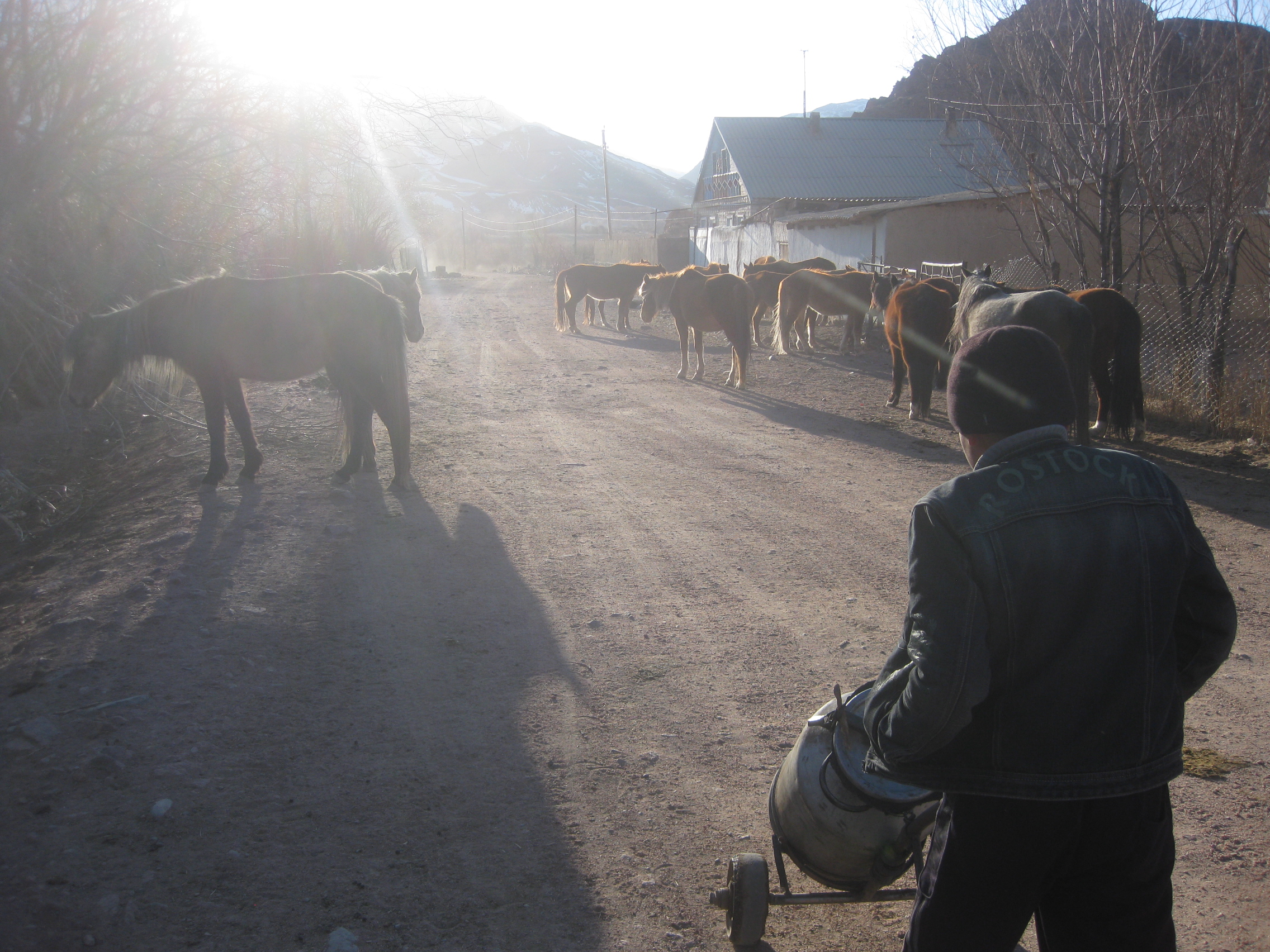
IMG_9073All the neighbors’ pretty horses

Ok, so the world has problems, but you’re going to fix them. Lead another training. Hold an intervention. Be the mediator. Paint a mural of the world and all the people, holding hands and singing sweet harmonies for all to dance upon in peace and friendship.

But reality is, you can’t always fix it. In fact, most of the time you won’t. People can’t always get along. People won’t always get along. You’d be crazy to expect otherwise. You have to accept that some individuals and some individual groups are not going to like each other and never will. Should we work for mediated peace or mutual understanding? Of course. But in all our efforts the success rate isn’t one-hundred percent. Talks break down. Negotiations fail. Wars break out.

There are only two prerequisites for groups to hate each other: they’re a) different, and b) right next to each other. That’s it. Those are the only two ingredients in the recipe for not getting along. It doesn’t take a history of violence, it doesn’t take premeditated offence; there’s usually no root of the problem to go back to. They simply will not agree to mutually exist in the same place together.

You see it on the news. You read about it in a magazine. One-million Syrian refugees have poured into Turkey. But until you’re staring across the table, sharing a Burger King meal at the airport in Istanbul with a young man from Syria, his house bombed, his father killed in the crossfire, his sister and mother surviving day to day in a tent camp in Jordan, he sleeping nights in internet cafes as he searches for work—until that moment it’s all statistics and talking heads playing he said she said. Until that moment you wonder why they can’t just get along.

That’s the moment you realize there is no longer the question “why?” That it doesn’t matter the reason. Hell, that the reason we’re all left reeling is because there is no reason. The only thing to do is buy him a burger, to lead another training, hold an intervention, be a mediator.

Or pack an emergency box or write an e-mail or host an exchange student and you realize, you only have you, only have your little sphere of influence, your little bubble where you’re going to decide to do more good than harm, to leave your world a little better than when you arrived.

You can argue the strategy. But don’t tell me the world needs less of that. Needs less of what the Peace Corps Volunteers are doing. Just get to work. Change—movement in a new direction—it’s the only thing that can chip at the walls of hate built so long and so high between neighbors.

—–

What things can you do to make your world a better place?

Love your neighbor

WWRD – What Would Randall Do? That’s the question I’ve been asking myself lately. Randall’s what Jesus would look like if Jesus had been a 6-foot-5 American training English teachers in Central Asia. I got to know him recently during a long conversation spanning working in Kyrgyzstan to Uzbek and Kyrgyz cultures to motivation of English teachers and the challenges of development work.

“Jesus didn’t command us to change the world,” says Randall, elbows and knees poking out beyond his desk. It’s covered with photos of family, local artwork and pithy motivational statements.

My mind dwells on just that: changing the world. It’s something I’ve been obsessing over lately, something I’ve been daunted by, wrapped up in, exhausted with. I wouldn’t necessarily have used the words “change the world” because when saying it out loud it sounds ridiculous. But practically, in my thoughts and my general attitude toward development work, that was what I was trying to do. I pictured myself as the agent for world peace. I was a grassroots diplomat. I didn’t have time or energy to waste pumping water for the widow who lives down the street.

“But what is Jesus’ command?” Randall continues, “To love God and love your neighbor.” That’s it. Randall nailed it. Or, Jesus rather, a few years earlier.

So what are we doing here on the other side of the world working in unfamiliar terrain among people we’d never met? Had we left our neighbors behind and abandoned that high calling? Maybe we need to return to the question that follows: “Who’s my neighbor?”

This was asked by a lawyer on the road to Jerusalem almost 2,000 years ago, and it elicited one of Jesus’ most memorable parables: The Good Samaritan. In this familiar illustration, a man is beaten, robbed and left for dead. Both a priest and a Levite see the man and pass him by before finally, a Samaritan stops, has compassion and cares for his needs. Jesus asserts that the Samaritan was a neighbor to this man and that each of us are to do likewise.

A good neighbor recognizes those who are in need and does something to help them. It seems simple, but here is where we get lost—we try to define need as the general condition of the world—broken and in pain—and we attempt to do work that we see as alleviating the world’s ills or fixing the world’s problems. But when we make our work so general, our declaration of love in service thins into a transparent sheet, like a single sheet of tissue, trying to catch all the world’s tears as they fall in one, torrential downpour. Our intensity drowns in this flood of need and our flame of passion once bright with fresh and youthful energy is doused beyond any chance of relighting.

So how is it done? How do you serve the world and survive?

Here’s the secret: The work must be done in specific with our love directed toward a person. The need must have a face, a name, a body and a soul. This doesn’t necessarily make the work itself easier. But it makes it possible.

“Who’s my neighbor?”—The one with the obvious need, lying in the path of your life, the one whom you must either stop to help or step over and pass by. What does it require?—A bent knee, an offering of help, a little money, the involvement of others, and continuing to check if they’re doing ok.

What does that look like in the Peace Corps?

It’s buying a few calves for a friend to raise and sell for income. It’s writing a project for a summer camp to give aspiring English majors a chance for practice and inspiration. It’s shaking a homeless man’s hand and walking together to a café for a bite to eat. It’s verbally standing up to a husband when he’s belittling his wife. It’s cooking dinner for some neighborhood kids when all they’ve had that day is bread and tea.

image A good neighbor shows up with gloves and a bottle of fermented horse milk
Back in my conversation with Randall, I’m stuck in the daunting and debilitating task of trying to fix the world’s problems. Here he lifts his hand as if to show the way out:

“It’s amazing really, [us trying to change the world.] We try to do what we’ve not been asked to do and that which we’re not capable of, yet we neglect to love our neighbor which is what we’ve been commanded to do and are actually capable of.”

It’s so much easier to say we’re working to change the world than it is to dirty our knees for a neighbor in need. But we’re not called to turn our eyes to the world. We’re called to love in simple, practical ways—and those are the ways that are truly, desperately needed—the people immediately in our lives.

And you know what’s so magical about this? When we love our neighbors—when we seek their good and show it by helping them when and where they need help, the world does begin to change, one neighbor at a time.

My neighbor sells drugs

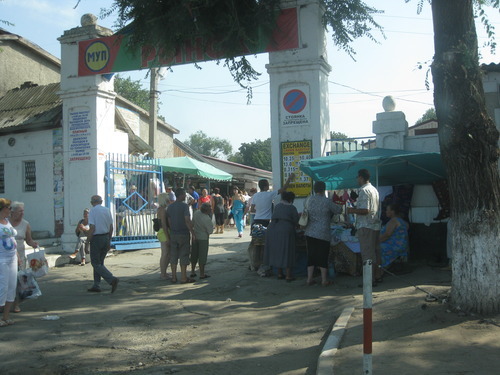
(This is probably going to blow their cover but) my neighbor sells drugs. They have a sign and everything; “Drugstore,” in Russian graces their front gate. Business must be good because they recently upgraded their sign from a pencil-on-cardboard to the standard placard-sized plastic model for higher visibility and prestige. As if anyone in town needed a sign to know where to find them. With fewer than 300 houses, not only does everyone have each house memorized, but will have looked through the windows of half of them in their morning jaunt down to the water pump and can tell you who had raspberry jam for breakfast and who had apricot.

Their house is not mainly a drugstore. It’s mainly a house. They sell pharmaceuticals for the extra needed inflow of cash. Almost everyone in town runs some kind of business it seems. With an official unemployment rate around 90%, people need to turn to entrepreneurial enterprise to make ends meet.

Not that 90% unemployment means everyone is doing poorly. Those figures only count those with government paid positions in the village—teachers, city hall workers, and a few people at the clinic. The owners of the largest store in town don’t count as being employed, even though they have a two story house and own multiple vehicles. Many of those with private businesses are actually doing much better. 

 Business is booming

“What do you think her monthly profits are, Nazgul?” My counterpart and I are leaving school and I stop by the little hut to buy a pack of cookies. There’s a lady who runs a tiny little shack outside the school, barely big enough for her and one customer. She sells piroshkis (fried bread with potatoes), snacks and a few school supplies. “I’m not sure but I know she makes more than me,” says Nazgul, biting into a Kontik Milk. “If all she sold was 150 piroshkis a day, she’d make more than me. And I have an education.”

I ask Nazgul about her AVON business. Once in awhile she gives me a small bottle of cream or cologne as a gift and I wonder if she’s making any money. “I mostly sell for the free gifts I get as a rep,” she tells me, “but I’m not losing money.”

But with a teacher’s salary of around $100 a month, selling AVON products isn’t just a hobby, it is a way of helping Nazgul and her family provide for daily necessities. Government salaries are only paid once a month and cash is needed throughout to buy foodstuffs and household goods. “If we didn’t have animals I suppose I’d be in the city,” says Nazgul, brushing her hands of chocolate crumbs.

Almost every household here raises farm animals and these are the true source of financial survival in the village. One of my business volunteer friends here calculated out profits for raising sheep and while he found it wasn’t a hugely profitable business it did provide two important things: food, and a buffer against inflation. A sheep can always be sold at market price.

The families with fewer farm animals are struggling. “When you have animals you have food and money,” my neighbor told me one day over the fence. He’s pitching hay. “No animals—no food and no money.” My good friend Maksat is one such family. His father passed away a couple years ago and through the various obligatory cultural ceremonies, hosting of guests and new financial burdens, he and his mother had to slaughter or sell off most of their animals. He has a job as a math teacher at the school, but the combination of his government salary plus his mother’s government pension is barely meeting the cost of living. He’s thinking about taking off for Turkey so he can find a job and send money home.

Since many Kyrgyz people who go abroad do so without visa’s or documentation, it is difficult to say exactly how many are abroad. Some conservative estimates put it at 20-25% of the population. This speaks volumes about the current economic situation here. When a quarter of the population has simply up and left, it sends the message that people are not able to live the kind of life they want here. Or at least they don’t believe they can.

Maksat is an incredibly intelligent and sharp man. His work ethic is inspiring and personally motivating. But Kyrgyzstan is about to lose him and his acumen to a foreign market. I often wonder about the kids and young people we train and teach as Peace Corps Volunteers here. How much are we contributing to the so called brain-drain in Kyrgyzstan? Are we simply providing them with the way to get out? While I would like for those with the knowledge and work ethic to make Kyrgyzstan a better nation to stay, I can’t blame them for doing what’s immediately best for their own families. Often that means taking their skills to further shores that will reward them for their work.

I drop my bag in the trunk of the taxi and head off to find a pit toilet while our driver is waiting for one more person to fill the cab. I pass by the group of men hawking DVDs on the side of the road. A sign displays a new price, 25 som, or about 50 cents for a burned disc of dubbed American and European films. It’s 5 som lower than last time I was here; it’s a competitive market. Those who don’t want to leave Kyrgyzstan, or those who aren’t able, still find ways to make a little cash. Here among the entrepreneurial stalls of a small village, hope floats above the dust of gypsy taxis and cows returning home. Somehow, people survive.

The map changes

I have a friend who is trying to visit 30 countries before she turns 30. Since I’ve already turned 29 for the second time and am only sitting at 9 countries, I’m fairly impressed. As we sat and talked about numbers and places, I wondered what people do when a country they’ve visited gets split or is absorbed into another. For example, if you had traveled through Sudan from north to south prior to 2011, could you now up your count by one?

And if you’re traveling with your Chinese friend from Beijing down to Taiwan, would you dare boast to him about hitting a “new country?”

And don’t forget the Central Asian conundrum. Having declared into being the new country, “Kyrzakhstan,” American Secretary of State John Kerry in a word docked the lists by one of any traveler to these two, unique countries. (If nobody’s heard of the countries you’ve been to, do they still count?)

My friend is counting Scotland even though it’s not technically a separate country, although it could become one after a referendum to be held this September. (By then my friend will be 30 anyway!)

It’s strange, this shifting and changing world. For all of human history we’ve physically only added and lost a few islands, but think of the millions of miles of arbitrary borders that have bobbed and weaved over mountains, along rivers and across valleys for millennia! It’s a strange concept, that borders change, because we’re used to living in the present and at any given moment (the miles of disputed borders aside) there is one lay of the nations.

I was one who used to think the world stayed the same. I had a printed map, after all, and Mr. P, my seventh grade teacher, expected me to memorize the names inside all those squiggly lines or else I’d fail the class. To me countries were green, yellow, purple and orange and smaller than my hand.

But rivers shift. New presidents are elected, or generals usurp control. And the ideas of these leaders shift more than rivers. Some start to think that maybe the grass really is greener on the other side.

image

 Hanging out in Transnistria. Wait – does that put me at 9 1/2?

The recent news about Crimea has most of the western world up in arms. (And let’s hope they don’t accidentally fire one of them.) But think about it—if you were learning geography in 1958, you’d say America has only 48 states and it wasn’t until various referendums, acts and contentious votes that the president finally signed the bills that joined two new states theoretically to America’s shores.

And if it’s Putin’s military presence we’re upset about, it was only a couple generations ago that Great Britain—still today America’s biggest ally—ruled an empire procured through decades of bloody campaigns across the world.

The world changes. That is a fact. Whether it should or not is another debate, but we can’t be surprised when it happens. Rulers of nations and peoples have been changing borders since the beginning of history and aren’t going to stop anytime soon, no matter how many Eurovision concerts are held or joint space flights are launched.

Sunday’s vote by the citizens of Crimea to join Russia plus Putin’s signing of the annexation today proves that. I’m not defending nor decrying the legitimacy of these actions. I’m just saying it happens all the time and we shouldn’t be so surprised.

So add another question to the list: should you have happened to visit Crimea in the past and counted it for Ukraine, do you change your mark for Russia? What’s the call now?