Discussion

Support the individual

Part 2 of ‘Change is complicated’

How many children would you bear for a gold medal?

I can bear being alone in a room with two or three for a couple hours. But that’s not the kind of “bearing” I mean. In the Kyrgyz Republic, a woman is presented with the medal “Hero Mother” for having and raising 10 or more children. That’s right. Ten. (I can’t even count that high before I lose my patience.) It’s a national practice dating back to 1944 when the Soviet Union began officially honoring and supporting women who made this incredible contribution to the state. Kyrgyzstan officially resumed the order in 1996.
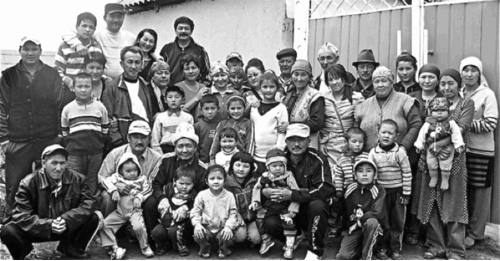
imageThis Kyrgyz family has gone platinum

For a mother this award isn’t a singular event; it’s the culmination of decades of daily effort in raising a child. What incredible responsibility to raise children to love their communities and work for the betterment of their nation! It is to each of our honor to support these families so each individual has the opportunity to learn how to pursue justice and effect changes to deeply broken systems.

We often complain about these systems—poor schools, corrupt courts, tampered elections—in a way that paints them as separate, detached forces floating above our heads for which we are not responsible and have no ability to change. But we cannot acquiesce the situation nor abandon our wills; for, these broken systems are the conglomerate result of individual decisions and actions.

What does this mean?

Steadily influence one person at a time. Verbally and publicly encourage and reward earnest effort and right behavior. Create laws and economic conditions which support entrepreneurs and small businesses. Award positions based on merit in an open and competitive process. Lead by example and with integrity.

Our influence as volunteers is truly very little when pushed up against systems, but to individuals our kind of work can have incredible impact. The work is not hopeless, though it might look that way. The problem is people—but because this is true—the solution is people as well.

We were sitting around our last cups of tea the other week when my friend’s mother started talking about her brother. He had been a top regional public lawyer in Kyrgyzstan, moving up through the ranks through his intelligence and hard work. Since he didn’t exact bribes, he lived a modest life within the means of his small government salary. But his integrity soon got him in trouble. At this level, when the next round of promotions came he found his position priced at $16,000. Without a savings account fed by accumulated bribe money, he was out of the running and out of a job.

I pray his honest labor was not in vain. These are the individuals we must support and uphold. This is the character we must develop in each child being raised. And God willing, when the future looks back and honors its heroes, it will honor this man and the people who sacrifice thusly as heroes of the highest order.

How to count

Counting here starts with the most important word of all: Beer. If this wasn’t a sign Kyrgyz was going to be the most awesomest language ever, I’d never drink another Jiboe again.

Each day in PST language classes, we learned to count as we learned to take baby steps in the culture.

beer…

eki…

ooch…

One, two, three days in training…one, two, three trainees sleeping…one, two, three sessions on diarrhea…one, two, three months to go ‘til school starts…one, two months to our Close of Service conference…one, two, WHAT?!?

Somehow I skipped a few numbers in there. How did time go so fast? Life during training seems like a whole different lifetime. But that’s the funny thing with numbers and time. It seems so long ago, but feels like it went by so fast.

So as I begin to count down the days, how do I make the days count?

Math instruction for the village kid — falling asleep has never been so easy
I’m wanting to extend for a third year, but even if my request is approved, I’ll still be leaving this village. Forever. It’s a shot in the gut, realizing that. It gives me that scrambling sense, the one where I’m told I can keep as much as I can hold and so I’m grabbing at everything, stacking it up in my arms, stuffing things in my pockets and they’re tumbling down, hitting the floor, slipping through my fingers.

I think about each of the “lasts.” The last hike up the red hill in town. The last dinner at my friend Maksat’s. The last time I’ll see these familiar mountains as they slip away in the rear view mirror.

It can’t end. It won’t. I still know these people, this valley. I’ve sewn my life into these hills and it will stretch and maybe even tear a bit but I will always be part of this and it will always be part of me.

I told my family when I was leaving the states that it wasn’t a forever goodbye. “You guys make this seem like you’re mourning my funeral. I’m not dying you know. And it’s just Kyrgyzstan. I’m not climbing in a rocket for the moon.”

Maybe fifty years ago the Peace Corps was like that, where you might as well have been serving on the moon, helping the mooninites improve their cheese production or something. Where volunteers sort of just disappeared into the countryside for two years, a letter occasionally wriggling its way loose and inching towards America, reassuring its recipients that the volunteer was still alive two months before.

Now we have cell phones and skype and facebook and tumblr and a thousand other little gadgets and applications where we connect and stay in touch. We use those to connect back home in the states, but really they’re for connecting to wherever home is.

So in counting down, I never reach zero. Because I’m not in a rocket ship for the moon, I’m on the same planet, looking up at that same orb above our heads. And while our views may be from different angles, I’ll always know we’re just a phone number away.

They already know how to fish

Part 2 of ‘Delegate’

There’s an oft-quoted proverb that goes, “Give a man a fish and feed him for a day. Teach a man to fish and feed him for a lifetime.” The meaning here is it’s better to teach than to give. For example, if you teach a student how to open an e-mail account rather than sending an e-mail for him, he can use this skill when you’re not around.

But the proverb goes deeper than that. The mentality behind it is so veiled that it has slipped undetected into the subconscious parts of our American brains. What this really means is that we, the fishing instructors of America, think we have all the answers and that we are saving the world, one new fisherman at a time.

And just look at the numbers—we’re more efficient, get better results, are backed by the latest research. You can’t argue with science—our life expectancy, GDP per capita, university rankings, GIQ—we’re winning at everything so everyone should follow our lead.

But maybe we’re winning because we made the scales. Rather, we should be asking ourselves, is the value of life found within these numbers? Does a higher GDP mean more joy? Does a diploma from an ivy league school create self-worth? Does living a longer life really mean living a better life?

Even if these are true indicators of peace, love and happiness, those goals are going to have to be arrived at using different methods because countries that are developing have vastly different variables to work with than the U.S. has had over the past three-hundred years.

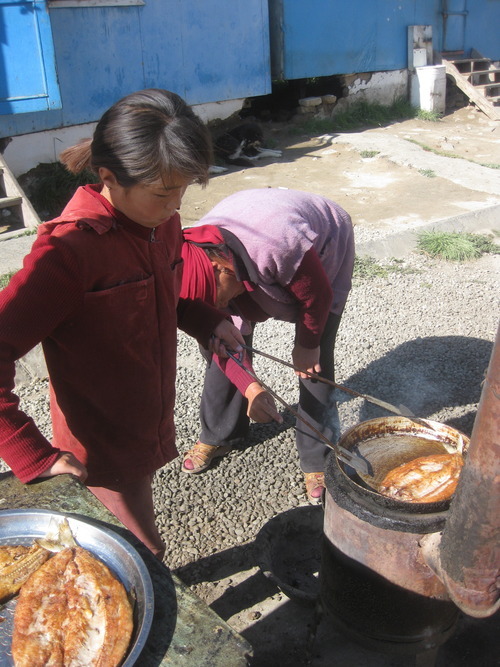
imageNot only can they catch fish, they can cook ‘em too

The U.S. is here doing development work because we can afford to be. We have the capital. But that doesn’t mean we have all the answers.

We spend billions of dollars trying to implement policies created in a different culture and different context, and the world is littered with the skeletons of failed projects ranging from the benignly obscure to the disastrously infamous. I won’t deny some of the incredible advances in quality of care for people living with HIV or inroads into better crop irrigation, as examples. But we need to be spending a lot more time and money supporting the solutions that are being created “by the people for the people” within the cultures and nations we try to serve.

We say, “Let me teach you how to fish,” but really we’re saying, “Let me teach you how I would fish.” We still miss the mark in this well-intentioned proverb.

So what are we doing here? If people are meant to simply use their own methods and do their own work, can’t they do that without us?

In a large part, yes. Peoples around the world should be free to choose how they live, work, and solve their own problems. Therefore we should go abroad not to implement our methods but to make human connections and come along side people to support and encourage—more like a fishing buddy than a fishing instructor. Yet this is not well received by the people who control the dollars because it cannot be tallied or counted like the number of fish distributed or fishing lessons taught. “Sure the stories are great,” they say, “but show us the results.” But how do you clearly measure the effect of believing in someone? What’s the quotient for consistently showing up in a child’s life? How do you put numbers on relationships? These are the things that won’t make it to a spreadsheet or statistical report, yet they are the things that are making a difference.

So don’t give a man a fish. Don’t even teach him how because he probably already knows. Instead, strive to make a lot of fishing buddies and see if that doesn’t just change the world.

Delegate

Bread

  • ½ kilo of flour
  • 150 mL of water
  • 1 Tbs sugar
  • ½ Tbs salt
  • 1 Tbs oil
  • 2 Tbs yeast

Put flour in large bowl. Make a well. Stir in all ingredients with water. Work in flour. Add additional 150 mL water, work in. Flour bowl. Cover by heat 30-60 min. Punch down, flour again. Bake in oven. You didn’t forget the yeast again, right?

My baking has improved. It’s incredible what a little help from Jamie Oliver can do. (Don’t tell Peace Corps I’m using a Brit’s recipe.) I’m learning to put all the ingredients together in just the right ways and let them work their own magic.

I was talking with my Grandparents on the phone this past weekend, telling them about the different projects I have going this semester and how classes have started. I’ve started to get a handle on how to delegate, which is amazing since it’s something I should have come in being able to do. We’re inundated from Day 1 with words like “sustainability,” “skill transfer,” and “capacity building.” Every era has its code phrases—you know, the ones you want to list on your grant applications for high visibility—and these are the ones that we’re immersed in even before we meet the culture. Delegation would seem to be step one in these code-word endeavors, yet there are several things that make delegating difficult.

It is really tempting to want to do everything yourself. When you do something on your own, you don’t have to try and explain it to anyone—in English that is, much less another language—nor do you need to depend on someone who might not come through with their end of the job. When you work by yourself, you’re the boss, middle management and common laborer and no part of the vision gets lost in translation. (Figuratively and literally.) Delegation can also be difficult because sometimes you assign tasks to people who don’t care about the project at all. And then there’s the amount of time to consider. If you delegate work out to someone, it might take a week for the task to get done when you could have done it in an afternoon.

This all might seem like a waste of time at first, but in the long run you are going to be able to accomplish not only a lot more in terms of volume but in efficacy of your projects as well. There are two things at work here: felt need and ownership. On some level delegating can seem like “kindly forcing” but when done correctly the delegator should be a catalyst for already existing potential energy.

First do your homework. The Peace Corps calls this “Participatory Analysis for Community Action” which is a complicated way of saying, “Ask a lot of questions.” Who are the movers and shakers in the community? If you’re doing a project at the school, what’s their calendar like for the year? Are there times where people will be on vacation? Harvesting potatoes? How is the community physically laid out? Can mothers get their children to the proposed kindergarten and pick them up again? What are the priorities? Does anyone even care if the volleyball court falls apart? This is how you discover what the members of the community want to do, not what you think it needs after your initial bleeding-heart dash through the neighborhood.

If you set this up correctly it will be much easier for the community to take ownership over the project. I used to say, “Oh, I’ll do that, don’t worry about it.” But then I would end up with a business plan in English and an owner who couldn’t read it, or a teacher who couldn’t check her e-mail account because I was gone on vacation. Spend the extra agonizing hours helping your counterpart double click icons and type in her password and I’m telling you, it’s going to pay off. Not only will you be able to say, “Hey, can you check on that e-mail?” and it will be taken care of, but after you leave she’s going to keep doing it on her own for her own purposes.

Which is the entire purpose and point of our existence as Peace Corps Volunteers. We fall out of a plane, wander around in the woods for awhile, then barely after finding our bearings are spotted and pulled back home. Two years can seem like a lifetime, but when compared to the actual lifetime of the people we serve, it becomes a brief window in which to get anything done.

That “anything” turns out to be not what projects you can lay claim to after you’re gone, but the skills your counterparts gained, the knowledge your students gleaned, the confidence of leaders, and all their own personal successes that will give them a better chance at actualizing their own dreams.

“It’s like leavening bread,” my grandpa said over the phone, “All the ingredients are there. You just have to make it rise.”

See people as people

If you haven’t yet read the book, Kabul Beauty School, pick up a copy this week. It should be required reading for any Peace Corps Volunteer or development worker living abroad.

In this true narrative, Deborah Rodriguez, known in her beauty salon as Crazy Deb, volunteers for temporary disaster relief in Afghanistan. After arriving with a group of health professionals, Deb starts to question why she, a hair stylist, was put with this group. Not feeling capable of contributing to the plans for clinics and medical care, she ventures out of the compound to make friends with local people. Her honest and sometimes brash interactions with Afghans gets her in trouble initially with her organization but allows her to form deep, lasting friendships with people. This ultimately leads to her launching and managing a beauty school in Kabul, the first since the topple of the Taliban, giving graduating students income for their families and hope for the future.

In a revealing episode early on, Deb is walking with her friend Roshanna looking at all the different people in the streets of Kabul. She starts to ask who these different people are and Roshanna tells her some are Uzbek, Tajik or Nuristani and some are Pashtun like herself. Deb thinks this is odd because she had always thought of Roshanna and everyone else as simply Afghan.

In the book Deb’s heart for all people in Afghanistan burns brightly through the audacious and bold ways she loves people practically, both in her friendships and in her work. Crazy Deb sees people as people.

I grew up in St. Paul, MN going to an elementary school with a large African-American and Hmong population of students. Now, I am a white, blonde-haired, blue-eyed, boy of Norwegian decent who grew up eating lefse and hot dish. Our family was not exactly a veritable United Nations; however, my school was quite a bit more diverse. I remember as a kindergartener walking to school in the morning holding hands with whomever and never thinking once about the color of his or her hand. Then one day all of that changed.

We were sitting in the corner of our kindergarten room on the carpet having a little discussion with our teacher on being clean; washing our hands, brushing our teeth, those kinds of things. The teacher asked, “What would happen if you never took a bath?” I thought about this—how if you didn’t bathe after playing outside, you would have dirt on you and eventually you would get blacker and blacker with dirt, and so I raised my hand and said innocently, “You would be a black person.”

The teacher snapped.

“Black people have pigment in their skin!” She shouted, “You would not be like a black person. That is a horrible thing to say.”

That day I learned to fear the topic of race, my ears burning with shame as I wondered why different colors made my teacher so angry.

Our education continued throughout those elementary years with more conversations about different people and different cultures. As a white, middle-America boy, those conversations always came with the caveat that I “need to be careful to treat minorities as equal.”

“Treat everyone equal now, especially people who are different than you.” Even at that young age I can remember thinking, “Since we are already equal, why do I have to be so careful to treat them equally?” I learned to see people who looked different than me as different, and though I couldn’t put it into words at the time, it always bothered me.

There is a problem when our cultural education goes so far that we end up focusing on our differences instead of what binds us together as humans.

This can happen with development workers too, who, for very practical reasons receive cultural training in order to be effective within a culture. But sometimes the well-intentioned efforts to be sensitive keep us from focusing on the human level which is the only place where one can truly reach another human being.

I’m not saying unique cultural differences should be forgotten; we should celebrate who we are and who our forefathers were because this can bring us great joy and identity. What I am saying is that we’ve become much too sensitive which has resulted in an emphasis on the differences. This ultimately creates more division as we define people by their culture rather than their humanity.

Today, in the United States, is Martin Luther King, Jr. Day. We share a name, Luther, given to each of us in honor of Martin Luther, the great reformer of five centuries past. Martin Luther fought for the truth that we are all loved by our creator, and from this truth Martin Luther King, Jr. fought for justice amidst the horrendous segregation and discrimination pervasive in his day.

In our day, we still haven’t yet realized a world where freedom rings from every mountaintop. It is my hope and prayer that each day we would proclaim this by the way we treat people—as people. Then maybe some day the dream will come true, where we can walk hand in hand, not because we’ve forgotten what color we are, but because we are defined by our common brotherhood.

imageHow will you help realize the dream?