Kyrgyzstan

‘Foreign’ is a word we use for things we don’t understand

Almost everything I’ve ever read about Kyrgyzstan has made it seem so foreign. And why not, I suppose; it fits the definition fairly well of being something other than one’s own, and from a general western perspective it is strange and unfamiliar. However, I think this label gets applied more often because so few know even the first thing about this place. How often do we call Australia a foreign country? When an undergrad goes “Down Under” does she proclaim to Facebook she is “off to a foreign land”? No. She just says she’s going to Australia.

Kyrgyzstan’s really not that strange, once you get to know it. That’s the whole point of travel, or it should be anyway—that we go places for understanding and not to draw lines in the sand between what’s “us” and what’s “them.”

This week I’ve been going through the book Shadow of the Silk Road by Colin Thubron. In his book he states he is traveling again through Central Asia for understanding, yet I can’t keep from being shocked by how foreign he makes everything sound through his verbose description. I would assume it’s my problem as the reader since he certainly is introducing a lot of new things. Except…I live here. Take a look at Thubron’s rendering of a meal in Kochkor, Kyrgyzstan, my backyard:

“An hour later I descended the hill to the tent. The lamb’s intestines were swimming in a bowl, and its bloodstained pelt curled on the floor. Twenty men had assembled to feast. They settled in a famished circle, squatting or cross-legged in their hefty boots, I in the place of honour. Their mouths gaped black or flashed gold in hard, burnished faces. Soon they were engorging minced lamb in pudding-like fistfuls, scouring their plates with work-blunted hands, while noodles dribbled from their lips like the whiskers of so many cuttlefish. Their cups filled up with tea, then vodka. They wrenched and gnawed on the bones, picked them white, discarded them, and sucked in the last gravy with a  noise like emptying bathwater. Then they dispersed without a word, or slept.”

If I were writing this part of the journey I would say, “And then we had dinner.” Because that’s what we eat: sheep and noodles. That’s what’s available here and people sit on the floor because no one wants to drag a wooden table and 20 chairs up to a yurt in the mountain. The name of this meal was left out as well: besh barmak which means “five fingers” and gives a pretty good indication that it is to be eaten with the hand and not a fork and knife.

But it’s not as sexy or fun to say, “And then we ate.” No one’s going to pay you to write a travel book that sounds just like life at home.

 Emerging from hibernation, the Minnesotans squint into the sunlight 

So, to show just how funny and ridiculous it can be, let’s take a look at how a Kyrgyz travel writer might describe a typical meal in say, suburban Minnesota, a la Colin Thubron:

An hour later I mounted the steps to the dining hall. The pig’s rump was screeching in a pan, it’s dried out skin flaked in a bag upon the elevated counter. A man with a woman and several offspring were gathered to feast. They stormed the table, some sitting in plastic butt-shaped booths to extend their reach. I was forced to sit at the end of the table, closest to the door, in shame. Their mouths shone ungodly white with teeth bleached by chemicals, their faces occasionally rubbed by the roughage of a felled tree. Soon they were slamming back gallons of milk and stabbing pig stomach in fits of fury, drowning the torn flesh with an acrid, vinegary brown sludge, while milk dripped from the children’s mustachioed faces. Their cups filled with a bubbling and frothing sickly sweet liquid, and food was soon replaced with an even sweeter dense cocoa based goo procured from a searing hot oven not two meters from where they lapped at their utensils like flint on steel. Then they dispersed with cries of sorrow as the opening scenes of prime time television had inadvertently passed away.

When first making contact, it’s ok to revel in the peculiarities and laugh at what’s so strikingly different than what you have known. It’s fun to read someone who says, “I went somewhere no one’s heard of. It was crazy!” These experiences are unique and different. But don’t leave it at that. Find in your travels people who are like you—people trying to not be bested by life’s challenges, trying to find a bit of rest from a day’s toil, trying to turn a dollar to support a family. Find in your travels the things that make us all the same—shared meals, the enjoyment of a good story, and the desire for justice and hope and a shot at making a life for ourselves in this crazy world.

Life is raspberry flavored

What’s the flavor of your life? Is it sour like a sugarless glass of lemonade? Or maybe bitter like a dark roast of coffee? Or sweet in the way of a jolly-rancher, sickly grape and then razor sharp as it melts on your tongue?

At some point in Kyrgyzstan’s soviet past, someone proposed that the perfect life is like a raspberry, round and plump, juicy and sweet. Life of a kind that’s plucked from the thorn bush, staining your fingers red and finishing with a perfect balance of flavor as it moves across your tongue. This phrase, “Life is a raspberry” means life is awesome, life is grand, life is wonderful.

But it’s rarely heard these days. Maybe people aren’t finding enough to warm their hearts over. Or maybe they’re not seeking the secret joy that can be found in any circumstance.  Lenin, still holding a tight grip on secret joy

“Yellow! Hey, yellow! Oh, the yellowest of boys—woo! Over here!” I spun around. He was standing next to his taxi, another voice yelling at me, the quintessential looking tourist, as I walked through our region’s city center.

“I’m not yellow,” I thought, “I’m…peach…or…translucent…or heck, I don’t know, but I don’t like being the brunt of jokes when people think I can’t understand.” Tourist season has arrived and soon I’ll be enjoying more stereotypes, and attempts at higher taxi fares and prices at the market. I can choose to react in anger, letting my passion escape in short staccato bursts. Or I could choose to bottle it up and slink away, licking my wounds of resentment.

Life can be faced like this, back stooped and shoulders curled, wrapped around each burden of stress and anxiety as if harboring them in deep waters under your chest. Worry will always be looking for a place to anchor and only needs a hollow cove to come and hide. The secret is to stand tall, shoulders back and chest out as if to dash to pieces any hope worry might have of settling in your soul.

My friend Akmoor and I were on our way to the bazaar to do some shopping.

“Osh City, Osh City, leaving for Osh!” cried one man, leaning over a Honda.

It was always the taxi guys, and for some reason I was feeling a bit devilish.

“Ok, 100 som!” I said cheerfully, offering 10 times less than the going price.

“100 som!? 100 som! How ‘bout I just take you for free? C’mon, I’ll take you all the way to Osh for free!”

“Ok, let’s go Akmoor!” Giggling we started to walk over to the taxi. Now I don’t understand Russian, but the tone bursting from this man spoke volumes.

“У@*#!…Я$!#…Д$!€&….”

We quickly turned and scooted ourselves away from the spittle forming at the corners of his mouth. “Wow, he’s sure got a stick up his butt,” I said in English.

“Stick…huh?” said Akmoor with a quizzical look.

I translated into Kyrgyz and she lost it, doubling over in laughter. We had to keep practicing this new phrase the rest of the way to the bazaar and I kept fielding questions like, “Stick up his butt…can I say stick up her butt?”

“Yes, Akmoor…”

Our taxi driver hadn’t taken it with his shoulders back or chest out. And it could have turned my mood sour like his as well, taken me down a notch, leveled me to the lowest common denominator. But Akmoor’s boisterous merriment simply washed over all that was wrong and lifted me on the giggles of her bubbling joy.

Life is always as good as your reactions. It’s been said 100 ways, but it’s true. There will always be tragedy, frustrations and setbacks but how you respond makes our earthly walk a trek in darkness or a journey to be enjoyed.

Life can be wonderful or life can be dark and I’m not saying everyone has a level playing field. Some suffer tragedy while some seem to sail through life with ease.

But life circumstances have never been a good indicator of happiness or satisfaction. I’ve seen those with high privilege bicker and argue with family members and create bitter enemies, and I know others who have lost a spouse and raised children without so much as a sheep in the yard thrive and grow and bring joy to those around them. Life can be like a raspberry if only one knows how to traverse the thorns.

Unfortunately, there are those who see the thorns as a barbed wall of fate and surrender the fight to the ironic idiosyncrasies of life. There’s an idea in Kyrgyzstan that all of life is fated and if anything good happens at all, it’s the blessing of God.

The puritans and fundamentalists of the first two centuries of America also held these beliefs, that God’s will was supreme and lives were predestined since before the foundations of the earth. But instead of acquiescing to a life outside of their control, they sought to actualize God’s providence by being some of the best workers, entrepreneurs and producers the world has ever seen.

Why? I’m not sure. I find it fascinating that two can respond to the same set of circumstances and belief in fate with diametrically opposite behavior. It seems to be the difference between, “If God wills, it will come to me,” and “If God wills, he won’t stop me.”

I settle up to the table for another meal of bread and vareniye, the jam that graces a Kyrgyzstani’s table at each meal, and ah! there it is: a dish of raspberries, preserved during summer months of plenty for the harsh of winter when no fresh produce can be found. It’s the perfect daily reminder to choose joy in those winter seasons of life and to remember that truly, “Life is a raspberry.”

In celebration of the blooming of spring, I’m posting this cheery photo for all of you of my dad and his friends sporting Kyrgyzstan’s national hat, the kalpak, while out golfing in Arizona.

These hats, as my volunteer friend Dan puts it, “Hold a special place in Kyrgyzstan’s heart and a special place on a Kyrgyz man’s head.” They are the traditional headwear for Kyrgyz men and are still worn by people in the villages and capital alike today. Made from natural sheep felt, kalpaks keep your head warm in winter, cool in summer and looking awesome all year round.

That’s, I guess, some of your beeswax

“How much money do you make?”

“What’s your religion?”

“What are you?”

Are these questions between intimate lovers, or between you and the man who just sat down next to you on the bus? The answer: Well, it depends where you are.

I get into these kinds of conversations all the time. People always seem to ask the exact same questions in the exact same order. It’s not that my Kyrgyz is great but that I’m fantastic at repeating a set of syllabic mumblings over and over again. I can even feel some of these conversations coming on and just hit the auto-pilot on my tongue and let it do the work. It usually begins when I’m standing outside with a man I’ve just met waiting for something. His face gets this look, he turns and spits, and then opens his mouth…

Here it comes.

Local: Are you married?

I friggin’ knew it.

Me: No.

Local: When are you getting married?

Me: I don’t have a girlfriend.

And now for a blank stare and repeating of the question.

Local: … no, I mean, when are you getting married?

(In Kyrgyzstan, men often pick a wedding day first and a bride second.)

Me: Only God knows. Cue the laughter.

Local: (Laughs) Maybe you will take one of our girls back to America? (More smiles)

Me: (Mouths Maybe you will take one of our girls back to America at the exact same time as Local is speaking) We’ll see.


Sometimes I mess with the answers, just to shake the question fatigue.


Local: America is wonderful, yes? Much better than Kyrgyzstan…

Me: No, they’re just different. I like Kyrgyzstan.

Local: But, America, life is so much better there, right?

Me: It depends. Life in Kyrgyzstan can be great.

Local: Ah, but American life must be wonderful.

Me: … Actually, all the streets in America are made of gold. If you get hungry, you can take a shovel and dig up a little bit of the road and go buy yourself a hamburger.

Local: …

Me: …

Local: … (lights cigarette)

I feel like I’m reliving the movie Groundhog Day whenever I have these conversations. They go exactly the same every time, down to the punctuation, and I’m now rolling somewhere in the 300’s of times I’ve been through these.

And it’s not just because I’m a foreigner that I get asked personal questions. My Kyrgyz friends say they too are often asked some of these, and I’ve been on many a mini-bus ride where the young men are asked by the older women if they are married, if yes, how many children they have, etc. It’s just kind of a Kyrgyz thing. Since there are few Kyrgyz people in a small country I suppose it’s a way of figuring out how you know each other, since fun connections do pop up in these conversations almost as a rule. Family relationships and belonging are important here.

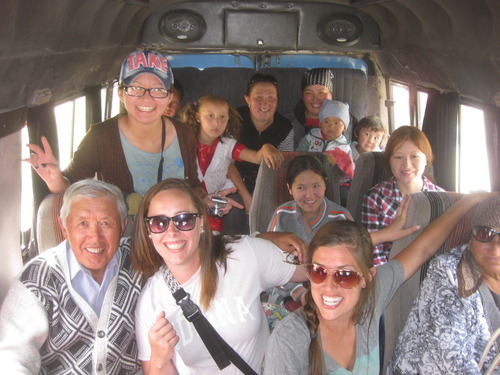
image On the upside, a mini-bus is a great place to make new friends

In America it’s the weather. We’re constantly making pointless observations to strangers about the activity in the sky—or not even the current activity but the potential of it to act a certain way at an unforeseen point in the future.


“Looks like rain.”

“Yep. Glad I have an umbrella.”

“Yep.”


My grandpa is one such exemplary American, always commenting on his thermometer in his mini-van if it gains or loses even a degree. I asked him why people talk about the weather so much. He said, “It’s the one thing we all have in common.”

America, it is said, is the great salad bowl and it can often be difficult to find commonalities between pepper flakes and a slice of tomato. But here in the Peace Corps in Kyrgyzstan, personal questions are the common ground.

My neighbor sells drugs

(This is probably going to blow their cover but) my neighbor sells drugs. They have a sign and everything; “Drugstore,” in Russian graces their front gate. Business must be good because they recently upgraded their sign from a pencil-on-cardboard to the standard placard-sized plastic model for higher visibility and prestige. As if anyone in town needed a sign to know where to find them. With fewer than 300 houses, not only does everyone have each house memorized, but will have looked through the windows of half of them in their morning jaunt down to the water pump and can tell you who had raspberry jam for breakfast and who had apricot.

Their house is not mainly a drugstore. It’s mainly a house. They sell pharmaceuticals for the extra needed inflow of cash. Almost everyone in town runs some kind of business it seems. With an official unemployment rate around 90%, people need to turn to entrepreneurial enterprise to make ends meet.

Not that 90% unemployment means everyone is doing poorly. Those figures only count those with government paid positions in the village—teachers, city hall workers, and a few people at the clinic. The owners of the largest store in town don’t count as being employed, even though they have a two story house and own multiple vehicles. Many of those with private businesses are actually doing much better. 

 Business is booming

“What do you think her monthly profits are, Nazgul?” My counterpart and I are leaving school and I stop by the little hut to buy a pack of cookies. There’s a lady who runs a tiny little shack outside the school, barely big enough for her and one customer. She sells piroshkis (fried bread with potatoes), snacks and a few school supplies. “I’m not sure but I know she makes more than me,” says Nazgul, biting into a Kontik Milk. “If all she sold was 150 piroshkis a day, she’d make more than me. And I have an education.”

I ask Nazgul about her AVON business. Once in awhile she gives me a small bottle of cream or cologne as a gift and I wonder if she’s making any money. “I mostly sell for the free gifts I get as a rep,” she tells me, “but I’m not losing money.”

But with a teacher’s salary of around $100 a month, selling AVON products isn’t just a hobby, it is a way of helping Nazgul and her family provide for daily necessities. Government salaries are only paid once a month and cash is needed throughout to buy foodstuffs and household goods. “If we didn’t have animals I suppose I’d be in the city,” says Nazgul, brushing her hands of chocolate crumbs.

Almost every household here raises farm animals and these are the true source of financial survival in the village. One of my business volunteer friends here calculated out profits for raising sheep and while he found it wasn’t a hugely profitable business it did provide two important things: food, and a buffer against inflation. A sheep can always be sold at market price.

The families with fewer farm animals are struggling. “When you have animals you have food and money,” my neighbor told me one day over the fence. He’s pitching hay. “No animals—no food and no money.” My good friend Maksat is one such family. His father passed away a couple years ago and through the various obligatory cultural ceremonies, hosting of guests and new financial burdens, he and his mother had to slaughter or sell off most of their animals. He has a job as a math teacher at the school, but the combination of his government salary plus his mother’s government pension is barely meeting the cost of living. He’s thinking about taking off for Turkey so he can find a job and send money home.

Since many Kyrgyz people who go abroad do so without visa’s or documentation, it is difficult to say exactly how many are abroad. Some conservative estimates put it at 20-25% of the population. This speaks volumes about the current economic situation here. When a quarter of the population has simply up and left, it sends the message that people are not able to live the kind of life they want here. Or at least they don’t believe they can.

Maksat is an incredibly intelligent and sharp man. His work ethic is inspiring and personally motivating. But Kyrgyzstan is about to lose him and his acumen to a foreign market. I often wonder about the kids and young people we train and teach as Peace Corps Volunteers here. How much are we contributing to the so called brain-drain in Kyrgyzstan? Are we simply providing them with the way to get out? While I would like for those with the knowledge and work ethic to make Kyrgyzstan a better nation to stay, I can’t blame them for doing what’s immediately best for their own families. Often that means taking their skills to further shores that will reward them for their work.

I drop my bag in the trunk of the taxi and head off to find a pit toilet while our driver is waiting for one more person to fill the cab. I pass by the group of men hawking DVDs on the side of the road. A sign displays a new price, 25 som, or about 50 cents for a burned disc of dubbed American and European films. It’s 5 som lower than last time I was here; it’s a competitive market. Those who don’t want to leave Kyrgyzstan, or those who aren’t able, still find ways to make a little cash. Here among the entrepreneurial stalls of a small village, hope floats above the dust of gypsy taxis and cows returning home. Somehow, people survive.