Kyrgyzstan

Support the individual

Part 2 of ‘Change is complicated’

How many children would you bear for a gold medal?

I can bear being alone in a room with two or three for a couple hours. But that’s not the kind of “bearing” I mean. In the Kyrgyz Republic, a woman is presented with the medal “Hero Mother” for having and raising 10 or more children. That’s right. Ten. (I can’t even count that high before I lose my patience.) It’s a national practice dating back to 1944 when the Soviet Union began officially honoring and supporting women who made this incredible contribution to the state. Kyrgyzstan officially resumed the order in 1996.
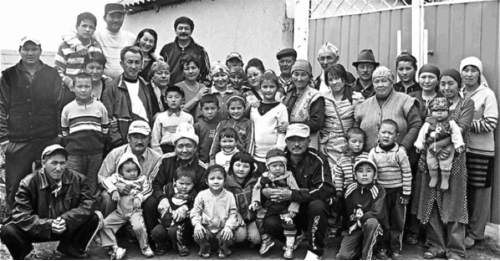
imageThis Kyrgyz family has gone platinum

For a mother this award isn’t a singular event; it’s the culmination of decades of daily effort in raising a child. What incredible responsibility to raise children to love their communities and work for the betterment of their nation! It is to each of our honor to support these families so each individual has the opportunity to learn how to pursue justice and effect changes to deeply broken systems.

We often complain about these systems—poor schools, corrupt courts, tampered elections—in a way that paints them as separate, detached forces floating above our heads for which we are not responsible and have no ability to change. But we cannot acquiesce the situation nor abandon our wills; for, these broken systems are the conglomerate result of individual decisions and actions.

What does this mean?

Steadily influence one person at a time. Verbally and publicly encourage and reward earnest effort and right behavior. Create laws and economic conditions which support entrepreneurs and small businesses. Award positions based on merit in an open and competitive process. Lead by example and with integrity.

Our influence as volunteers is truly very little when pushed up against systems, but to individuals our kind of work can have incredible impact. The work is not hopeless, though it might look that way. The problem is people—but because this is true—the solution is people as well.

We were sitting around our last cups of tea the other week when my friend’s mother started talking about her brother. He had been a top regional public lawyer in Kyrgyzstan, moving up through the ranks through his intelligence and hard work. Since he didn’t exact bribes, he lived a modest life within the means of his small government salary. But his integrity soon got him in trouble. At this level, when the next round of promotions came he found his position priced at $16,000. Without a savings account fed by accumulated bribe money, he was out of the running and out of a job.

I pray his honest labor was not in vain. These are the individuals we must support and uphold. This is the character we must develop in each child being raised. And God willing, when the future looks back and honors its heroes, it will honor this man and the people who sacrifice thusly as heroes of the highest order.

Most of the world doesn’t understand “9-5”

I recently saw an article floating around my facebook newsfeed disparaging America for refrigerating eggs. People were like, “What the hell, America?! You are so stupid!” And I was like, if we have resorted to criticizing America for refrigerating eggs, that is actually proof of how great America is. “Oh, no civil war? No mass starvation? People aren’t fleeing the country by the millions? Ok, well I guess everything is going pretty—REFRIGERATED EGGS!! OH MY GOD! ALERT THE PRESSES!”

Just imagine: a country so incredible its affluence permits people to spend hours arguing in weblog comment feeds about the proper temperatures for eggs. Few places on this globe allow for such luxury.

What about turkey eggs?

It’s now after fall break at my village school, and our recently settled schedule has been messed up again. An outbreak of hep A has obliged our director to ban unnecessary movement throughout the school and keep classes in students’ own homerooms. I suspect at least a few of the absentees are cases of great acting rather than a crippling month long illness. “I can’t go to school, mom. I’ve got that thing, I think, that people are talking about, you know, the one where people get to—I mean—have to stay home from school…”

In one particularly bad day of student attendance last spring, I talked my counterpart into taking a little visit together to the “troubled” students’ houses to talk with the parents. While several of them were supportive and said they would do a better job encouraging, what one mother said caught me off-guard. I asked if school was important and she said yes, but that her son was needed to do the farm work so the family could have food.

I know not everyone in America has it altogether easier, and most people work very hard. But if I had to put a number on the average work schedule here, 5am-9pm would be a little more accurate. People work really, really hard, and especially the women since the lack of running water and consistent electricity tends to hit the domestic chores the hardest.

It’s not always the same kind of work we’re used to in the states, assisted by all our time-savers. But people are doing what they need to do in the moment to secure a future. That means when the coal truck comes to town, you stop what you’re doing, go home, negotiate a price, and then spend the next couple hours shoveling it into your shed. Staying warm is kind of a priority in Kyrgyzstan. Yet this disrupts my neat little 9-5 schedule I have all written out for myself, like I thought I was still in the states or something.

We get up, we brush our teeth, we hit the office, take an hour off for lunch, put in a few more hours and then go home to an evening full of whatever we want to do. We press a button and the dishes are magically polished. We flip a switch and are kissed by warm air. Our biggest complaints are re-matching socks from the dryer or that minute rice actually takes five. Now I scrub my clothes with a bar of soap and that’s after hauling the water from a pump down the street. I never realized what a precious gift I was being handed – that precious gift called time.

Time gives us so many opportunities. We can get a second job, help our kids with their homework, volunteer at a food bank, or even surf the web for articles on eggs. Let’s just not forget what grace a 9-5 affords.

Stars Twinkle

Night crept in with dark brilliance, seeping into the earth below. A canopy of stars unfurled like a blanket across the sky. Over the far mountain reared the stallion, a deep purple armored with precious stones, now shining blue, now flashing red. I could see his silhouette in light, trace his wild mane, watch him kick the glacial peak, sending a milky dust into the cosmic air.

I had never seen the stars twinkle. I knew it only in a nursery rhyme, that old tune sung at the cradle. They existed there too, but we spewed smog and light with such oppression we blotted out the very stars themselves.

Somehow it surprised me, that towering glow. Somehow it blindsided me, that nature scene, pulling the air from my lungs in short gasps each time I stepped down from the porch; that undisturbed universe, never heeding the scratched protests beneath my feet.

Water is a limited resource

“Turn it off when you brush – it’s a five gallon rush – turn it off, off, off, off, off…ba dum ba dum ba dum…”

The words came rolling out of the fifth-grade recesses of my brain, matching the rhythm of my footsteps. I hauled the water and hummed the tune, making my way back over the kilometer of icy road to pour another bucket into the tank in our sauna. It would take four more trips before it would be full enough to light the bath. These words had stuck with me some twenty years, yet it wasn’t until now that they held any weight. One quickly learns the value of a gallon when every drop must be hauled by hand.

We were lucky. At least the water was flowing today. In other parts of the country water is often so scarce that people actually wash their hands with vodka – a testament to both the lack of clean water and the copious amounts of alcohol that line the shelves in every dukon.

Almost every household chore begins this way, with a trot down to the nearest working pump, a 40 liter container and wheelbarrow in tow. Often in winter there is a line. Usually it is the grade-school-aged boys that are sent on this task and so I would find myself, a tall shoot waiting my turn among the donkey pulled carts and two or three boys wrestling on the ground over who would get to go next. The rate of flow was enough to turn any man into a philosopher – or maybe just turn him mad.

 Patience is a virtue


And it takes intelligent men to control it, pushing it around in little spade-deep canals in half-acre fields, scribbling down the household gardens to receive water in daily schedules, pouring tea kettles down the pumps to break the sheet of ice that had formed the night before. Water is managed like money, stored like a second car, doled out like a paycheck and portioned out to the last drop. A song may be stuck in your head for twenty years, but some things you just have to see before it sticks.

Grandpa really did walk uphill both ways

There’s this old man living in our house. He’s been here a few months now. We call him Chong-Ata or “Big-Father.” He’s my host grandpa and recently celebrated his 84th Birthday – no small feat in a country with a current life expectancy of 65. Until recently, I didn’t know much about him other than the envy I have for his life of quiet leisure.

Over the past few months our conversations have been mostly limited to “How did you sleep?” and “Pass the sugar.” For a man who spends most of his time napping and drinking tea these are actually quite useful phrases; however, I began to work up the courage to ask a few more questions. My chance came one evening when we were all around the dinner table, sipping our last cups of tea.

Grandpa Jumabek was the oldest male of eight children, and when his father passed away, the responsibility of caring for his family fell literally on his shoulders. It was the late 1930s and food was scarce in the Kara-Suu Valley where the family lived. To the north over a mountain range lived his aunt, and knowing her family had food, he decided to make the trip to ask for help. Wearing a thin pair of shoes, Jumabek trekked for three days up and through a narrow pass, arriving in the Chui Valley on the other side. After staying a couple days, his aunt sent him back up over the mountains with two sacks of flour and a donkey in tow. Returning home, he was exhausted, having worn off a layer of skin on his feet leaving them bloodied and raw. Jumabek was only nine years old.

At nine years old I was proud of making my own sandwich. Being the breadwinner for an entire family is so much more badass.

My awe for this man grew, as did his stature. A broad and imposing man, I had to look twice to realize he’s actually several inches shorter than I am. It’s amazing what high regard can do for a person through the eyes of the admirer.

So the next time you see a man surrounded by a gaggle of admiring grandkids spinning tales with “back in my day,” think twice before you disbelieve. He might just be telling the truth.

imageOnce shouldering a injured horse, Chong-Ata now shoulders three generations.