PC Life

Expect the unexpected

A project I’d like to start sometime is waking up in the morning and listing all the things I’m going to do that day, then at night making a second list of all the things I actually did and contrast the two lists. A short reading of the morning and evening entries would look like I’m living two parallel lives with geography being the only bridge between them. Allow me to indulge:

—-

SATURDAY

Morning Entry

10am – I’m awake. *yay.

11am – fire has been lit with extra sheep poop added

12am – finishing leisurely brunch while browsing discgolfer magazine

Evening Entry

9am – woken by my neighbor friend’s second cousin calling me to come outside *vague ideas of strangling someone

10am – trudging out of village in search of “Yellow Tree” so that we can strip its bark and boil it to make medicine for neighbor friend’s niece who has Hepatitis A

11am – watching an old shepherd scratch in the snow a map of where to find Yellow Tree who then decides to show us the way himself and leaves his cow in the care of a fellow neighbor

12am – getting stabbed in the hands by inch long thorns while breaking apart the freshly uncovered Yellow Tree which has turned out to be a bush. *rah.

—-

imageAlways expect disc golf

It’s a cliché title, but it couldn’t be more accurate. I often find myself saying that today is “unusual like usual.” This is where flexibility comes in.

I’m not talking physical flexibility, though that also comes in quite handy when the 40th person stuffs herself into the 17-passenger van you’re riding or when you’re chasing two sheep that escaped your host dad’s flock down a mountainside. I’ve been attending the women’s club yoga sessions for that. (Strictly for flexibility reasons, I swear.)

What we’re talking here is the ability to adapt, change, bend, and stretch out of your comfort zone so that the next time you can stretch a little bit further. There are always going to be situations that you don’t want to be in but simply have to get through with sanity attached.

Sometimes it comes loose. Sometimes you flip out and yell at the man who’s calling at you, “America! America!” Sometimes you lock yourself in your room all day eating clif bars for breakfast, lunch and dinner.

Sometimes you come out.

But be warned. There’s just no telling how far you may have to walk for what kind of colored tree covered with who-knows how many thorns. At least it’ll be expected.

Don’t join the Peace Corps

You heard me. Don’t do it. I’m telling you, it’s going to break your heart.

The Core Expectations for Volunteers states you are expected to “serve where the Peace Corps asks you to go, under conditions of hardship, if necessary…” What it doesn’t state however is just what hardship means.

Right now you’re thinking, “Oh. There’ll be no flush toilets or showers. I can handle that. I might have to squash a few spiders, but for the high calling of changing the world, I think I can put up with those things.”

But the truth is, hardship isn’t the quirky and fun hardship you’re expecting, where each new day brings adventure upon crazy adventure, more wonderful than the next. True hardship is much more sobering.

During your service you might have to bury a neighbor. Or watch helplessly as your host family is torn to pieces by corruption. You might show up to school to learn one of your students was killed by a classmate. Your host sister could be kidnapped and forced to marry a man she’s never met. You might witness abuse, violence and mistreatment. You may see your best student lose to a kid from another school because his bribe was the biggest. Your dog might be fed a needle, just to quiet it down, forever.

And if none of that happens, then something else will. There’s just no knowing how hard it will be or it what way. It could be dealing with other volunteers is your biggest challenge. Or that you can never live up to the expectations of your host organization. Or that the Internet is so accessible you spend your entire day trolling Facebook, jealous of all the lives continuing on back home.

And what about all the things you’ll give up? Your boyfriend might not wait two years for you. You’ll put your career on hold. Your familiar support networks probably won’t be around – there’ll be no gym, no fast food joint, no car to drive, no family to visit. The stress and diet could make you lose thirty pounds—or gain thirty—whichever you don’t want.

The Peace Corps uses phrases like, “Life is calling. How far will you go?” and in a breath you’re ready to sign your name on the line. But two years is a long, long time and in the middle you find the world you wanted to change is a confusing and complex puzzle of which you are just one, tiny piece.

So please, if you’re not ready for the heartbreak in the hardship, don’t join the Peace Corps.

Or do.

Because you might just find that all your blood, sweat and tears are worth it – worth the pain, worth the time and worth the investment in the people for whom your heart breaks. Because you might learn some of the most important lessons of your life – that a broken heart can heal stronger than it was before, that a softened heart has more compassion for the world, and that in between its cracks and fissures is the only place where true beauty and grace can grow.

image

How to poop in a hole

This was one thing that I was legitimately worried about before arriving. I had only squatted once in my entire life, and that was an emergency so things just kind of happened on their own. Now that it was going to be intentional, I wasn’t so sure how it was going to work out. I still remember one of the trainers on our last day of orientation at the hotel saying, “Oh yeah – one more thing – you get down like this,” and proceed to flat foot squat on the floor. He must have been missing a tendon or two because my legs didn’t bend that way and I was positive that position would send me straight down the hole.

The first morning in my host family’s house was all trial and error. I went to the outhouse seven times in two hours, but ironically nothing was coming out. Did the pants go in front or in back? I honestly had no idea; I kept swinging my hips forward and backward, eyeballing the distance between my jeans and the imminent free falling object. I could only squat for about 45 seconds at a time, both arms straight out to the sides bracing myself in a tremendous iron cross that would make an Olympic gymnast jealous. I was a nervous wreck for days, avoiding the toilet and corking it “until the time felt right.”

I had been completely spoiled by my previous living abroad experience those two years in Japan. Those people know how to go in style: built in bidets with dials to adjust the temperature, knobs to change the angle and pressure, and a button that when pressed plays the sound of tinkling water for the more modest goers. Even the seat was heated; you could take a nap on it and still look at yourself in the mirror afterward.

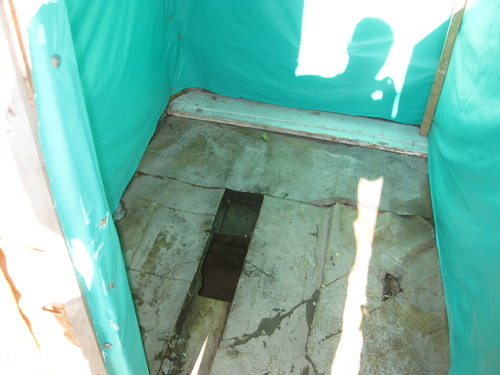
imageThere’s no toilet in the toilet

When I arrived in Kyrgyzstan I found not only an absence of the bells and whistles but the complete absence of a toilet at all. It did, however, force me to acclimate very quickly. I can cork it a good while, but there just ain’t no will power on God’s green earth that will stop a bout of giardia from passing as it so pleases.

Now a year on, I’ve grown so accustomed I just squat and play Sudoku on my cell phone – with a vice-like grip mind you – mashing the numbers and hoping it doesn’t fall. My legs have gotten more flexible. I can stay down for about 16 or 17 minutes before my feet go numb (I time it with my Sudoku games – don’t judge).

The one upside about being able to poop in a hole is that it is a truly transferrable skill. I can now poop in all kinds of holes in all kinds of places. Of all the things I’ve learned in the Peace Corps, that right there is the most satisfying.

Floss

Government insurance is nice. Let me restate that. Government insurance is really nice.

Now, as Peace Corps Volunteers we don’t receive the same nice salaries as government employees (something about there being “volunteer” in the title), but we do enjoy the benefits of good medical care. During our hub-site medical days we received so many shots we were veritable pincushions. We would take them two at a time – one in each arm – just to save on shot taking time. At first I asked questions, like, “What’s this for?” After a couple weeks it was, “Where’s my juice box?”

During service we are well taken care of too. Multiple volunteers this past year have been flown to Bangkok or Washington, D.C. for treatment that can’t be done in country. Peace Corps will even pay for pregnancies from pre-natal care through six months after the baby is born, including those who become pregnant just before completion of service. (Married couples: start thinking about your timing.) If you’re going to get seriously ill or injured in life, Peace Corps service is the time to do it.

But reality is, we are “out in the field” for a majority of the time, and two years in a developing country does a number on your health. This is something most of us don’t realize until we’re cutting new holes in our belts or swallowing an army of pills to chase out that colony of worms that has settled in our small intestine. We make sacrifices nutritionally, bacterially, with lack of exercise and with increased stress. That’s why taking responsibility for watching our own health is so vitally important.

image A village Volunteer’s medical plan: a book titled Where There Is No Doctor

I’m seeing the dentist next week on one of my trips to the capital, and I know what he’s going to say. It’s the same thing the dentist always says to me: “You need to floss more.” The advice is free, yet I’ve now learned the value of good health care. So much so, that maybe this time, I might just listen.

The usefulness of being able to communicate with another 0.06% of the world’s population

I speak Kyrgyz. Or, at least strange sounding syllables spill from my mouth that occasionally result in shared meaning. It might be the gestures though. It’s amazing the number of things you can get by simply pointing and grunting.

They say if you learn Chinese you can instantly communicate with another 1.3 billion people. The only catch is they’re all in China. (Well, if we’re speaking percentages, mostly anyway.) There’s nothing wrong with China, but you have to have pretty specific business to make the language knowledge worth it. Now take Kyrgyz. We’re talking 5 million, tops. You have to have a very specific reason to use that long term, like marrying a Kyrgyz person or being locked in a Kyrgyz prison for drug trafficking.

From the beginning I only had two goals for my Peace Corps service: make friends and learn the language. These come slowly for me and especially the language half – I have to study the same things over and over again until they stick. Yet, I’ve never regretted a single moment spent studying. Despite the persistent question of future usefulness, I guarantee you that every little thing I learn now is immediately beneficial. And learning the language helps make huge strides with making friends, too.

And that’s why I spend the hours and the energy, and soak in the sweat that drips from concentration and embarrassment alike. I do this to make my time effective, to make my time worth it and to grow these relationships. The Kyrgyz might only be one tiny fraction of the world, but they’re the whole world to me.

imageA lesson in vowel-harmony zen from Bakyt-Baike, our fearless tutor