Social

Makal Monday: A horse that says ‘I won’t walk’

“Makal” in the Kyrgyz language means “proverb.” Kyrgyz is full of wonderful and puzzling little proverbs – some that match common proverbs often heard in English and some that are real head scratchers. Most Mondays I’ll post one of the more fun ones for you. Let’s see if we can’t make some of these commonplace in America by the time I get back!

At baspaim degen jerin ming basat

Ат басрайм деген жерин миң басат

“A horse that says, ‘I won’t walk,’ will walk that route a thousand times”

Two months after graduating college I found myself alone in a small, tatami mat room sleeping on the floor. I had travelled 6,000 kilometers to teach English in Japan, and wondered as I drenched my sleeping pad with the sweat of a Shizuoka summer what teaching would be like.

I had been a camp counselor on occasion and loved it. I had worked with youth in a number of capacities and had even taken a TEFL class to gain a few skills for potentially teaching abroad. But I had no formal classroom experience and wasn’t sure how teaching English to classrooms full of kids who didn’t really need it would go. It turned out to be similar to teaching math to kids in America; most were there only because it was a required course, weren’t going to be using the subject at any point in their life, and frankly didn’t like it.

There were a few students who made some of the days worth it and of course life outside of school certainly made up for the time with its share of excitement and so I stayed two years. After returning home I knew I wanted to live abroad again. I just wasn’t going to be doing any more of that teaching English business.

Here I am, four years of teaching English under my belt and another on its way. This horse is being spurred on over ground it said it would never travel.

Never say never.


Continuing in the vein of full disclosure, I was disappointed when I received my Peace Corps assignment as a TEFL trainer. Why couldn’t I have gotten something more exciting, like digging wells or something? Ah—because other than teaching, I have no skills.

(If you’re a future potential job employer reading these words, please go back and forget that last sentence. Also, please stop reading.)

I really don’t. I’ve never dug a well, I barely eat any green plant life grown from the ground much less know how to grow it, my only quasi-entrepreneurial experience ended in a sad summer climbing ladders for CollegePro Painters and the sight of blood outside of someone’s body or any medical abnormality for that matter makes me pass out. So teaching English it was.

There really couldn’t be a more tame profession. But add Peace Corps to the mix and the seemingly benign is suddenly pushed smack against the threshold of survival. Every day poses fascinating challenges to overcome: schedule changes, freezing temperatures in classrooms, teachers eating the chalk and kids out harvesting potatoes. Even the Peace Corps Volunteer teachers find themselves in incredibly exciting, albeit harrowing, situations.

And there are kids here who want to learn, even if it’s a smallish handful. Not every single person is going to appreciate having you around, but even so, you’ll reach celebrity status with at least a few of them. And how could you not love the groupies? The ones who, for a single club lesson will chatter at their parents for a week, so excited to have learned a phrase of English from a real live American! (Ok, so maybe it is just the celebrity that keeps me going.)

After saying I’d never do it again, in the end I come back because I love it. I really can’t think of anything easier to do and I suppose that should be a sign that I’m meant to do it. Being in front of a classroom of kids is fun and simple. Or maybe I shouldn’t say simple—I’ve had to learn a lot, read a bunch, practice a ton and train others to figure out what I’m doing. But in the midst of it all, there’s a relaxing ease which makes it enjoyable, interesting and rewarding.

That’s the great thing about teaching English in the Peace Corps. TEFLers do get to see more immediate results and benefits of their work: kids winning spots in international exchange programs, going on to compete in national competitions, getting into good programs at universities and simply progressing on to conversational fluency. And the skills kids gain from having a mentor and teacher who invests his or her life are immeasurable and beyond the scope of quantifying. Being an English Education volunteer is a lucky post.

I don’t know what I’ll be doing in the future. I’m not sure I will go into education once I’m back in the states. Based on experience though, this horse of course, better not say never.
Don’t complain, take the pain

One of my favorite little scenes from The Simpsons is when Marge and Homer leave the kids in the care of Abe, the grandpa, to go out on a date. In the few hours they are gone, CPS stops by to discover “horrid” living conditions due to a series of unfortunate events and takes the kids. When Marge arrives home and discovers this, she confronts Grandpa:

Marge: We leave you the kids for three hours and the county takes them away?!

Grandpa: Oh, bitch, bitch, bitch!

Marge had quite the legitimate reason to bitch, if her words can be called that. Much more often I find myself bitching and moaning and nagging and complaining about the circumstances that surround me with very little reason to do so. I do it because I’ve been slighted or because things aren’t going my way, or because I’m upset by the ways things in Kyrgyzstan operate differently than I’m used to.

The truth is, there’s always a better way out than bitching about it.

Complaining is very little in the way of constructive progress. It might be ok for a moment or two, and it can even work as a good stress reliever if done in a safe environment, for example to a close friend who knows it’s his or her purpose for a short while to listen, or to a notebook which will except every expletive and take the punctuated abuse with grace and unwavering support. (Thank you, sweet pages.)

The better way is to bounce back and push in a new direction, to open a yet untried door. If you’ve arrived at a point where you’ve encountered enough trouble and opposition where you’re constantly complaining, it probably means that you’re going the wrong direction.

For me, I’ve often found that that direction is the path of least resistance. I want things to come to me. I want the world to roll on, straight and true without me having to put in a lot of work and commitment. So when I find things not going my way, I complain about it.

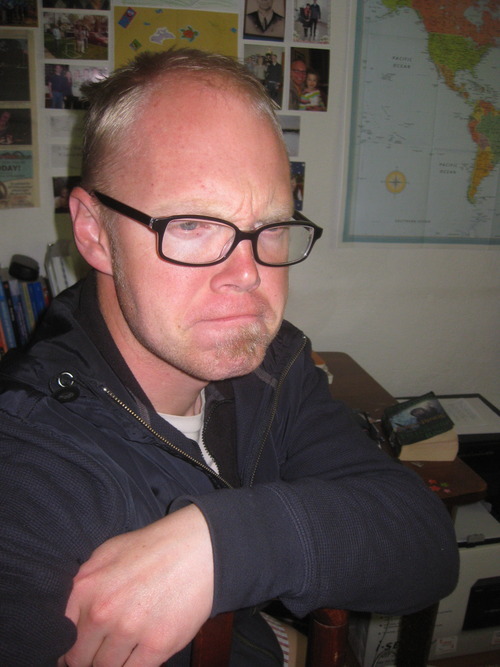
image Grumpiness is apparently not a very flattering look

Life is full of all kinds of things that are unpleasant, yet must be done. In the Peace Corps it could be trying to get a counterpart to adapt a particular teaching methodology, or washing all your laundry by hand, or attending to a long list of e-mails that have piled up while you were off the grid for a week. These are some of mine, and each person is going to have his or her own painful tasks that simply must be done yet get put off indefinitely until the pain eats away at enough of your joy where your hollow shell of a body somehow kicks into gear and does a half-ass job.

Whew.

A recent “tool” I’ve discovered is the strategy put forth by Phil Stutz and Barry Michels in their appropriately titled book The Tools. For this particular tool, instead of fleeing from the pain of diligent work, you embrace it. As you think about the difficult task ahead, you silently scream, “Bring on the pain!” Then, as you begin to work, answer an e-mail, make a phone call or whatever it is, you silently scream, “I love pain!” Then, as you are pushing through the task you quietly shout at the top of your lungs, “Pain sets me free!”

No, it’s not some kind of self-flagellation. It’s a straight shooting acknowledgement of the truth. Self-discipline, like any discipline, is inherently painful. It’s no fun to have to do stuff you don’t want to do. Your body is going to resist it and will tell you it’s in agony over being forced to do something it doesn’t want.

This tool very helpful when facing an undesirable task or when in an undesirable position. You learn to recognize it for what it is, as undesirable and inherently painful, and then go into it with eyes wide open knowing you’re not going to like it. But then, something strange happens. As your body gets to work, suddenly you find that you like getting things accomplished. That the knowledge of completing the undesirable task feels so much better than all the brooding and avoiding you were doing before you started. And then, when you break free on the other side, you find that the pain has set you free indeed.

So I give you my word, dear tumblr readers, I’m going to curb the complaints and instead invest that energy into trying new strategies. (Sorry sweet pages of my journal—you’re not off the hook.)

Oh, and some assertiveness, I guess, maybe

I could give you 3 or 4 names of volunteers I serve with who are exceedingly good at being assertive. I could, but I won’t. I won’t because everyone in Kyrgyzstan who reads this already knows who they are, and for everyone else the names wouldn’t mean anything. Let’s just leave it at, they exist, and they make it well known that they do.

This is a good thing. We’ve been invited to work with our counterparts and in our communities in order to effect some kind of change in them for the better, and nothing grows without some considerable change in momentum, namely a swift kick in the rear.

I never want to hurt anyone’s feelings. Or rear. Maybe that’s why it’s taken me so long to figure out some of this leadership stuff. Leaders are hated for decisions they make. But they’re also loved for those same decisions. Leaders nudge, push and stretch the status quo and that is going to make some people uncomfortable.

But it’s never been about being comfortable. It’s about what’s best for the most people. We don’t know what can come of a little painful change until we’ve tried it. The seed cannot produce more fruit unless it first dies.

image My counterpart, Nazgul, kicking butt and taking names at a teacher training

I care less now what people think about me and more what they think about accomplishing a task. There is always culturally relevant tact to be considered, but at the end of the day, taking charge, being responsible and doing the right thing will never go out of style.

I can’t help you. I’m sorry.

I was an idiot. That’s all I can say, really. I thought the world was brighter, thought the world was a place for only happiness and joy. But the world is broken and its buckled pavement is not meant for smooth rolling, only tripping through the dark.

It’s the eighth rising—the stilted ways in which we pick ourselves back up again to battle on against the ironies and absurdities heaving up through the road.

I dreamed I was a pebble, tumbling along in streams of others, once here, once there until I settled in a little pool and found that everyone trickles on in their own broken streams, now settling into soft earth, now cascading on to open waters across the blue.

I never thought I would settle here. But then I never could have expected any place in particular at 30 years. It’s just where life has gone. I’ve allowed it to take me, allowed myself to fall into the debts I feel I owe the world, pulling me in and covering me in dozens of little eddies of uncommitted obligation.

I’ll try to remember the world was not meant for regret but for fullness, that the only place happiness is found is in chosen joy, joy pulled from the ashes of a tortured and smoldering world, fresh it may seem from the ancient battle for the souls of its newly formed, walking upright, now bent upon the earth.

I’m sorry to everyone I thought needed to rely on me, as if I could provide some kind of saving grace or passageway to a better life. I’m sorry to all those whom I tried to convince that my own life was clinical or pure. If I’ve learned anything in the last two years, it’s that nothing has escaped corruption and vanity covers all, covers me and my little kingdom of swept dirt.

I’m just one drop in this fantastical ocean, broken fully again and again upon massive stones, tossed into the air where brilliant light has shone through every speck of my being, casting a rainbow of colors across the mist of a thousand others, equally broken upon the edges of life.

I’m not alone.

So I’ll climb out of bed. Make a phone call. Throw some discs. Forgive me for trying to be anything other than human. Forgive me for ignoring you, for withholding from you, for demanding to be your only option. I’m just one of many, needing to find my own little hexagonal comb of joy, to snuggle in sweet abandon, resting in the comfort of home, that place where I am known.

Life is raspberry flavored

What’s the flavor of your life? Is it sour like a sugarless glass of lemonade? Or maybe bitter like a dark roast of coffee? Or sweet in the way of a jolly-rancher, sickly grape and then razor sharp as it melts on your tongue?

At some point in Kyrgyzstan’s soviet past, someone proposed that the perfect life is like a raspberry, round and plump, juicy and sweet. Life of a kind that’s plucked from the thorn bush, staining your fingers red and finishing with a perfect balance of flavor as it moves across your tongue. This phrase, “Life is a raspberry” means life is awesome, life is grand, life is wonderful.

But it’s rarely heard these days. Maybe people aren’t finding enough to warm their hearts over. Or maybe they’re not seeking the secret joy that can be found in any circumstance.  Lenin, still holding a tight grip on secret joy

“Yellow! Hey, yellow! Oh, the yellowest of boys—woo! Over here!” I spun around. He was standing next to his taxi, another voice yelling at me, the quintessential looking tourist, as I walked through our region’s city center.

“I’m not yellow,” I thought, “I’m…peach…or…translucent…or heck, I don’t know, but I don’t like being the brunt of jokes when people think I can’t understand.” Tourist season has arrived and soon I’ll be enjoying more stereotypes, and attempts at higher taxi fares and prices at the market. I can choose to react in anger, letting my passion escape in short staccato bursts. Or I could choose to bottle it up and slink away, licking my wounds of resentment.

Life can be faced like this, back stooped and shoulders curled, wrapped around each burden of stress and anxiety as if harboring them in deep waters under your chest. Worry will always be looking for a place to anchor and only needs a hollow cove to come and hide. The secret is to stand tall, shoulders back and chest out as if to dash to pieces any hope worry might have of settling in your soul.

My friend Akmoor and I were on our way to the bazaar to do some shopping.

“Osh City, Osh City, leaving for Osh!” cried one man, leaning over a Honda.

It was always the taxi guys, and for some reason I was feeling a bit devilish.

“Ok, 100 som!” I said cheerfully, offering 10 times less than the going price.

“100 som!? 100 som! How ‘bout I just take you for free? C’mon, I’ll take you all the way to Osh for free!”

“Ok, let’s go Akmoor!” Giggling we started to walk over to the taxi. Now I don’t understand Russian, but the tone bursting from this man spoke volumes.

“У@*#!…Я$!#…Д$!€&….”

We quickly turned and scooted ourselves away from the spittle forming at the corners of his mouth. “Wow, he’s sure got a stick up his butt,” I said in English.

“Stick…huh?” said Akmoor with a quizzical look.

I translated into Kyrgyz and she lost it, doubling over in laughter. We had to keep practicing this new phrase the rest of the way to the bazaar and I kept fielding questions like, “Stick up his butt…can I say stick up her butt?”

“Yes, Akmoor…”

Our taxi driver hadn’t taken it with his shoulders back or chest out. And it could have turned my mood sour like his as well, taken me down a notch, leveled me to the lowest common denominator. But Akmoor’s boisterous merriment simply washed over all that was wrong and lifted me on the giggles of her bubbling joy.

Life is always as good as your reactions. It’s been said 100 ways, but it’s true. There will always be tragedy, frustrations and setbacks but how you respond makes our earthly walk a trek in darkness or a journey to be enjoyed.

Life can be wonderful or life can be dark and I’m not saying everyone has a level playing field. Some suffer tragedy while some seem to sail through life with ease.

But life circumstances have never been a good indicator of happiness or satisfaction. I’ve seen those with high privilege bicker and argue with family members and create bitter enemies, and I know others who have lost a spouse and raised children without so much as a sheep in the yard thrive and grow and bring joy to those around them. Life can be like a raspberry if only one knows how to traverse the thorns.

Unfortunately, there are those who see the thorns as a barbed wall of fate and surrender the fight to the ironic idiosyncrasies of life. There’s an idea in Kyrgyzstan that all of life is fated and if anything good happens at all, it’s the blessing of God.

The puritans and fundamentalists of the first two centuries of America also held these beliefs, that God’s will was supreme and lives were predestined since before the foundations of the earth. But instead of acquiescing to a life outside of their control, they sought to actualize God’s providence by being some of the best workers, entrepreneurs and producers the world has ever seen.

Why? I’m not sure. I find it fascinating that two can respond to the same set of circumstances and belief in fate with diametrically opposite behavior. It seems to be the difference between, “If God wills, it will come to me,” and “If God wills, he won’t stop me.”

I settle up to the table for another meal of bread and vareniye, the jam that graces a Kyrgyzstani’s table at each meal, and ah! there it is: a dish of raspberries, preserved during summer months of plenty for the harsh of winter when no fresh produce can be found. It’s the perfect daily reminder to choose joy in those winter seasons of life and to remember that truly, “Life is a raspberry.”