pc

It’s easy to criticize the guy who’s doing something

There are numerous empty carcasses caught in the interwebs about Peace Corps being little more than a way for over-privileged college grads to pad a resume or drink cheap beer on a two year adventure. People moan and complain about everything under the sun that is wrong with the system, wrong with staff, wrong with policy, wrong with vision. But in the end it comes down to just one thing: the volunteer himself. What are you, given an all-expenses-paid two year stint in a foreign country, going to do? The options for abuse and ineffectiveness are wide and easily available. But the opportunities to do something great are as tall as the stars and as deep as the hearts of the people you live among.

What I’m doing may not jibe with those in the comfy academic or political swivel chairs. And I admit that I’m not saving the world; no development or friendship program can. But at least I’m doing something. I am sharing my skills and knowledge in order to do my part to try and make my little sphere a better place.

It’s easy to criticize the guy who’s doing something, because there’s something there to criticize. The Peace Corps is that guy – is filled with those people. People who stop gaping at the problem and put their hand to the plow.

There’s a proverb in Kyrgyz that reads: Koz Korkok – Kol Batyr. It means, “The eye is a coward but the hand is a hero.” If you merely look upon all that must be done to make the world a better place, the coward emerges to stomp with his boots of judgment and despair upon what little spark of inspiration had flamed. But put your head down and get to work, and the hand will fan that flame into a vibrant energy that can effect a great change.
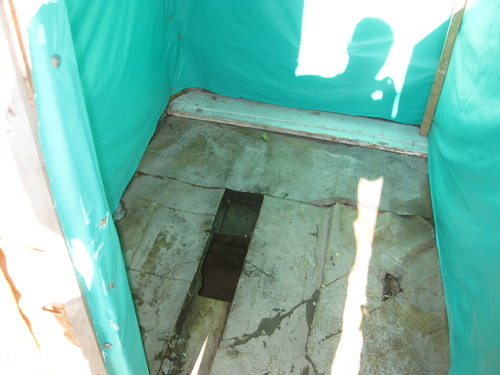
How to poop in a hole

This was one thing that I was legitimately worried about before arriving. I had only squatted once in my entire life, and that was an emergency so things just kind of happened on their own. Now that it was going to be intentional, I wasn’t so sure how it was going to work out. I still remember one of the trainers on our last day of orientation at the hotel saying, “Oh yeah – one more thing – you get down like this,” and proceed to flat foot squat on the floor. He must have been missing a tendon or two because my legs didn’t bend that way and I was positive that position would send me straight down the hole.

The first morning in my host family’s house was all trial and error. I went to the outhouse seven times in two hours, but ironically nothing was coming out. Did the pants go in front or in back? I honestly had no idea; I kept swinging my hips forward and backward, eyeballing the distance between my jeans and the imminent free falling object. I could only squat for about 45 seconds at a time, both arms straight out to the sides bracing myself in a tremendous iron cross that would make an Olympic gymnast jealous. I was a nervous wreck for days, avoiding the toilet and corking it “until the time felt right.”

I had been completely spoiled by my previous living abroad experience those two years in Japan. Those people know how to go in style: built in bidets with dials to adjust the temperature, knobs to change the angle and pressure, and a button that when pressed plays the sound of tinkling water for the more modest goers. Even the seat was heated; you could take a nap on it and still look at yourself in the mirror afterward.

imageThere’s no toilet in the toilet

When I arrived in Kyrgyzstan I found not only an absence of the bells and whistles but the complete absence of a toilet at all. It did, however, force me to acclimate very quickly. I can cork it a good while, but there just ain’t no will power on God’s green earth that will stop a bout of giardia from passing as it so pleases.

Now a year on, I’ve grown so accustomed I just squat and play Sudoku on my cell phone – with a vice-like grip mind you – mashing the numbers and hoping it doesn’t fall. My legs have gotten more flexible. I can stay down for about 16 or 17 minutes before my feet go numb (I time it with my Sudoku games – don’t judge).

The one upside about being able to poop in a hole is that it is a truly transferrable skill. I can now poop in all kinds of holes in all kinds of places. Of all the things I’ve learned in the Peace Corps, that right there is the most satisfying.

Water is a limited resource

“Turn it off when you brush – it’s a five gallon rush – turn it off, off, off, off, off…ba dum ba dum ba dum…”

The words came rolling out of the fifth-grade recesses of my brain, matching the rhythm of my footsteps. I hauled the water and hummed the tune, making my way back over the kilometer of icy road to pour another bucket into the tank in our sauna. It would take four more trips before it would be full enough to light the bath. These words had stuck with me some twenty years, yet it wasn’t until now that they held any weight. One quickly learns the value of a gallon when every drop must be hauled by hand.

We were lucky. At least the water was flowing today. In other parts of the country water is often so scarce that people actually wash their hands with vodka – a testament to both the lack of clean water and the copious amounts of alcohol that line the shelves in every dukon.

Almost every household chore begins this way, with a trot down to the nearest working pump, a 40 liter container and wheelbarrow in tow. Often in winter there is a line. Usually it is the grade-school-aged boys that are sent on this task and so I would find myself, a tall shoot waiting my turn among the donkey pulled carts and two or three boys wrestling on the ground over who would get to go next. The rate of flow was enough to turn any man into a philosopher – or maybe just turn him mad.

 Patience is a virtue


And it takes intelligent men to control it, pushing it around in little spade-deep canals in half-acre fields, scribbling down the household gardens to receive water in daily schedules, pouring tea kettles down the pumps to break the sheet of ice that had formed the night before. Water is managed like money, stored like a second car, doled out like a paycheck and portioned out to the last drop. A song may be stuck in your head for twenty years, but some things you just have to see before it sticks.

Grandpa really did walk uphill both ways

There’s this old man living in our house. He’s been here a few months now. We call him Chong-Ata or “Big-Father.” He’s my host grandpa and recently celebrated his 84th Birthday – no small feat in a country with a current life expectancy of 65. Until recently, I didn’t know much about him other than the envy I have for his life of quiet leisure.

Over the past few months our conversations have been mostly limited to “How did you sleep?” and “Pass the sugar.” For a man who spends most of his time napping and drinking tea these are actually quite useful phrases; however, I began to work up the courage to ask a few more questions. My chance came one evening when we were all around the dinner table, sipping our last cups of tea.

Grandpa Jumabek was the oldest male of eight children, and when his father passed away, the responsibility of caring for his family fell literally on his shoulders. It was the late 1930s and food was scarce in the Kara-Suu Valley where the family lived. To the north over a mountain range lived his aunt, and knowing her family had food, he decided to make the trip to ask for help. Wearing a thin pair of shoes, Jumabek trekked for three days up and through a narrow pass, arriving in the Chui Valley on the other side. After staying a couple days, his aunt sent him back up over the mountains with two sacks of flour and a donkey in tow. Returning home, he was exhausted, having worn off a layer of skin on his feet leaving them bloodied and raw. Jumabek was only nine years old.

At nine years old I was proud of making my own sandwich. Being the breadwinner for an entire family is so much more badass.

My awe for this man grew, as did his stature. A broad and imposing man, I had to look twice to realize he’s actually several inches shorter than I am. It’s amazing what high regard can do for a person through the eyes of the admirer.

So the next time you see a man surrounded by a gaggle of admiring grandkids spinning tales with “back in my day,” think twice before you disbelieve. He might just be telling the truth.

imageOnce shouldering a injured horse, Chong-Ata now shoulders three generations.

Floss

Government insurance is nice. Let me restate that. Government insurance is really nice.

Now, as Peace Corps Volunteers we don’t receive the same nice salaries as government employees (something about there being “volunteer” in the title), but we do enjoy the benefits of good medical care. During our hub-site medical days we received so many shots we were veritable pincushions. We would take them two at a time – one in each arm – just to save on shot taking time. At first I asked questions, like, “What’s this for?” After a couple weeks it was, “Where’s my juice box?”

During service we are well taken care of too. Multiple volunteers this past year have been flown to Bangkok or Washington, D.C. for treatment that can’t be done in country. Peace Corps will even pay for pregnancies from pre-natal care through six months after the baby is born, including those who become pregnant just before completion of service. (Married couples: start thinking about your timing.) If you’re going to get seriously ill or injured in life, Peace Corps service is the time to do it.

But reality is, we are “out in the field” for a majority of the time, and two years in a developing country does a number on your health. This is something most of us don’t realize until we’re cutting new holes in our belts or swallowing an army of pills to chase out that colony of worms that has settled in our small intestine. We make sacrifices nutritionally, bacterially, with lack of exercise and with increased stress. That’s why taking responsibility for watching our own health is so vitally important.

image A village Volunteer’s medical plan: a book titled Where There Is No Doctor

I’m seeing the dentist next week on one of my trips to the capital, and I know what he’s going to say. It’s the same thing the dentist always says to me: “You need to floss more.” The advice is free, yet I’ve now learned the value of good health care. So much so, that maybe this time, I might just listen.