pcv

Cigarettes and Jesus

It’s currently 2am as I write this, here on this side of the world, in my little village, lost somewhere up the side of a mountain. I’ve got a couple more hours to go, or fewer, if I decide to cut my losses and go to bed.

This post is more personal than any of my previous posts to date. Not that each and every one doesn’t hold dear, personal meaning to me, nor that they’ve been somehow untrue. Just removed maybe. Or not quite as raw.

It’s been a stressful few months since returning from a quick Christmas visit back home. I’ve been stressed out by schedules and lack of schedules, ineffectiveness and having too much to do, relationships and the void that comes with being out here all alone. It seems to be everything or nothing at all.

My stress is both fueled by and relieved by those little moments in between drags, standing, as Alanis Morissette would put it, with “one hand in my pocket and the other one…flicking a cigarette.” It’s not the healthiest way to deal with these crushing feelings, but at least I’ve got a little paper stick to crush at the end of it.

It seems like the night is the only time to get anything done. I’m constantly interrupted by life—random text messages and phone calls from people all over the country, the neighbor kids wanting me to watch their dance routine, the constant tea breaks when trying to get applications and lesson plans written with counterparts, the horses coming home… And then I realize I’m out of water and have to walk down to the pump and wait in line, or I try to make a run to the outhouse and my landlord’s brother is walking by and needs to engage in a half hour chat about Islam and then my modem won’t connect to the internet and my e-mail won’t load and I’m hungry and need to think about making something to eat…

A lot of it would be normal interruptions anyone would face, but it seems like here I put in nine hours and then I come home to another full days worth of work.

And I’ve been stressed out by the looming decision to extend or not. There are so many pros to staying and so many cons to make me want to escape, and so many negatives about returning home now and so many good things to go home to. It’s stressful to try and put a weight on each of those and then watch as the scale swings in the winds of my emotions.

And then there’s Jesus. Sweet Jesus. Jealous Jesus. He’s been taking a bat to the idols in my inner worship hall recently, smashing to bits what I’ve so carefully constructed from glittery patches of worthless things, and that’s been good. Really good. I really don’t know why I don’t listen to him and rest in his presence more often. He’s always been so good to me and that whole advocating on my behalf thing before God…well, I’d be in a world of hurt without him. Life always goes better with him, even through the pain of giving up the things I’ve been using to get me through—resentment, lust, gossip, envy, laziness, and that inward “self bending in on the self,” as my namesake so eloquently put it.

Long, out-loud conversations seem to do the best. They move in a direction instead of spinning on that dwelling spiral, like a penny in those wide, yellow donation tubs that only seem to be found in malls, spinning, spinning forever it seems, hypnotizingly slow at first and then faster and faster until they hit the bottom of the bin with a trapping clunk.

Long conversations that last longer than the glow at the end of a penny cigarette—long conversations about this life here and just who it is I’m talking to, a God who has been at the moment of this feeling, at the inception of this temptation, at the end of this thought and walked on to the grave and stepped back out of it, yanking victory from the pit of hell and ascending to lead captives in his train. Captives like me. Oh! How lovely is your dwelling place!

Thank you Jesus for being here and being my friend.
image Psalm 121

The map changes

I have a friend who is trying to visit 30 countries before she turns 30. Since I’ve already turned 29 for the second time and am only sitting at 9 countries, I’m fairly impressed. As we sat and talked about numbers and places, I wondered what people do when a country they’ve visited gets split or is absorbed into another. For example, if you had traveled through Sudan from north to south prior to 2011, could you now up your count by one?

And if you’re traveling with your Chinese friend from Beijing down to Taiwan, would you dare boast to him about hitting a “new country?”

And don’t forget the Central Asian conundrum. Having declared into being the new country, “Kyrzakhstan,” American Secretary of State John Kerry in a word docked the lists by one of any traveler to these two, unique countries. (If nobody’s heard of the countries you’ve been to, do they still count?)

My friend is counting Scotland even though it’s not technically a separate country, although it could become one after a referendum to be held this September. (By then my friend will be 30 anyway!)

It’s strange, this shifting and changing world. For all of human history we’ve physically only added and lost a few islands, but think of the millions of miles of arbitrary borders that have bobbed and weaved over mountains, along rivers and across valleys for millennia! It’s a strange concept, that borders change, because we’re used to living in the present and at any given moment (the miles of disputed borders aside) there is one lay of the nations.

I was one who used to think the world stayed the same. I had a printed map, after all, and Mr. P, my seventh grade teacher, expected me to memorize the names inside all those squiggly lines or else I’d fail the class. To me countries were green, yellow, purple and orange and smaller than my hand.

But rivers shift. New presidents are elected, or generals usurp control. And the ideas of these leaders shift more than rivers. Some start to think that maybe the grass really is greener on the other side.

image

 Hanging out in Transnistria. Wait – does that put me at 9 1/2?

The recent news about Crimea has most of the western world up in arms. (And let’s hope they don’t accidentally fire one of them.) But think about it—if you were learning geography in 1958, you’d say America has only 48 states and it wasn’t until various referendums, acts and contentious votes that the president finally signed the bills that joined two new states theoretically to America’s shores.

And if it’s Putin’s military presence we’re upset about, it was only a couple generations ago that Great Britain—still today America’s biggest ally—ruled an empire procured through decades of bloody campaigns across the world.

The world changes. That is a fact. Whether it should or not is another debate, but we can’t be surprised when it happens. Rulers of nations and peoples have been changing borders since the beginning of history and aren’t going to stop anytime soon, no matter how many Eurovision concerts are held or joint space flights are launched.

Sunday’s vote by the citizens of Crimea to join Russia plus Putin’s signing of the annexation today proves that. I’m not defending nor decrying the legitimacy of these actions. I’m just saying it happens all the time and we shouldn’t be so surprised.

So add another question to the list: should you have happened to visit Crimea in the past and counted it for Ukraine, do you change your mark for Russia? What’s the call now?

Be affectionate

This spring marks 8 years since I’ve been in love. It was that kind of love that awakened the butterflies in my tummy and lifted my feet to the clouds. I was hers and she was mine and as long as we stayed off that ground called reality, we could dance on those clouds indefinitely.

Indefinitely turned out to be 5 months.

Neither of us made long term commitments or true gestures of service toward each other. Mostly we just enjoyed making out or holding hands in the car. Ok, so maybe it wasn’t love. But the affection sure was nice.

But affection is not just for those (in my case) rare and deep relationships. Affection is a life need as much as air or water and without it we wither, we wilt and we die.

I first felt this in my time in Japan, discovering stretches of months where I hadn’t hugged anyone or even shook a man’s hand. Now with five months behind me of living on my own in Kyrgyzstan I’m starting again to feel the ground about me become parched and cracked.

I’d be good to learn to be more affectionate and open to closeness like most Kyrgyz people show so well. I don’t know if it’s a deep-seated piece of Kyrgyz culture or if it simply stems from situations where 40 people are squeezed together in a van, but here people seem to wear their personal-space bubbles like body suits. Touching is ok.

People lean in when sharing pictures on a cell phone, brush your knee as you sit cross-legged around a meal of plov, and stroke your arm in condolence. You can see young female friends walking down the street hand-in-hand or guys in their 20s with an arm around each other’s shoulders as they walk. Handshakes sometimes last for an entire conversation and won’t end until one is pulling the other towards home for some tea. Neighbor kids playing in the street look out for each other too, and if one falls, an older kid will be quick with a kiss to make it all better. Even the more manly young men will at least head-butt upon meeting a friend.

And sometimes affection just falls in your lap
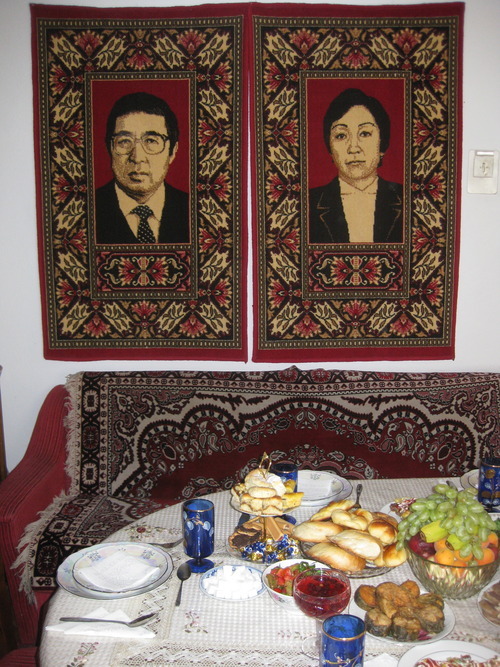
Butting heads is not quite the same sensation as holding hands with a cute little butterfly whisperer, but it definitely shows you you’re loved. And that’s the good and right meaning of affection—that others feel close to you and desire to be close enough even to touch. So as I learn how much it means to me, I’m working on being affectionate to others as well. That means showing up at the door and returning that tiny and grimy, snot-smeared hug when I’m back from a weekend away. It means leaning on arms at story time and true bear hugs of reckless abandon that say I’m all-in. By being affectionate, we give each other that wonderful opportunity to grow and blossom, surrounded by flowery friends, in a well-watered and beautiful garden of life.

People are the same everywhere. They’re just different.

There was a knock at the door.

Bang bang bang

I decided to ignore it. I had come home from school not feeling very well and so had slipped into bed for a couple hours of afternoon rest. The door was locked to keep any neighbors or friends from just wandering in as they occasionally do so I could have a couple uninterrupted hours.

There was another knock at the door, this time combined with callings of my name.

Bang bang bang “Lu-ter!” Bang bang bang. “Luuu-ter!”

It was my landlord, who lives in the adjacent house on the property.

“Ignore him,” I thought naively, “That’s the best way to make him go away.” Unfortunately, it only served as a challenge.

There were several yanks on the door, the loose deadbolt rattling in its locked position. More knocking. Then the phone started to ring. I let it ring through. It rang again. I let it ring through again. It rang twice more before there was a reprieve in ringing and knocking.

“Thank God. He’s finally learned I don’t want to go to the door.” But it was just the eye of the storm. Moments later he returned with his son who, while my landlord began a barrage of knocks on the front door, walked around the side of my house and launched an attack on the window. It was too much. I waved my white flag.

“WHAT?!?” I screamed from my bed.

“Lu-ter,” my landlord said in a cheery voice, “Come drink tea!”

I was furious.

“Is my house on fire?” I yelled back.

“What?”

“Is. My. House. On. Fire?”

“…No…”

“Then leave me the hell alone and stop knocking!”

“Lu-ter – just come open the door.”

“No! I will not open the door!”

“Why?”

“I want to rest! Why is that so difficult to understand?”

“Ok, ok, just asking…” He walked away.

By this point I was so irritated I couldn’t get to sleep. Why didn’t he understand that when nobody answers the door, it means they don’t want to and aren’t going to? Doesn’t he know how rude it is to knock more than 2 or 3 times?

Doesn’t Luther know how rude it is not to answer the door when someone is knocking?

I didn’t get why my landlord wouldn’t stop knocking. My landlord didn’t get why I wouldn’t answer.

The difficulties in living and working cross-culturally are in our expectations. Growing up in one particular culture, we are conditioned to expect certain behaviors from people in specific situations. And when people don’t behave as we expect, we get frustrated, annoyed, confused or upset.

I came in knowing there would be cultural differences, but I didn’t think about how difficult it was going to be to draw the line between what makes us all the same as humans and what separates us by our cultural habits. It’s not so easy to know if your landlord is simply knocking because it’s the culturally friendly thing to do, or if he is inherently rude. Just what is it about human beings that makes us the same? What are the universal truths about our species? What are the behaviors we should expect out of any person, anywhere?”

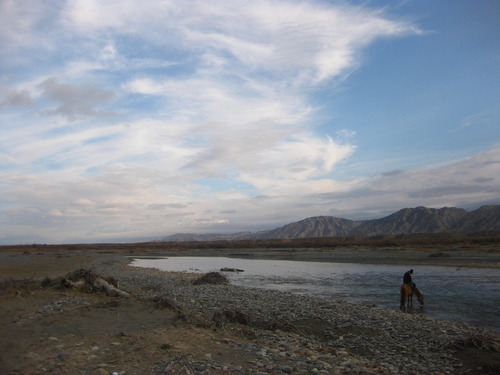
imageEveryone wants to be immortalized…in carpet.
I believe it comes down to God’s truths laid out in the Bible. God’s truths cross all cultures and all of history, laying out the expectation that we are to respond in service and honor and worship of Him by doing things like pursuing justice, taking care of widows and orphans, being honest and showing one another grace.

But just how this plays out in our behaviors isn’t always clear. Being raised in one environment makes it very difficult to separate out truth from behavior. Kyrgyz and Americans are both hospitable, but a Kyrgyz person will show this by force serving you multiple cups of tea beyond your bursting point while Americans will tell you to “help yourself.” Americans and Kyrgyz will want you to eat well so Americans will feed you a portion from each section of the food pyramid while a Kyrgyz person will watch in eager expectation as you try to swallow the lump of pure-fat-sheep-butt in a breadless sheep-liver sandwich. Americans and Kyrgyz respect the elder generation and so Americans will create opportunities for elders to continue to take control of their own lives while grown Kyrgyz children will make space in their already small homes to provide for all the needs of their elderly parents.

Our intentions are often exactly the same because as humans we’re following one, collective gut in how we should treat people. But, while what our gut tells us may be the same, what our gut tells us to do can be oh, so different.

Change is complicated

There are many things in Kyrgyzstan that need to change. This shouldn’t be a surprise to anyone. We are invited to be here by the government because of what we can offer in making the country a little better place. Where I’m stuck, however, is in what that definition of “little” means.

Along my search, let me share an anecdote as example:

Take the English teacher who is inflating grades or changing scores on his students’ tests to make him look better. It would seem at first glance that this is a very morally corrupt man and he has issues that need to be righted. Cut and dry. After all, he’s hurting his students’ motivation to study. When they know it doesn’t matter what scores they get on the test because they will pass regardless, most students lose interest in exerting any kind of effort.

So you approach the teacher and tell him what he’s doing is wrong and that he is detrimentally affecting his students’ futures. You’re going to make your mark: he’s going to change. But you’re not ready for his answer. He tells you he would love to grade fairly, and it makes him angry to inflate the grades, but if he doesn’t he will 1. Get yelled at by the parents of his students and he has to live next door to some of them 2. The parents will complain to the director that he is a bad teacher and the director will take the parents’ side and 3. The director will himself give him a hard time and possibly even fire him if he doesn’t report good grades.

So you feel sorry for him and your incensed rage and moral compass guide you to the next level. You approach the director and tell him what he’s doing is wrong and that he needs to support his teachers in a united front against all that opposes the forward progress of knowledge. But you’re floored by his response when he tells you that he can’t let anyone in the school fail because if he does the superintendent will yell at him and he could possibly get fired and then how would he feed his family? Not to mention all the teachers who are older than him who would call the superintendent themselves to make up lies about him if he tried to tell them how to run their classrooms.

So you realize the problem lies with the school district. You march right up to the superintendent’s office and you demand a meeting. You tell him directly that he can’t force all schools to allow every student to pass because this is hurting the quality of education and is greatly affecting attendance at your school, especially among upperclassmen. He needs to do the right thing. But once again your righteous indignation is turned on its head—he tells you that if there are any failures in his district he will look really bad compared to all the other districts who are just passing kids through and then someone from the ministry of education will come down, chew him out and put someone else in charge who will take orders.

At this point you’re wondering how far up the ladder you need to go. There are so many obstacles at every level that getting a teacher to grade fairly might require an official decree from the president of the country and enforcement by the executive branch.

Other countries have succeeded in doing this, including the former Soviet Republic, Georgia. The Rose Revolution in 2003 saw massive sweeping changes executed by strong leadership that led to a significant rise in quality of life for everyday Georgians. Corruption wasn’t tolerated on any level and within a matter of a couple years, citizens were enjoying higher salaries, a competent and helpful police force, and fair chances for more people to get a higher education. It took strong, unified leaders with an unwavering sight on their vision to turn things around.

But this is really, really hard to do. It requires a perfect storm of people with the same vision all falling into place at once. Unfortunately for our hapless English teacher, if he tries to stand up and do the right thing on his own he will be quickly swallowed up in a system outside of his—and any other individual’s—control.

I wish I as an individual could change the whole country—stand up and give that rising speech—and suddenly everything would turn on its corrupted heels and march towards fairness and justice. I care about this country and the direction it’s headed because I live here—Kyrgyzstan is my home—and what happens affects my students and my host families and my friends. They’re the victims of these broken systems. Yet a strange fact remains: the same people who are the victims are the ones who are responsible; they’re all so interconnected it’s like a knotted ball where if you pull on just one loose end, the whole thing only becomes more tightly tangled.

Where do we, as Peace Corps Volunteers, fit with trying to help untangle the knot? If we stand up and say something it could be our job as well that’s pulled out from under us to be replaced with a plane ticket back home. Or we could just be noise that’s dissipated by local winds less sympathetic to a foreign voice. Or we could offend our friends with harsh words when our only intent was to help.

So do we just try and do the “little” things? Keep our heads down, teach our classes, give our trainings, lead our camps and hope that something somewhere rubs off on the right people who will stand up and be that change? Are those little things actually the big things that will someday tip the scales?

It’s something I don’t have an answer to. I wish I could be more directly involved. Maybe it’s my job to inspire the voices rather than be the voice. Yet that is complicated too.

imageKyrgyzstan – a country of vast potential