pcv

Wash your hands

When I was little and would use the facilities so to speak, I would wash my hands with soap if it was #2 or simply rinse them a bit for #1. Those were the standard operating procedures for Little Luth. I never really thought about the science behind why hands needed to be clean or how one methodically went about ensuring they were so.

Now my hygiene habits weren’t particularly worse than anyone else around me on a typical day back in the states, but they probably weren’t as clinically sterile as they could have been. How often did I rub my hands on my pants and then take a bite of a sandwich or open the door of a Chipotle before enjoying a burrito? (Mmm…burrito…wait, what are we talking about again? Oh yes.)

In the past year and a half my hand-washing habits had gotten worse. Even now I’m sitting in my house, a head cold and nervous it might be hep A since a bout has been going around my village lately picking off one student after another. The opportunities for hand-washing are greatly decreased here due to lack of running water and hand-washing stations posted around plus the cultural habit of shaking every man’s hand no matter how soon you need to be eating something. That’s one more incentive to ‘get it right’ when you do have the chance.

A health volunteer friend of mine, Tori, came out to my village earlier this winter to do a couple of health lessons for my students, one being hand-washing for the adorable second and third graders. Or at least I considered them to be adorable until my counterpart decided it was a good idea to stuff 90 of them into a classroom for the lesson. It’s easy to have a less gracious view of 90 little snots all talking at once and shoving each other to get as close as possible to the front of the room.

imageSaving the world, one pair of hands at a time

I listened to her lesson in between breaking up fights and rerouting attention and realized, “Wow. I’m learning something.” There’s a kind of technique to hand-washing that goes beyond just letting water run over your hands. I was especially impressed by the double fingernail scrub (picture a row of choir kids singing with their hands clasped in front of them) and the thumb wash (picture milking a cow). I was going to be so much healthier from her on out, and a lot more happy each time I washed my hands singing the full ABCs before I walked away.

The neatest thing about the training though was how memorable it was. To this day I still wash my hands differently because of that training. And this is what any of our trainings focus on: behavior change. Just how you can get someone to change risky behavior for healthier behavior is a tricky task set before volunteers on a daily basis.

So thank you Tori! My hands have never felt so clean, nor have I had so much fun washing!

Health volunteers are doing amazing things and are making a big difference in communities around the world. Remember to thank a Health Peace Corps Volunteer the next time you see one!

Bread tastes better when you bake it yourself

One of the great benefits of living with a host family is having food. It’s an even greater benefit for the volunteer who lives far from any kind of substantial food market and so doesn’t have to be responsible for the slaughtering for all his own meals.

Despite our hitherto “I-live-here-you-feed-me” agreement, my host parents took a trip to the big city for a few days so it was up to my 16-year-old brother and me to cook food and generally fend for ourselves. How the whole house didn’t descend into Lord of the Flies was a miracle, and counted up there was the fact that dinner appeared on the table at regular intervals. It didn’t even resemble a raw pig on a stake, most of the time.

imageA Peace Corps volunteer’s last supper. No pork on this table.

I’m a fairly good cook when I feel like cooking, namely when starvation is the other option, and I follow a mean recipe. There’s something about making bread, however, that a recipe doesn’t tell you and that’s the secret ingredient of love. You have to romance the dough, with a sweet-water bath and full body massage with oil.

The bread I tried to make that day, however, wasn’t feelin’ the love. I got a slap on the face in the form of ten little hockey pucks of hardened flour. Being, again, the only option between us and starvation, I took a bite. My host brother took off for the neighbor’s.

She cut me deep, that bread, (no, I mean literally—she was really hard) and it was a long time until I had the confidence to put myself on the line for another.

I got the chance some months later now living on my own. This time I wasn’t going to fail and laid it on thick with the charm, sweets and tush patting. How she could have turned out to be a spoiled little fruit cake is impossible to tell, and I’m sure there was no connection. Anyway, I ended up passing her off on a friend who was apparently more desperate than I.

If love can be reduced to a fortune cookie, and I think we can all agree that it can, the third time is the charm and the secret is in the second rise. You let her think the romance is on, then you introduce that walnut seed of doubt, working it in then finishing with a redeeming spin of honey. If my first bread was a date at McDonald’s, this one was a full day at the spa followed by dinner at something French sounding.

I don’t think I have to tell you what the best part of that date was though. That bread hung around for breakfast, if you know what I mean.

Bread just tastes better when you make it yourself. (And I think now is a good time to drop the love metaphors.) It’s enjoying something that you labored over and saw through from inception ‘til the delicious end. And even if that end was bitter, it’s still something to know that you did it yourself.

Lesson learned. Now I wonder if the host ‘rents still have a room available.

How to count

Counting here starts with the most important word of all: Beer. If this wasn’t a sign Kyrgyz was going to be the most awesomest language ever, I’d never drink another Jiboe again.

Each day in PST language classes, we learned to count as we learned to take baby steps in the culture.

beer…

eki…

ooch…

One, two, three days in training…one, two, three trainees sleeping…one, two, three sessions on diarrhea…one, two, three months to go ‘til school starts…one, two months to our Close of Service conference…one, two, WHAT?!?

Somehow I skipped a few numbers in there. How did time go so fast? Life during training seems like a whole different lifetime. But that’s the funny thing with numbers and time. It seems so long ago, but feels like it went by so fast.

So as I begin to count down the days, how do I make the days count?

Math instruction for the village kid — falling asleep has never been so easy
I’m wanting to extend for a third year, but even if my request is approved, I’ll still be leaving this village. Forever. It’s a shot in the gut, realizing that. It gives me that scrambling sense, the one where I’m told I can keep as much as I can hold and so I’m grabbing at everything, stacking it up in my arms, stuffing things in my pockets and they’re tumbling down, hitting the floor, slipping through my fingers.

I think about each of the “lasts.” The last hike up the red hill in town. The last dinner at my friend Maksat’s. The last time I’ll see these familiar mountains as they slip away in the rear view mirror.

It can’t end. It won’t. I still know these people, this valley. I’ve sewn my life into these hills and it will stretch and maybe even tear a bit but I will always be part of this and it will always be part of me.

I told my family when I was leaving the states that it wasn’t a forever goodbye. “You guys make this seem like you’re mourning my funeral. I’m not dying you know. And it’s just Kyrgyzstan. I’m not climbing in a rocket for the moon.”

Maybe fifty years ago the Peace Corps was like that, where you might as well have been serving on the moon, helping the mooninites improve their cheese production or something. Where volunteers sort of just disappeared into the countryside for two years, a letter occasionally wriggling its way loose and inching towards America, reassuring its recipients that the volunteer was still alive two months before.

Now we have cell phones and skype and facebook and tumblr and a thousand other little gadgets and applications where we connect and stay in touch. We use those to connect back home in the states, but really they’re for connecting to wherever home is.

So in counting down, I never reach zero. Because I’m not in a rocket ship for the moon, I’m on the same planet, looking up at that same orb above our heads. And while our views may be from different angles, I’ll always know we’re just a phone number away.

They already know how to fish

Part 2 of ‘Delegate’

There’s an oft-quoted proverb that goes, “Give a man a fish and feed him for a day. Teach a man to fish and feed him for a lifetime.” The meaning here is it’s better to teach than to give. For example, if you teach a student how to open an e-mail account rather than sending an e-mail for him, he can use this skill when you’re not around.

But the proverb goes deeper than that. The mentality behind it is so veiled that it has slipped undetected into the subconscious parts of our American brains. What this really means is that we, the fishing instructors of America, think we have all the answers and that we are saving the world, one new fisherman at a time.

And just look at the numbers—we’re more efficient, get better results, are backed by the latest research. You can’t argue with science—our life expectancy, GDP per capita, university rankings, GIQ—we’re winning at everything so everyone should follow our lead.

But maybe we’re winning because we made the scales. Rather, we should be asking ourselves, is the value of life found within these numbers? Does a higher GDP mean more joy? Does a diploma from an ivy league school create self-worth? Does living a longer life really mean living a better life?

Even if these are true indicators of peace, love and happiness, those goals are going to have to be arrived at using different methods because countries that are developing have vastly different variables to work with than the U.S. has had over the past three-hundred years.

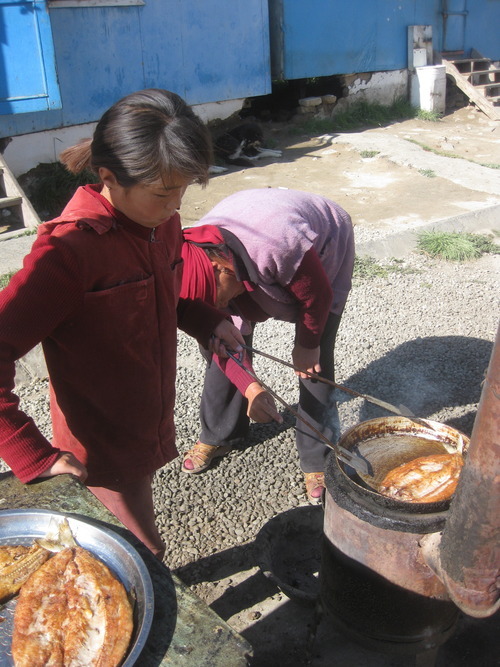
imageNot only can they catch fish, they can cook ‘em too

The U.S. is here doing development work because we can afford to be. We have the capital. But that doesn’t mean we have all the answers.

We spend billions of dollars trying to implement policies created in a different culture and different context, and the world is littered with the skeletons of failed projects ranging from the benignly obscure to the disastrously infamous. I won’t deny some of the incredible advances in quality of care for people living with HIV or inroads into better crop irrigation, as examples. But we need to be spending a lot more time and money supporting the solutions that are being created “by the people for the people” within the cultures and nations we try to serve.

We say, “Let me teach you how to fish,” but really we’re saying, “Let me teach you how I would fish.” We still miss the mark in this well-intentioned proverb.

So what are we doing here? If people are meant to simply use their own methods and do their own work, can’t they do that without us?

In a large part, yes. Peoples around the world should be free to choose how they live, work, and solve their own problems. Therefore we should go abroad not to implement our methods but to make human connections and come along side people to support and encourage—more like a fishing buddy than a fishing instructor. Yet this is not well received by the people who control the dollars because it cannot be tallied or counted like the number of fish distributed or fishing lessons taught. “Sure the stories are great,” they say, “but show us the results.” But how do you clearly measure the effect of believing in someone? What’s the quotient for consistently showing up in a child’s life? How do you put numbers on relationships? These are the things that won’t make it to a spreadsheet or statistical report, yet they are the things that are making a difference.

So don’t give a man a fish. Don’t even teach him how because he probably already knows. Instead, strive to make a lot of fishing buddies and see if that doesn’t just change the world.

Delegate

Bread

  • ½ kilo of flour
  • 150 mL of water
  • 1 Tbs sugar
  • ½ Tbs salt
  • 1 Tbs oil
  • 2 Tbs yeast

Put flour in large bowl. Make a well. Stir in all ingredients with water. Work in flour. Add additional 150 mL water, work in. Flour bowl. Cover by heat 30-60 min. Punch down, flour again. Bake in oven. You didn’t forget the yeast again, right?

My baking has improved. It’s incredible what a little help from Jamie Oliver can do. (Don’t tell Peace Corps I’m using a Brit’s recipe.) I’m learning to put all the ingredients together in just the right ways and let them work their own magic.

I was talking with my Grandparents on the phone this past weekend, telling them about the different projects I have going this semester and how classes have started. I’ve started to get a handle on how to delegate, which is amazing since it’s something I should have come in being able to do. We’re inundated from Day 1 with words like “sustainability,” “skill transfer,” and “capacity building.” Every era has its code phrases—you know, the ones you want to list on your grant applications for high visibility—and these are the ones that we’re immersed in even before we meet the culture. Delegation would seem to be step one in these code-word endeavors, yet there are several things that make delegating difficult.

It is really tempting to want to do everything yourself. When you do something on your own, you don’t have to try and explain it to anyone—in English that is, much less another language—nor do you need to depend on someone who might not come through with their end of the job. When you work by yourself, you’re the boss, middle management and common laborer and no part of the vision gets lost in translation. (Figuratively and literally.) Delegation can also be difficult because sometimes you assign tasks to people who don’t care about the project at all. And then there’s the amount of time to consider. If you delegate work out to someone, it might take a week for the task to get done when you could have done it in an afternoon.

This all might seem like a waste of time at first, but in the long run you are going to be able to accomplish not only a lot more in terms of volume but in efficacy of your projects as well. There are two things at work here: felt need and ownership. On some level delegating can seem like “kindly forcing” but when done correctly the delegator should be a catalyst for already existing potential energy.

First do your homework. The Peace Corps calls this “Participatory Analysis for Community Action” which is a complicated way of saying, “Ask a lot of questions.” Who are the movers and shakers in the community? If you’re doing a project at the school, what’s their calendar like for the year? Are there times where people will be on vacation? Harvesting potatoes? How is the community physically laid out? Can mothers get their children to the proposed kindergarten and pick them up again? What are the priorities? Does anyone even care if the volleyball court falls apart? This is how you discover what the members of the community want to do, not what you think it needs after your initial bleeding-heart dash through the neighborhood.

If you set this up correctly it will be much easier for the community to take ownership over the project. I used to say, “Oh, I’ll do that, don’t worry about it.” But then I would end up with a business plan in English and an owner who couldn’t read it, or a teacher who couldn’t check her e-mail account because I was gone on vacation. Spend the extra agonizing hours helping your counterpart double click icons and type in her password and I’m telling you, it’s going to pay off. Not only will you be able to say, “Hey, can you check on that e-mail?” and it will be taken care of, but after you leave she’s going to keep doing it on her own for her own purposes.

Which is the entire purpose and point of our existence as Peace Corps Volunteers. We fall out of a plane, wander around in the woods for awhile, then barely after finding our bearings are spotted and pulled back home. Two years can seem like a lifetime, but when compared to the actual lifetime of the people we serve, it becomes a brief window in which to get anything done.

That “anything” turns out to be not what projects you can lay claim to after you’re gone, but the skills your counterparts gained, the knowledge your students gleaned, the confidence of leaders, and all their own personal successes that will give them a better chance at actualizing their own dreams.

“It’s like leavening bread,” my grandpa said over the phone, “All the ingredients are there. You just have to make it rise.”