pcv

Live in priorities, not schedules

How are those New Year’s resolutions going?

Mine are going great! The secret to making your resolutions last into February is to not make them until Jan. 31st. (My secret’s up.)

New Year’s resolution time is always very exciting for me because I really like lists. I have all kinds of them taped to my wall, saved on my computer, jotted down in the notebook I carry in my pocket and on sticky notes on my desk. I love shopping lists, packing lists, and to-do lists—I love them all! But the lists I love the most have to do with future plans. I love brainstorming career paths, degree programs and grad schools. I love new teaching semesters because I get to schedule out my week in neat little tables. And I love making plans for my day. The problem is, my future doesn’t take orders very well.
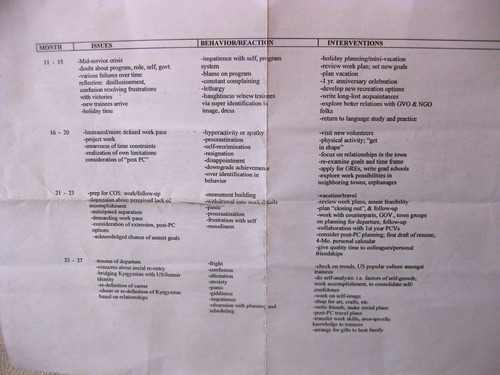
imageOh joy! A list identifying and intervening on my Peace Corps induced problems!

I’ve complained up and down during Peace Corps service about things not going to plan, time being wasted, and unexpected things popping up for a year and a half and yet, until the middle of my second year I still had a detailed schedule hanging on my wall of everything I would be doing each hour of the day.

6:00am               Wake

6:00-7:00          Fire & Breakfast

Boil water, put on work clothes, headlamp, take out ashes, bathroom, get bucket of sheep poop, light fire, monkey with it, reboil water, wash, eat breakfast, monkey with fire again

7:00-7:30           Scripture, Prayer & Journaling

7:30-8:30           Get ready for the day

Brush teeth, dishes, straighten, food prep, empty water bucket, pack bag, restoke fire, get dressed, short phone calls

8:35                   Out the door

9:00-3:00         Work in all its unpredictable glory

Classes, clubs, lesson planning, project work

3:30pm             Arrive home

3:30-4:30         Light fire, eat, exercise.

4:30-5:30         Study Kyrgyz

5:30-6:15         Nap or writing or guitar

6:15-6:30         Prepare bag for evening. Print, etc.

6:30                  Leave house

6:45-8:45         Work and drink tea

8:45                  Excuse myself. Thanks for the evening!

9:00                  Arrive home, stoke stove

9:15-9:45         Scripture, type day’s reflections

9:45-10:00      Bathroom, straighten, brush teeth, eye drops

10:00               Lights out

I don’t think I ever followed this for a single day.

It was completely unrealistic to think I could keep a schedule when there are so many variables and unforeseen hiccups and other people’s schedules to deal with. Or their lack of schedules to be more precise. If I were to keep a schedule it would be better to look something like this:

Sometime in the morning:      Wake up

Day time:                               Do some things

Evening:                                 Potentially back at own home

Night:                                    Sleeping of some sort

Though I might be getting a little too detailed with that Evening slot.

The fact of the matter is, it’s a bad idea to live in schedules because you’re never going to get everything done, and this can be frustrating and disheartening. There will always be un-ticked boxes and line items that get carried over for another day (week, month). Yet—there are still really important things on that schedule that need to be accomplished. So how is this done?

As always, it can be solved with another list:

My priorities

1. God – hang out time with Jesus, scripture, journaling, showing people grace

2. Lay down—Get up schedule

3. Dialing America and other volunteers

4. School – classes, lessons, clubs, teacher trainings

5. Project work

6. Kyrgyz study

7. Writing

8. Reading

9. Hanging out with friends

10. Chores

11. Travel

12. Everything else

Live in priorities. This way, when you lose your way along the crazy twists and turns that each day takes, you can pull out your priority guide for direction. It won’t always be perfect because—hey—the world is not a perfect place, filled with both disappointing detours and serendipitous scenic routes. Yet, if you resolve to live in your priorities, you will always know that what you’re doing lines up with your deepest beliefs and desires. And that’s a resolution worth keeping.

The government loves acronyms

PCV1:  Dude, have you checked out the PCTs?

PCV2:  Yeah man, that one SOCD? I mean, SCD now – Rockin’.

PCV1:  Which one?

PCV2:  The one with the crazy LCF.

PCV1:  Eh, the SCD’s ok – the HE’s better.

PCV2:  Too bad we’re not PCVTs…

PCV1:  Hey, did you get your SPA?

PCV2:  No. Stupid SPA rep’s got it out for me.

PCV1:  You should just do a PCPP – a lot easier, you know.

PCV2:  I might throw it at VAST and see what happens. Oh! Did you hear who ET’d?

PCV1:  No!

PCV2:  That K-20 who didn’t send BAS to the DO and the SSC flipped out. The CD started AS but she didn’t want to deal.

PCV1:  VAC should say something.

PCV2:  You going to see your PM at PST?

PCV1:  Naw, I still haven’t done the VRF… But I might have to see the PCMC for some Cipro. I popped ‘em all last week.

PCV2:  Rough, man.

Was this a Peace Corps conversation? Or secret code in some shadier dealing?

If you’re in the application process to become a volunteer, you’ve probably already run into some of these abbreviations. Many of the Peace Corps publications include a list of acronyms or initialisms on the opening page so you’re not lost after the first sentence. There was even a special session during our Pre-Service Training explaining some of the more common ones. I was like, “If we have to spend all this time sorting out abbreviations, is shortening our phrases actually saving us any time?” The inevitable “huh?” that comes up in these conversations coupled with the explanation can end up taking several times longer than just saying the original phrase.

imageThis message is going in the T-R-A-S-H

And then there are the conversations that get sidetracked because no one really knows what the acronym stands for.

“Hey, the PCMO—”

“No, she’s the PCMC now.”

“What does that mean?”

“I don’t know…Peace Corps Manager of Care?”

“No dude, the M still means Medical. I think she’s a Choreographer or something.”

“That doesn’t even make any sense.”

So far in my volunteer service for the government I’ve learned enough acronyms to fill a pallet of alphabet soup. It wouldn’t surprise me in the least if I learned the government has a federal bureau of abbreviations. Or in their love language, the FBA.

It’s impossible to avoid relationship

Note I didn’t say “a” relationship. I find those quite easy to avoid. Or maybe they’re avoiding me. Either way I don’t have one. The irony here is that all the ones I’m not looking for seem to be the ones that find me.

I recently moved into a little 3-roomed house in my village. The hope was to escape the constant obligations that come with being in close proximity to other humans. If that makes me a misanthrope, then I may indeed be one, albeit a misanthrope who needs people. I’m that kind of guy who will never invite anyone anywhere or even dial a number, but will sit in his cold, dark room in the fetal position, rocking back and forth, wondering why nobody is hanging out with him.

This has worked perfectly for me in Kyrgyzstan because people are continually asking for me to be around; whether it’s to work on a project, help a student prepare for a contest, eat dinner, slaughter a sheep, drink champagne, search for Yellow Tree or anything else on God’s brown earth.

Since I’m frequented with these types of interactions so often, there were several occasions, mostly early on, where I would meet someone, strike up a conversation and then promptly put them out of my mind forever. Or others I would get to know, criticize highly and then brush off my hands knowing I would never see them again.

The problem was, they kept showing up.

imageSeparated at birth

“Uh, what’s your name again, person I spent an entire weekend with and helped celebrate your birthday and who allowed me to crash at your parents’ house and who lists me as a good friend on Facebook?”

“Oh, haha, yeah, that thing I said, the one meant to be behind your back…I, uh…sorry.”

Talk about a lesson in humility.

When you first make a connection with someone, whether it’s a simple ‘hi,’ or a week together on a mutual trip, you have begun a relationship that will last forever. You don’t know when or where or how you’ll see them again, and maybe you never will, but that doesn’t mean the relationship has ended. So be civil when meeting, honest when getting to know someone, kind towards one another always, and maybe for good measure, try to remember their name. You’re in this for the long haul.

See people as people

If you haven’t yet read the book, Kabul Beauty School, pick up a copy this week. It should be required reading for any Peace Corps Volunteer or development worker living abroad.

In this true narrative, Deborah Rodriguez, known in her beauty salon as Crazy Deb, volunteers for temporary disaster relief in Afghanistan. After arriving with a group of health professionals, Deb starts to question why she, a hair stylist, was put with this group. Not feeling capable of contributing to the plans for clinics and medical care, she ventures out of the compound to make friends with local people. Her honest and sometimes brash interactions with Afghans gets her in trouble initially with her organization but allows her to form deep, lasting friendships with people. This ultimately leads to her launching and managing a beauty school in Kabul, the first since the topple of the Taliban, giving graduating students income for their families and hope for the future.

In a revealing episode early on, Deb is walking with her friend Roshanna looking at all the different people in the streets of Kabul. She starts to ask who these different people are and Roshanna tells her some are Uzbek, Tajik or Nuristani and some are Pashtun like herself. Deb thinks this is odd because she had always thought of Roshanna and everyone else as simply Afghan.

In the book Deb’s heart for all people in Afghanistan burns brightly through the audacious and bold ways she loves people practically, both in her friendships and in her work. Crazy Deb sees people as people.

I grew up in St. Paul, MN going to an elementary school with a large African-American and Hmong population of students. Now, I am a white, blonde-haired, blue-eyed, boy of Norwegian decent who grew up eating lefse and hot dish. Our family was not exactly a veritable United Nations; however, my school was quite a bit more diverse. I remember as a kindergartener walking to school in the morning holding hands with whomever and never thinking once about the color of his or her hand. Then one day all of that changed.

We were sitting in the corner of our kindergarten room on the carpet having a little discussion with our teacher on being clean; washing our hands, brushing our teeth, those kinds of things. The teacher asked, “What would happen if you never took a bath?” I thought about this—how if you didn’t bathe after playing outside, you would have dirt on you and eventually you would get blacker and blacker with dirt, and so I raised my hand and said innocently, “You would be a black person.”

The teacher snapped.

“Black people have pigment in their skin!” She shouted, “You would not be like a black person. That is a horrible thing to say.”

That day I learned to fear the topic of race, my ears burning with shame as I wondered why different colors made my teacher so angry.

Our education continued throughout those elementary years with more conversations about different people and different cultures. As a white, middle-America boy, those conversations always came with the caveat that I “need to be careful to treat minorities as equal.”

“Treat everyone equal now, especially people who are different than you.” Even at that young age I can remember thinking, “Since we are already equal, why do I have to be so careful to treat them equally?” I learned to see people who looked different than me as different, and though I couldn’t put it into words at the time, it always bothered me.

There is a problem when our cultural education goes so far that we end up focusing on our differences instead of what binds us together as humans.

This can happen with development workers too, who, for very practical reasons receive cultural training in order to be effective within a culture. But sometimes the well-intentioned efforts to be sensitive keep us from focusing on the human level which is the only place where one can truly reach another human being.

I’m not saying unique cultural differences should be forgotten; we should celebrate who we are and who our forefathers were because this can bring us great joy and identity. What I am saying is that we’ve become much too sensitive which has resulted in an emphasis on the differences. This ultimately creates more division as we define people by their culture rather than their humanity.

Today, in the United States, is Martin Luther King, Jr. Day. We share a name, Luther, given to each of us in honor of Martin Luther, the great reformer of five centuries past. Martin Luther fought for the truth that we are all loved by our creator, and from this truth Martin Luther King, Jr. fought for justice amidst the horrendous segregation and discrimination pervasive in his day.

In our day, we still haven’t yet realized a world where freedom rings from every mountaintop. It is my hope and prayer that each day we would proclaim this by the way we treat people—as people. Then maybe some day the dream will come true, where we can walk hand in hand, not because we’ve forgotten what color we are, but because we are defined by our common brotherhood.

imageHow will you help realize the dream?

Expect the unexpected

A project I’d like to start sometime is waking up in the morning and listing all the things I’m going to do that day, then at night making a second list of all the things I actually did and contrast the two lists. A short reading of the morning and evening entries would look like I’m living two parallel lives with geography being the only bridge between them. Allow me to indulge:

—-

SATURDAY

Morning Entry

10am – I’m awake. *yay.

11am – fire has been lit with extra sheep poop added

12am – finishing leisurely brunch while browsing discgolfer magazine

Evening Entry

9am – woken by my neighbor friend’s second cousin calling me to come outside *vague ideas of strangling someone

10am – trudging out of village in search of “Yellow Tree” so that we can strip its bark and boil it to make medicine for neighbor friend’s niece who has Hepatitis A

11am – watching an old shepherd scratch in the snow a map of where to find Yellow Tree who then decides to show us the way himself and leaves his cow in the care of a fellow neighbor

12am – getting stabbed in the hands by inch long thorns while breaking apart the freshly uncovered Yellow Tree which has turned out to be a bush. *rah.

—-

imageAlways expect disc golf

It’s a cliché title, but it couldn’t be more accurate. I often find myself saying that today is “unusual like usual.” This is where flexibility comes in.

I’m not talking physical flexibility, though that also comes in quite handy when the 40th person stuffs herself into the 17-passenger van you’re riding or when you’re chasing two sheep that escaped your host dad’s flock down a mountainside. I’ve been attending the women’s club yoga sessions for that. (Strictly for flexibility reasons, I swear.)

What we’re talking here is the ability to adapt, change, bend, and stretch out of your comfort zone so that the next time you can stretch a little bit further. There are always going to be situations that you don’t want to be in but simply have to get through with sanity attached.

Sometimes it comes loose. Sometimes you flip out and yell at the man who’s calling at you, “America! America!” Sometimes you lock yourself in your room all day eating clif bars for breakfast, lunch and dinner.

Sometimes you come out.

But be warned. There’s just no telling how far you may have to walk for what kind of colored tree covered with who-knows how many thorns. At least it’ll be expected.