peace corps

Spying on sheep: The diplomacy of a Peace Corps ‘foreign agent’

In recent legislative news here in Central Asia, Kyrgyzstan is proving that once again, life in a former Soviet Republic truly is stranger than fiction. In a country where I’m still asked about once a month if I’m a spy, it’s necessary to discover ways to traverse these conversations.

For my Internet friends: I am not a spy. (Just what you’d expect a spy to say, I suppose.) But I can do better than that. Here’s how I usually handle it:

New acquaintance: Are you a spy?

Me: Yes. Yes, I am a spy. A shepherd spy to be specific. I’m out here in the village to count sheep. How many sheep do you have?

Agent ShepherdAgent Shepherd, busy at work

There is a combined total of zero points of useful intelligence out where I live and though I’m sure the Ambassador would drop everything if I were to call her with news of disputes over watering schedules for local gardens, I think national security and development holds the trump. This question is usually asked of me a bit tongue-in-cheek anyway, so it’s ok to have a little laugh.

Access CampI’ve always been quite good at keeping under the radar

Other than the sticky situations that arise from pushing a ‘foreign agenda’ of peace and friendship upon the people of Kyrgyzstan while indoctrinating their children with a working knowledge of English, there are other kinds of conversations that require the same delicate step and well placed word. As a “grassroots diplomat,” I’ve developed five basic strategies for diplomatically dealing with the more hairy situations:

1) Feign ignorance

This is usually not very difficult since most of the time I don’t have to feign. I’m just straight up ignorant. But for those situations or conversations I would like to get out of, I try to either look really confused or give answers that have nothing to do with the question.

Man on street: Hey, we’re headed up to the mountain—you think you could spare a hundred som—you know, for just a wee bottle.

Me: Yes, I have 2 sisters.

Man on street: No, we’re headed up to the mountain see, and just to celebrate, it being spring and all, and you do want to be respectful of us and so forth…

Me: Thirty.

Man on street: Huh?

Me: I’m thirty years old. Your mountains are very beautiful. I like to play Frisbee.

Man on street: Alright, take care now, we’ll see you around, Luther.

2) Make a joke

Older man: You can marry my daughter. We will have American in-laws.

Me: I can’t marry your daughter because I don’t own any sheep for the bridal gift.

Funny and, sadly true. (Though I’ve been keeping my secret agent eye on a few of the more ‘suspicious’ ones.)

3) Be profusely grateful

Host: Drink the vodka!

Me: Thank you! (Leaves vodka on table.)

Host: No, I mean, drink—you should drink.

Me: I am so grateful for your hospitality! (Smiles like an idiot and looks around room.)

Host: But…the vodka…

Me: You are so generous! Thank you deeply from my heart! (Continues to ignore vodka and shoves an entire fistful of raisins in mouth.)

Host:

4) Give a culturally appropriate response

Neighbor: Come over to my house for besh barmak for dinner.

Me: Oh, that would be good. God willing. (Smiles, shakes hand and leaves.)

5) Call a spade a spade

I believe in the importance of dealing candidly and directly with important issues, and I don’t shy away from engaging others in conversation when the greater good of our community or the future of Kyrgyzstan is at stake. Simply laughing off bigotry, laziness or abuse is a sin in of itself. (Though showing these stances to be ridiculous by bringing them to their logical conclusions like the article above can sometimes be effective.) The trick is to be able to respond with the appropriate level of gravity without creating enemies. This balance is exceptionally difficult to strike, especially given the fact that ideological differences can sometimes preclude any chance of friendly relations.

Sometimes creating enemies is unavoidable and therefore the right thing to do. I believe when it comes to the topics of justice and a fair shot at opportunity we shouldn’t compromise. Still, we have a wide array of possible choices of discourse and should always weigh carefully the cultural implications, choose responsibly and act with discretion. If that makes me deserving of the title, ‘foreign agent,’ so be it. Those sheep had it coming to them anyway.

Failure must be an option

I jingled the keys in my pocket. It was 8 minutes past the bell and I was still waiting for the first student to show up. A minute later one of my girls shuffled in. She was the only one in her class who had showed up to school that day, and wondered if she could just go home. I thought about the possibility of an early lunch, and sent her on her way.

Unfortunately this is an all too common experience in village schools. Attendance is abysmal in the fall because many students are helping with harvests, terrible in winter because the school is freezing and many catch colds, and bad in spring due to various tests, holidays, and sending animals off to the summer pasture. But the biggest reason why kids aren’t in class is because nothing is really expected of them.

If students come to class or not, they will get a diploma. No questions asked. It doesn’t take a PhD in psychology to realize that under these circumstances most junior and seniors simply aren’t going to show up. Senioritis hits hard anywhere; if I had known 12 years ago that I could have skipped the entire month of May and still gotten my same GPA and diploma, I would have been a much better golfer that summer.

There are schools in Kyrgyzstan where administrative leadership and control is working well. One of my friends described her school days as orderly and quite strict with real consequences for not coming to school or not doing homework. If you were late, you had to run 3 laps around the school yard. If you didn’t do your homework, your parents were contacted. If you didn’t show up, you had to go around to every teacher the next day and explain why you weren’t there, take whatever verbal punishment was coming to you, and then do the homework anyway. Students were responsible for their actions.

 Epic signage fail…Tho you do have to give them credit for trying.
Sometimes letting someone fail is the best thing you can do for them. Always allowing people to pass right through life with the belief that what they do has no bearing on their outcome leads to disastrous results.

Additionally, you need to make sure the relationship between a student’s action and his or her failure is made clear. It can’t be arbitrary and it can’t be outside of their direct control. As an example, one of our seventh grade students was having some participation issues and so we assigned him a low grade for the day. When he complained about it I made the effort to explain to him: “Choose to screw around and you will get a D for this class. But also, you can still turn it around. If you consistently show up, with your homework done and work until the bell rings, you can still get an A for the quarter. It is your own choice. You will choose what grade you receive.”

The next time we had class he worked diligently, without disrupting other students, and even presented his written work in front of his classmates at the end of the activity. I was really proud of him and made the point of praising his efforts and announcing to the class his “A” for the day. (A culturally appropriate move.) The relationship between action and consequence—both positive and negative—must be clearly seen by the student and strictly followed through by the teacher.

Without the possibility of failure, it’s difficult to define success. When we take away the possibility of failure, nobody learns to appreciate what incredible heights of success they can reach. This teaches students to be satisfied with the mediocre and chalk their lack of achievement up to dumb luck or blind fate. If Kyrgyzstan is to see real improvements in development, this is the kind of “option” we truly need to eliminate.

Pickles aren’t magic

I’ve always been a fan of pickles. Dill pickles, to be specific. Pickles on a stick at the Minnesota State Fair, blue ribbon baby dills, extra pickles on my Chick-fil-A sandwich, pickles in a bloody mary (I eat the pickle and toss the rest out because, ew, tomato juice! *shudder), pickles sliced and pickles diced and mixed with miracle whip. Mmmm…pickles.

When I was little, aka up until last summer, I thought pickles were magic. How did pickles grow? On trees? In salt water near the coasts? And why were they so delicious? Now, that child-like wonder has been shattered. It turns out they’re not magic at all. It’s just cucumbers plus vinegar and time. (And not the homophonic spice.)

Vinegar’s good in its own right, I guess, but really pickles? I thought you were special. I thought you had something no other delicious condiment carried, something that would ignite the wonder in my soft and supple brain.

That innocent youth was shattered last summer when Nazgul invited me to do some canning with her.

image

 Can you can? Nazgul can can.

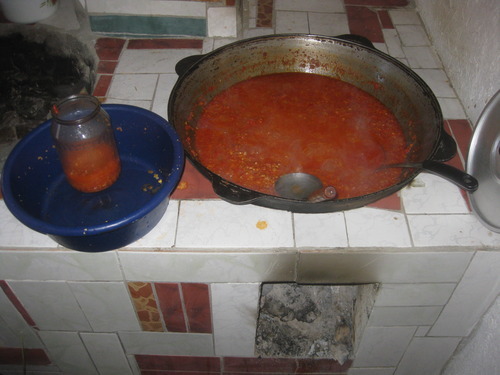
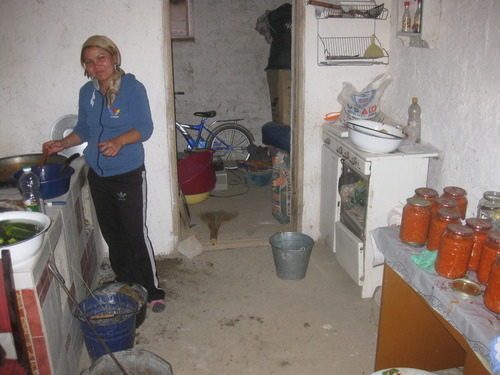
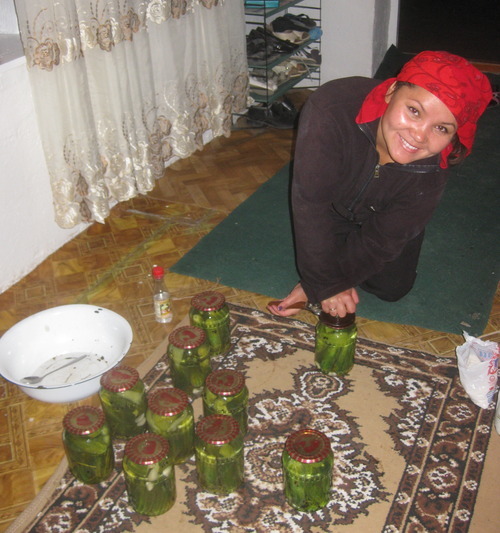
We ground tomatoes, peppers, carrots and garlic until their juices ran off the table and onto the floor. We chopped onions until no more tears could fall. We lit a fire and steamed the jars and simmered the sauce until we had 12 quarts of winter salad and 13 jars worth of pickles. The canned vegetable stuff I got. The pickles were just too simple to comprehend. All you do is put some cucumbers and some dill in a jar, pour in a spoon of sugar and a spoon of salt and a spoon of concentrated vinegar, fill with water and then seal. That’s it. The only thing left to do is wait. It’s one of the most disappointing lessons I’ve learned in the Peace Corps.

It’s now May and all my pickles are gone. My last two jars I shared with the ladies who came to our village English teaching methodology training we hosted. The other jars had served me well over the winter, in those desperately cold and God-forsaken months where the closest available thing to a vegetable was the sole of my shoe that was falling off. (It needed more dill.)

Peace Corps—you opened this kid’s eyes to all kinds of wonder and amazement, but did you really have to steal one from me?

And then I put on my favorite movie soundtrack, Happy Gilmore, and Pilot takes me home…..

“Oh oh oh it’s magic!!! You know….never believe it’s not so!….”

image

image

image

image

Don’t complain, take the pain

One of my favorite little scenes from The Simpsons is when Marge and Homer leave the kids in the care of Abe, the grandpa, to go out on a date. In the few hours they are gone, CPS stops by to discover “horrid” living conditions due to a series of unfortunate events and takes the kids. When Marge arrives home and discovers this, she confronts Grandpa:

Marge: We leave you the kids for three hours and the county takes them away?!

Grandpa: Oh, bitch, bitch, bitch!

Marge had quite the legitimate reason to bitch, if her words can be called that. Much more often I find myself bitching and moaning and nagging and complaining about the circumstances that surround me with very little reason to do so. I do it because I’ve been slighted or because things aren’t going my way, or because I’m upset by the ways things in Kyrgyzstan operate differently than I’m used to.

The truth is, there’s always a better way out than bitching about it.

Complaining is very little in the way of constructive progress. It might be ok for a moment or two, and it can even work as a good stress reliever if done in a safe environment, for example to a close friend who knows it’s his or her purpose for a short while to listen, or to a notebook which will except every expletive and take the punctuated abuse with grace and unwavering support. (Thank you, sweet pages.)

The better way is to bounce back and push in a new direction, to open a yet untried door. If you’ve arrived at a point where you’ve encountered enough trouble and opposition where you’re constantly complaining, it probably means that you’re going the wrong direction.

For me, I’ve often found that that direction is the path of least resistance. I want things to come to me. I want the world to roll on, straight and true without me having to put in a lot of work and commitment. So when I find things not going my way, I complain about it.

image Grumpiness is apparently not a very flattering look

Life is full of all kinds of things that are unpleasant, yet must be done. In the Peace Corps it could be trying to get a counterpart to adapt a particular teaching methodology, or washing all your laundry by hand, or attending to a long list of e-mails that have piled up while you were off the grid for a week. These are some of mine, and each person is going to have his or her own painful tasks that simply must be done yet get put off indefinitely until the pain eats away at enough of your joy where your hollow shell of a body somehow kicks into gear and does a half-ass job.

Whew.

A recent “tool” I’ve discovered is the strategy put forth by Phil Stutz and Barry Michels in their appropriately titled book The Tools. For this particular tool, instead of fleeing from the pain of diligent work, you embrace it. As you think about the difficult task ahead, you silently scream, “Bring on the pain!” Then, as you begin to work, answer an e-mail, make a phone call or whatever it is, you silently scream, “I love pain!” Then, as you are pushing through the task you quietly shout at the top of your lungs, “Pain sets me free!”

No, it’s not some kind of self-flagellation. It’s a straight shooting acknowledgement of the truth. Self-discipline, like any discipline, is inherently painful. It’s no fun to have to do stuff you don’t want to do. Your body is going to resist it and will tell you it’s in agony over being forced to do something it doesn’t want.

This tool very helpful when facing an undesirable task or when in an undesirable position. You learn to recognize it for what it is, as undesirable and inherently painful, and then go into it with eyes wide open knowing you’re not going to like it. But then, something strange happens. As your body gets to work, suddenly you find that you like getting things accomplished. That the knowledge of completing the undesirable task feels so much better than all the brooding and avoiding you were doing before you started. And then, when you break free on the other side, you find that the pain has set you free indeed.

So I give you my word, dear tumblr readers, I’m going to curb the complaints and instead invest that energy into trying new strategies. (Sorry sweet pages of my journal—you’re not off the hook.)

Oh, and some assertiveness, I guess, maybe

I could give you 3 or 4 names of volunteers I serve with who are exceedingly good at being assertive. I could, but I won’t. I won’t because everyone in Kyrgyzstan who reads this already knows who they are, and for everyone else the names wouldn’t mean anything. Let’s just leave it at, they exist, and they make it well known that they do.

This is a good thing. We’ve been invited to work with our counterparts and in our communities in order to effect some kind of change in them for the better, and nothing grows without some considerable change in momentum, namely a swift kick in the rear.

I never want to hurt anyone’s feelings. Or rear. Maybe that’s why it’s taken me so long to figure out some of this leadership stuff. Leaders are hated for decisions they make. But they’re also loved for those same decisions. Leaders nudge, push and stretch the status quo and that is going to make some people uncomfortable.

But it’s never been about being comfortable. It’s about what’s best for the most people. We don’t know what can come of a little painful change until we’ve tried it. The seed cannot produce more fruit unless it first dies.

image My counterpart, Nazgul, kicking butt and taking names at a teacher training

I care less now what people think about me and more what they think about accomplishing a task. There is always culturally relevant tact to be considered, but at the end of the day, taking charge, being responsible and doing the right thing will never go out of style.