peace corps

Can you share some tips about the Peace Corps application process?

Hello Rubyclocks,

Thanks for reading the blog! In the past I’ve answered questions like yours privately, but I think you’re asking great questions, and I know there are more people out there with your same questions about the application and screening process so I’ll post my answer this to the blog. (If that’s ok…like you have a choice, haha—thanks!)

From what I’ve heard there’s been a pretty big overhaul in how people apply. Three and a half years ago when I first sent in my online application, you basically just surrendered yourself to the whims and voodoo science behind the placement of volunteers. There was no choice in where you ended up serving your 2 years. There is a rhyme and reason to this method, namely the Peace Corps wants you to be as flexible and adaptable as possible. Since there will be so many things you will need to adapt to and change for once you begin your service in country, the Peace Corps wants to know they’ve found someone who is committed to serving rather than committed to a particular place. Now, however, it looks like you can apply to specific countries. This is also good I think because it helps to match people’s skills/knowledge/language/interests up with sites. That being said, you are still going to need to be exceedingly flexible and patient and willing to learn, change, bend and grow as a volunteer, no matter where you end up serving.

This is the best thing you can be in order to be a competitive applicant. Show that you are willing to try new things and be comfortable with the unknown and ambiguous situations.

At a minimum you will need a 4 year degree (though certain relevant work experience can also count instead) and 30 hours of volunteer tutoring time to volunteer in the English Education sector. Thirty hours is really very little though, and to be a competitive application you should be volunteering as much as possible, whether that is in after school programs, in literacy, as a coach, in a hospital or any other number of places. Having lots of volunteer experience is a must.

It also helps to have lived in a different culture for an extended period of time and studied a language, and if not, at least time spent getting to know other cultures is important. The best predictor of future success is past success and so if you can show that you are interested to the point where you’ve been putting in the work and investing the time already, that will be a good indicator to the Peace Corps that you are serious and will be a successful volunteer.

If you’re a student, get involved in campus or student organizations that are currently doing things that are helping people around the world. If you can’t find one, start one!

Last general piece of advice is to follow your passions. Don’t do anything just to fill a resume. I did a lot of that when I was younger and I ended up resenting and regretting the kind of things I was doing with my time, because I really didn’t like what I was doing, I only liked the fact that I could say I was doing it. Passion is contagious and if you love what you do, you will naturally attract and motivate others; they will want to come alongside and support your efforts too. The Peace Corps needs all kinds of different people, talents, personalities and experienced volunteers! Even though I’m an education volunteer, I still get to play Frisbee with kids and help a friend startup a small souvenir business – once you get to site you’ll figure out the possibilities and what you’re interested in.

Specifically, stay out of trouble with the law, and stay out of debt. If you have outstanding student loans or credit card debt, you need to have a specific plan in place for how you are going to continue to fulfill those financial obligations while you’re serving for 27 months. Lots of people are able to get student loans deferred, so it’s not a huge worry. (Check out www.peacecorps.gov for more details.) You also can’t have applied to be a CIA agent or have family members working for the CIA…and, if you’re a Peace Corps Volunteer you can never work for the CIA in the future…for all you spies thinking about applying, heh.

There’s also a very lengthy medical clearance process (I can go into more details on that in another post…it’s part of the reason why it took me 17 months between my application and when I arrived in Kyrgyzstan!) so be patient and jump through all the hoops and it will go alright.

Where are you at in school? I’ve been trying to check out your tumblr blog, but my internet out here in the village is so slow, I wasn’t able to open it. Do you still have a couple years left or have you graduated? Why are you interested in education? What made you interested in Peace Corps? Peace Corps loves to use catchy little phrases and one of them is “The toughest job you’ll ever love” but in this case it’s fairly accurate, however, you’re not going to love the tough stuff. You’re going to hate it. And then love other things. And then hate it again. And then hopefully love it again, haha.

Let me know if you have any other specific questions! Best of luck in your application process and love what you do!

Luther

I can’t help you. I’m sorry.

I was an idiot. That’s all I can say, really. I thought the world was brighter, thought the world was a place for only happiness and joy. But the world is broken and its buckled pavement is not meant for smooth rolling, only tripping through the dark.

It’s the eighth rising—the stilted ways in which we pick ourselves back up again to battle on against the ironies and absurdities heaving up through the road.

I dreamed I was a pebble, tumbling along in streams of others, once here, once there until I settled in a little pool and found that everyone trickles on in their own broken streams, now settling into soft earth, now cascading on to open waters across the blue.

I never thought I would settle here. But then I never could have expected any place in particular at 30 years. It’s just where life has gone. I’ve allowed it to take me, allowed myself to fall into the debts I feel I owe the world, pulling me in and covering me in dozens of little eddies of uncommitted obligation.

I’ll try to remember the world was not meant for regret but for fullness, that the only place happiness is found is in chosen joy, joy pulled from the ashes of a tortured and smoldering world, fresh it may seem from the ancient battle for the souls of its newly formed, walking upright, now bent upon the earth.

I’m sorry to everyone I thought needed to rely on me, as if I could provide some kind of saving grace or passageway to a better life. I’m sorry to all those whom I tried to convince that my own life was clinical or pure. If I’ve learned anything in the last two years, it’s that nothing has escaped corruption and vanity covers all, covers me and my little kingdom of swept dirt.

I’m just one drop in this fantastical ocean, broken fully again and again upon massive stones, tossed into the air where brilliant light has shone through every speck of my being, casting a rainbow of colors across the mist of a thousand others, equally broken upon the edges of life.

I’m not alone.

So I’ll climb out of bed. Make a phone call. Throw some discs. Forgive me for trying to be anything other than human. Forgive me for ignoring you, for withholding from you, for demanding to be your only option. I’m just one of many, needing to find my own little hexagonal comb of joy, to snuggle in sweet abandon, resting in the comfort of home, that place where I am known.

Life is raspberry flavored

What’s the flavor of your life? Is it sour like a sugarless glass of lemonade? Or maybe bitter like a dark roast of coffee? Or sweet in the way of a jolly-rancher, sickly grape and then razor sharp as it melts on your tongue?

At some point in Kyrgyzstan’s soviet past, someone proposed that the perfect life is like a raspberry, round and plump, juicy and sweet. Life of a kind that’s plucked from the thorn bush, staining your fingers red and finishing with a perfect balance of flavor as it moves across your tongue. This phrase, “Life is a raspberry” means life is awesome, life is grand, life is wonderful.

But it’s rarely heard these days. Maybe people aren’t finding enough to warm their hearts over. Or maybe they’re not seeking the secret joy that can be found in any circumstance.  Lenin, still holding a tight grip on secret joy

“Yellow! Hey, yellow! Oh, the yellowest of boys—woo! Over here!” I spun around. He was standing next to his taxi, another voice yelling at me, the quintessential looking tourist, as I walked through our region’s city center.

“I’m not yellow,” I thought, “I’m…peach…or…translucent…or heck, I don’t know, but I don’t like being the brunt of jokes when people think I can’t understand.” Tourist season has arrived and soon I’ll be enjoying more stereotypes, and attempts at higher taxi fares and prices at the market. I can choose to react in anger, letting my passion escape in short staccato bursts. Or I could choose to bottle it up and slink away, licking my wounds of resentment.

Life can be faced like this, back stooped and shoulders curled, wrapped around each burden of stress and anxiety as if harboring them in deep waters under your chest. Worry will always be looking for a place to anchor and only needs a hollow cove to come and hide. The secret is to stand tall, shoulders back and chest out as if to dash to pieces any hope worry might have of settling in your soul.

My friend Akmoor and I were on our way to the bazaar to do some shopping.

“Osh City, Osh City, leaving for Osh!” cried one man, leaning over a Honda.

It was always the taxi guys, and for some reason I was feeling a bit devilish.

“Ok, 100 som!” I said cheerfully, offering 10 times less than the going price.

“100 som!? 100 som! How ‘bout I just take you for free? C’mon, I’ll take you all the way to Osh for free!”

“Ok, let’s go Akmoor!” Giggling we started to walk over to the taxi. Now I don’t understand Russian, but the tone bursting from this man spoke volumes.

“У@*#!…Я$!#…Д$!€&….”

We quickly turned and scooted ourselves away from the spittle forming at the corners of his mouth. “Wow, he’s sure got a stick up his butt,” I said in English.

“Stick…huh?” said Akmoor with a quizzical look.

I translated into Kyrgyz and she lost it, doubling over in laughter. We had to keep practicing this new phrase the rest of the way to the bazaar and I kept fielding questions like, “Stick up his butt…can I say stick up her butt?”

“Yes, Akmoor…”

Our taxi driver hadn’t taken it with his shoulders back or chest out. And it could have turned my mood sour like his as well, taken me down a notch, leveled me to the lowest common denominator. But Akmoor’s boisterous merriment simply washed over all that was wrong and lifted me on the giggles of her bubbling joy.

Life is always as good as your reactions. It’s been said 100 ways, but it’s true. There will always be tragedy, frustrations and setbacks but how you respond makes our earthly walk a trek in darkness or a journey to be enjoyed.

Life can be wonderful or life can be dark and I’m not saying everyone has a level playing field. Some suffer tragedy while some seem to sail through life with ease.

But life circumstances have never been a good indicator of happiness or satisfaction. I’ve seen those with high privilege bicker and argue with family members and create bitter enemies, and I know others who have lost a spouse and raised children without so much as a sheep in the yard thrive and grow and bring joy to those around them. Life can be like a raspberry if only one knows how to traverse the thorns.

Unfortunately, there are those who see the thorns as a barbed wall of fate and surrender the fight to the ironic idiosyncrasies of life. There’s an idea in Kyrgyzstan that all of life is fated and if anything good happens at all, it’s the blessing of God.

The puritans and fundamentalists of the first two centuries of America also held these beliefs, that God’s will was supreme and lives were predestined since before the foundations of the earth. But instead of acquiescing to a life outside of their control, they sought to actualize God’s providence by being some of the best workers, entrepreneurs and producers the world has ever seen.

Why? I’m not sure. I find it fascinating that two can respond to the same set of circumstances and belief in fate with diametrically opposite behavior. It seems to be the difference between, “If God wills, it will come to me,” and “If God wills, he won’t stop me.”

I settle up to the table for another meal of bread and vareniye, the jam that graces a Kyrgyzstani’s table at each meal, and ah! there it is: a dish of raspberries, preserved during summer months of plenty for the harsh of winter when no fresh produce can be found. It’s the perfect daily reminder to choose joy in those winter seasons of life and to remember that truly, “Life is a raspberry.”

In celebration of the blooming of spring, I’m posting this cheery photo for all of you of my dad and his friends sporting Kyrgyzstan’s national hat, the kalpak, while out golfing in Arizona.

These hats, as my volunteer friend Dan puts it, “Hold a special place in Kyrgyzstan’s heart and a special place on a Kyrgyz man’s head.” They are the traditional headwear for Kyrgyz men and are still worn by people in the villages and capital alike today. Made from natural sheep felt, kalpaks keep your head warm in winter, cool in summer and looking awesome all year round.

That’s, I guess, some of your beeswax

“How much money do you make?”

“What’s your religion?”

“What are you?”

Are these questions between intimate lovers, or between you and the man who just sat down next to you on the bus? The answer: Well, it depends where you are.

I get into these kinds of conversations all the time. People always seem to ask the exact same questions in the exact same order. It’s not that my Kyrgyz is great but that I’m fantastic at repeating a set of syllabic mumblings over and over again. I can even feel some of these conversations coming on and just hit the auto-pilot on my tongue and let it do the work. It usually begins when I’m standing outside with a man I’ve just met waiting for something. His face gets this look, he turns and spits, and then opens his mouth…

Here it comes.

Local: Are you married?

I friggin’ knew it.

Me: No.

Local: When are you getting married?

Me: I don’t have a girlfriend.

And now for a blank stare and repeating of the question.

Local: … no, I mean, when are you getting married?

(In Kyrgyzstan, men often pick a wedding day first and a bride second.)

Me: Only God knows. Cue the laughter.

Local: (Laughs) Maybe you will take one of our girls back to America? (More smiles)

Me: (Mouths Maybe you will take one of our girls back to America at the exact same time as Local is speaking) We’ll see.


Sometimes I mess with the answers, just to shake the question fatigue.


Local: America is wonderful, yes? Much better than Kyrgyzstan…

Me: No, they’re just different. I like Kyrgyzstan.

Local: But, America, life is so much better there, right?

Me: It depends. Life in Kyrgyzstan can be great.

Local: Ah, but American life must be wonderful.

Me: … Actually, all the streets in America are made of gold. If you get hungry, you can take a shovel and dig up a little bit of the road and go buy yourself a hamburger.

Local: …

Me: …

Local: … (lights cigarette)

I feel like I’m reliving the movie Groundhog Day whenever I have these conversations. They go exactly the same every time, down to the punctuation, and I’m now rolling somewhere in the 300’s of times I’ve been through these.

And it’s not just because I’m a foreigner that I get asked personal questions. My Kyrgyz friends say they too are often asked some of these, and I’ve been on many a mini-bus ride where the young men are asked by the older women if they are married, if yes, how many children they have, etc. It’s just kind of a Kyrgyz thing. Since there are few Kyrgyz people in a small country I suppose it’s a way of figuring out how you know each other, since fun connections do pop up in these conversations almost as a rule. Family relationships and belonging are important here.

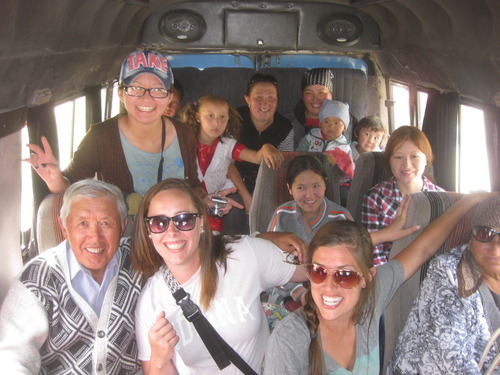
image On the upside, a mini-bus is a great place to make new friends

In America it’s the weather. We’re constantly making pointless observations to strangers about the activity in the sky—or not even the current activity but the potential of it to act a certain way at an unforeseen point in the future.


“Looks like rain.”

“Yep. Glad I have an umbrella.”

“Yep.”


My grandpa is one such exemplary American, always commenting on his thermometer in his mini-van if it gains or loses even a degree. I asked him why people talk about the weather so much. He said, “It’s the one thing we all have in common.”

America, it is said, is the great salad bowl and it can often be difficult to find commonalities between pepper flakes and a slice of tomato. But here in the Peace Corps in Kyrgyzstan, personal questions are the common ground.