Author: Luther

Don’t complain, take the pain

One of my favorite little scenes from The Simpsons is when Marge and Homer leave the kids in the care of Abe, the grandpa, to go out on a date. In the few hours they are gone, CPS stops by to discover “horrid” living conditions due to a series of unfortunate events and takes the kids. When Marge arrives home and discovers this, she confronts Grandpa:

Marge: We leave you the kids for three hours and the county takes them away?!

Grandpa: Oh, bitch, bitch, bitch!

Marge had quite the legitimate reason to bitch, if her words can be called that. Much more often I find myself bitching and moaning and nagging and complaining about the circumstances that surround me with very little reason to do so. I do it because I’ve been slighted or because things aren’t going my way, or because I’m upset by the ways things in Kyrgyzstan operate differently than I’m used to.

The truth is, there’s always a better way out than bitching about it.

Complaining is very little in the way of constructive progress. It might be ok for a moment or two, and it can even work as a good stress reliever if done in a safe environment, for example to a close friend who knows it’s his or her purpose for a short while to listen, or to a notebook which will except every expletive and take the punctuated abuse with grace and unwavering support. (Thank you, sweet pages.)

The better way is to bounce back and push in a new direction, to open a yet untried door. If you’ve arrived at a point where you’ve encountered enough trouble and opposition where you’re constantly complaining, it probably means that you’re going the wrong direction.

For me, I’ve often found that that direction is the path of least resistance. I want things to come to me. I want the world to roll on, straight and true without me having to put in a lot of work and commitment. So when I find things not going my way, I complain about it.
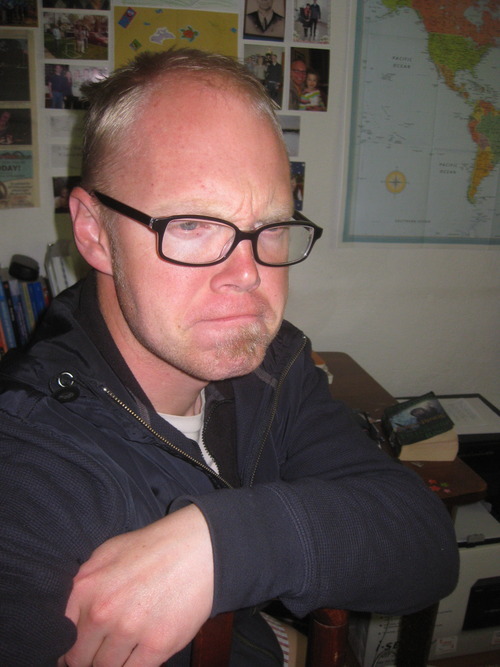
image Grumpiness is apparently not a very flattering look

Life is full of all kinds of things that are unpleasant, yet must be done. In the Peace Corps it could be trying to get a counterpart to adapt a particular teaching methodology, or washing all your laundry by hand, or attending to a long list of e-mails that have piled up while you were off the grid for a week. These are some of mine, and each person is going to have his or her own painful tasks that simply must be done yet get put off indefinitely until the pain eats away at enough of your joy where your hollow shell of a body somehow kicks into gear and does a half-ass job.

Whew.

A recent “tool” I’ve discovered is the strategy put forth by Phil Stutz and Barry Michels in their appropriately titled book The Tools. For this particular tool, instead of fleeing from the pain of diligent work, you embrace it. As you think about the difficult task ahead, you silently scream, “Bring on the pain!” Then, as you begin to work, answer an e-mail, make a phone call or whatever it is, you silently scream, “I love pain!” Then, as you are pushing through the task you quietly shout at the top of your lungs, “Pain sets me free!”

No, it’s not some kind of self-flagellation. It’s a straight shooting acknowledgement of the truth. Self-discipline, like any discipline, is inherently painful. It’s no fun to have to do stuff you don’t want to do. Your body is going to resist it and will tell you it’s in agony over being forced to do something it doesn’t want.

This tool very helpful when facing an undesirable task or when in an undesirable position. You learn to recognize it for what it is, as undesirable and inherently painful, and then go into it with eyes wide open knowing you’re not going to like it. But then, something strange happens. As your body gets to work, suddenly you find that you like getting things accomplished. That the knowledge of completing the undesirable task feels so much better than all the brooding and avoiding you were doing before you started. And then, when you break free on the other side, you find that the pain has set you free indeed.

So I give you my word, dear tumblr readers, I’m going to curb the complaints and instead invest that energy into trying new strategies. (Sorry sweet pages of my journal—you’re not off the hook.)

Oh, and some assertiveness, I guess, maybe

I could give you 3 or 4 names of volunteers I serve with who are exceedingly good at being assertive. I could, but I won’t. I won’t because everyone in Kyrgyzstan who reads this already knows who they are, and for everyone else the names wouldn’t mean anything. Let’s just leave it at, they exist, and they make it well known that they do.

This is a good thing. We’ve been invited to work with our counterparts and in our communities in order to effect some kind of change in them for the better, and nothing grows without some considerable change in momentum, namely a swift kick in the rear.

I never want to hurt anyone’s feelings. Or rear. Maybe that’s why it’s taken me so long to figure out some of this leadership stuff. Leaders are hated for decisions they make. But they’re also loved for those same decisions. Leaders nudge, push and stretch the status quo and that is going to make some people uncomfortable.

But it’s never been about being comfortable. It’s about what’s best for the most people. We don’t know what can come of a little painful change until we’ve tried it. The seed cannot produce more fruit unless it first dies.

image My counterpart, Nazgul, kicking butt and taking names at a teacher training

I care less now what people think about me and more what they think about accomplishing a task. There is always culturally relevant tact to be considered, but at the end of the day, taking charge, being responsible and doing the right thing will never go out of style.

Things don’t always move forward (yet I digress)

There’s a joke by the late Mitch Hedberg that goes something like this: “You ever heard someone say, ‘Hey, wanna see a picture of me when I was younger?’ Every picture of you is when you were younger. I’d like to see a picture of you when you were older. ‘Hey wait a minute—lemme see that camera.’…heh heh, yeah…”

Have you ever looked back on one of those photos—one where you’re younger—and noticed what’s in the background? Most of those things have probably improved since the sepia toned days of your youth. Consider the finned monster of a car you dad was driving, or the crib you’re standing in—you know, the one with the side that opened and closed like a guillotine—or the polyester pants you’re wearing at the July 4th parade, melting onto your thighs.

Yes, we’ve come a long way since those bare-leg-on-vinyl days, when cars guzzled a gallon every 6 miles and kids sat unbuckled in the backseat clutching throat-sized toys doused in lead-based paint. We’re so used to things changing and improving that somehow those words have become synonyms. But in reality, not everywhere experiences forward progress.

image

 Welcome (back) Home

There are many people in Kyrgyzstan who pine for the old Soviet days. While most of life was dictated by a bureaucracy on high, that life held a calming order and sense of security. No one had to wonder where they would find a job or how they were going to feed their family. Teachers were respected and schools were given priority in government budgets. Students flourished in an education system that put the first human in space. People enjoyed leisure time taking effective public transportation through cities and towns dotted with green parks and running water.

Three-and-a-half bouncing hours south from the capital lies my own little Peace Corps village. Its school, constructed just before the breakup of the USSR, was built with every modern convenience. The school boasted multiple networked computer labs for the sciences linked to a central station in each room where the teacher could listen by headphones to individual work or display work on a raised monitor. There was a coal-burning heating plant pumping hot water through a system of radiators to three floors. Each floor had its own bathrooms with flush toilets and running water. The cafeteria served hot lunch for all attending students.

But, shortly after independence, things began to quickly fall apart. The director cut many of the radiator system’s pipes out of the school, installing some in his own home and selling the rest for a personal profit. Along with the heat, the running water went too, when pipes from the nearby spring broke due to lack of maintenance and were dug up to be sold.

The school’s lunch program degenerated into cookies and tea, now served only to grades 1-4 in a 10 minute passing period. Today I trip on old metal tubes in my classroom that ran the wires for the networks, their stubs jutting out, betraying where computers once stood.

A school that once graduated significant contributors to science and math in the USSR is now part of a national education system incapable of producing enough engineers and skilled workers to take their own gold out of their own land, instead relying on foreign companies who reap the majority of the profit. The breakup of the USSR is a macrocosm of all the little systems that soon broke apart as a result.

What infuriates me about all of this is not the fact that things got worse or that there was no longer money to keep things going. This is understandable. What brings my righteous rage to a full boil are the personal choices made by individuals to hurt their own country. Here we are huddled together in school, all winter long, trying to form English words between chattering teeth because the previous director decided he wanted to steal the pipes for his own personal gain. It’s maddening.

But I also need to check my judgment before walking through that door. (Which is really, really difficult to do.) Who is to say I wouldn’t react in the exact same way if all of a sudden the U.S. was to split up into 50 different countries and in the chaos the paychecks stopped, shops closed down and it was every man for himself? If something can be taken advantage of in the face of no oversight and without any chance of falling fate to some ill consequence, many are going to go ahead and do what makes sense for their own personal survival.

Sure independence had been declared, but it wasn’t after a long battle for freedom. Independence was sort of thrust upon Kyrgyzstan after the breakup of the Soviet Union and all of a sudden people needed to figure things out for themselves.

I asked Nazgul, my counterpart, what it was like back when the Motherland collapsed and Kyrgyzstan found itself stepping out on toddler’s legs, blinking into the dawn of independence. “There was no bread,” she said without pause, offering no lofty ideals of freedom or independence nor mention of a nation-state bearing the name of her people. She was only 9 years old at the time; those aren’t the things one notices at that age, but rather a father conspicuously home from work, a hungry belly and the crumbs that line the bottom of the bread basket. “Kyrgyzstanis may be more free,” one man told me, “but you can’t eat freedom.”

image

 Teachers enjoying flatbread with great Kyrgyz poets and thinkers

The task before us is huge. There is so much work to be done. There is a definite need for Peace Corps Volunteers in education, health and business to work with locals to establish right practices and effective methodology. There’s an even bigger need for Kyrgyzstanis to work for their own fellow citizens. We need people willing to invest their time, energy and strengths to build a nation, not place more obstacles in its path.

It’s not that most people are totally complacent. People want more and demonstrate so, but they turn to old desires for authoritative control and to central government for finding solutions to pressing issues. We do need a public system of checks on citizens’ free reign decision making, but corruption continues to eat away at growth. Many people still haven’t worked up the full committal of courage to take these challenges head on and are just beginning to feel their way gingerly out over untested and fragile ground. People must be willing to change, to sidestep culture to a certain degree, to invest money, to make unpopular yet necessary decisions, to put in the hours and to know they have a chance at seeing results commensurate to their level of work. Bit by bit, people are coming around, and more than any other demographic, it’s Kyrgyzstan’s youth leading the charge.

This new generation is at an unprecedented point in history—they are the first to have been born into an independent Kyrgyzstan, a country now responsible for its own future—and are more removed from its soviet past. I’ve worked with groups of youth who dream big but more importantly, have a track record of applying their learning and have logged hours upon hours working for the betterment of their communities.

One such youth attending a goal-setting session stated she would study English three hours every day until she won a spot in a study abroad program to America. I told her I thought maybe that was a bit ambitious and how was she going to balance that with school and other demands at home? She answered that she already studies English three hours a day—after finishing washing the evening meal’s dishes—and this was sort of just a recommitment. Far be it from me to discourage her. She exemplifies the future hope of this nation. This is the way forward.

Kyrgyzstan—may your future be as bright as the sun that blazes upon your flag, high and free.

image

How can I be a competitive Peace Corps Volunteer applicant?

Hello stonecldfox,

It’s no bother! No need to apologize for asking questions. Currently I’m sitting in my house eating a block of cheese and waiting for a local friend to take me to visit other friends in a different village. She said we were leaving almost 2 hours ago, so it looks like my day is going to finish with lots of sitting around… I also need to bake bread, so there’s an activity for the day. (Cheese sandwiches are far superior to just cheese.)

Wow, where are you volunteering? What led you to the decision to take a year off to go do that? Are you just finishing up now, or will you be starting this next year?

I took a semester off the middle of my college years because I had no idea why I was there and couldn’t get myself to do any of the work. After just those few months I did return because sitting in class was better than dealing with Christmas returns at Toys-R-Us. I don’t regret going back because having a 4 year degree is what allowed me to teach in Japan after graduating and then come here to do Peace Corps. But, if I could go back I would have waited longer to figure out why I was in university and just what it was I wanted to study.

I think the short answer to your question is, it doesn’t really matter what you major in. Just do something you really like and are passionate about. Think about how you spend your free time—what are the things you’re doing instead of completing that meta-analysis search for articles on the relationship between percentage of nitrogen in soil and the height of bean plants? (Maybe that is what you’re doing in your free time and if so…cool.) Don’t make university even more of a burden by not caring what you’re studying.

For Peace Corps in specific, your degree with help direct what sector you are placed in. I studied communication and had 2+ years of TEFL experience, so it was obvious that I would teach English. But, if your major is say Psychology, you could potentially end up in health, business or education (or agriculture, youth development or a few other sectors not in Kyrgyzstan). Your Peace Corps recruiter will look at not only your degree but your experience as well for deciding where you will be a great fit. Don’t be afraid to say what you want to do for 2 years of your life and communicate where you think your skills and interests would fit well in your interview.

I should mention again that Peace Corps has just undergone a big overhaul in how they place volunteers and now I think you apply for specific sectors in specific countries.

Remember too that once you get to your site, you will find all kinds of cross-sector projects that need help getting off the ground. You can really get involved in almost anything you like so don’t worry about getting “stuck” doing a specific task you don’t like for 2 years.

For the international experience question, one year is a lot. Recruiters are looking for that kind of experience rather than a three-week vacation in the Bahamas. But then again, it depends on what you do with your time. If you spend a year lying on the beach, it would be better experience to have spent three weeks teaching youth leadership skills at a community organization overseas somewhere. Peace Corps wants to know that you can be flexible, adaptable, open to change and have a willingness to do whatever needs to be done, growing and honing your skills all while integrating into a different culture. Call up a Peace Corps recruiter and ask these questions as well. They will have good advice for you too.

So, it sounds like you’re doing the right things! Keep loving it!

Exercising is apparently good for you

I would say about 90% of the people in the world today are better runners than me. And that’s counting the little tiny infants born this morning. Yeah—that would include you Kaylin. (Eight pound jerk.) Oh, hey, heh, congratulations Steve and Jess!

Last week was the first time in almost four years I exercised 5 days in a row, and I’m enjoying all sorts of benefits not least of which is the super-human ability to poop on consecutive days.

I was inspired by the women of Kyrgyzstan through a health training held last year. (The inspiration had a long incubation period.) I didn’t attend the training myself because, well, they were requiring participants to move and stuff, but I heard those ladies did well. Having made the mistake in the first place of showing up, many were required to jog in a little 5K and several of them did it in healed sandals and you know I wasn’t going to be shown up by that. I just happen to be able to shimmy and shake all up and down the catwalk in stilettos thank you very much.

Along with my previous mentioned feats of awesomeness gained from moving my feet slightly faster than normal, here is a list of other benefits I have observed: (Beat these ladies…)

  • I can now touch my toes (one leg at a time. Let’s not get crazy here.)
  • More people are talking to me when I leave my house (Yes, “Hey! Where are you going?!” still counts.)
  • It’s forcing me to drink more water.
  • (And on a related note) I’m getting more quality alone time in the outhouse.
  • Increased appetite has encouraged me to cook. Anything at all. (Also my bread recipe has begun to be secretly copied by the housewives. Ask Nazgul if you don’t believe me.)
  • It’s a good excuse to wear figure revealing pants in public. (Damn, does my butt look good.)
  • The world seems more bearable. (Note the word “seems.”)
  • It doubles as a fantastic new procrastination device.

All selfie photo attempts of me running ironically turned out blurry so I leave you with a pre-running shot while I was seeing the doctor in Bishkek. (Always consult your doctor before beginning any new exercise routine.)

This is actually part of a new experiment Peace Corps is doing to create a fleet of “Ironman Volunteers.” This new breed won’t ever need to sleep and can run all day, literally, on a diet of sheep butt and borsok alone. But—(clasps mouth)—I’ve said too much.