Humor

Spying on sheep: The diplomacy of a Peace Corps ‘foreign agent’

In recent legislative news here in Central Asia, Kyrgyzstan is proving that once again, life in a former Soviet Republic truly is stranger than fiction. In a country where I’m still asked about once a month if I’m a spy, it’s necessary to discover ways to traverse these conversations.

For my Internet friends: I am not a spy. (Just what you’d expect a spy to say, I suppose.) But I can do better than that. Here’s how I usually handle it:

New acquaintance: Are you a spy?

Me: Yes. Yes, I am a spy. A shepherd spy to be specific. I’m out here in the village to count sheep. How many sheep do you have?

Agent ShepherdAgent Shepherd, busy at work

There is a combined total of zero points of useful intelligence out where I live and though I’m sure the Ambassador would drop everything if I were to call her with news of disputes over watering schedules for local gardens, I think national security and development holds the trump. This question is usually asked of me a bit tongue-in-cheek anyway, so it’s ok to have a little laugh.

Access CampI’ve always been quite good at keeping under the radar

Other than the sticky situations that arise from pushing a ‘foreign agenda’ of peace and friendship upon the people of Kyrgyzstan while indoctrinating their children with a working knowledge of English, there are other kinds of conversations that require the same delicate step and well placed word. As a “grassroots diplomat,” I’ve developed five basic strategies for diplomatically dealing with the more hairy situations:

1) Feign ignorance

This is usually not very difficult since most of the time I don’t have to feign. I’m just straight up ignorant. But for those situations or conversations I would like to get out of, I try to either look really confused or give answers that have nothing to do with the question.

Man on street: Hey, we’re headed up to the mountain—you think you could spare a hundred som—you know, for just a wee bottle.

Me: Yes, I have 2 sisters.

Man on street: No, we’re headed up to the mountain see, and just to celebrate, it being spring and all, and you do want to be respectful of us and so forth…

Me: Thirty.

Man on street: Huh?

Me: I’m thirty years old. Your mountains are very beautiful. I like to play Frisbee.

Man on street: Alright, take care now, we’ll see you around, Luther.

2) Make a joke

Older man: You can marry my daughter. We will have American in-laws.

Me: I can’t marry your daughter because I don’t own any sheep for the bridal gift.

Funny and, sadly true. (Though I’ve been keeping my secret agent eye on a few of the more ‘suspicious’ ones.)

3) Be profusely grateful

Host: Drink the vodka!

Me: Thank you! (Leaves vodka on table.)

Host: No, I mean, drink—you should drink.

Me: I am so grateful for your hospitality! (Smiles like an idiot and looks around room.)

Host: But…the vodka…

Me: You are so generous! Thank you deeply from my heart! (Continues to ignore vodka and shoves an entire fistful of raisins in mouth.)

Host:

4) Give a culturally appropriate response

Neighbor: Come over to my house for besh barmak for dinner.

Me: Oh, that would be good. God willing. (Smiles, shakes hand and leaves.)

5) Call a spade a spade

I believe in the importance of dealing candidly and directly with important issues, and I don’t shy away from engaging others in conversation when the greater good of our community or the future of Kyrgyzstan is at stake. Simply laughing off bigotry, laziness or abuse is a sin in of itself. (Though showing these stances to be ridiculous by bringing them to their logical conclusions like the article above can sometimes be effective.) The trick is to be able to respond with the appropriate level of gravity without creating enemies. This balance is exceptionally difficult to strike, especially given the fact that ideological differences can sometimes preclude any chance of friendly relations.

Sometimes creating enemies is unavoidable and therefore the right thing to do. I believe when it comes to the topics of justice and a fair shot at opportunity we shouldn’t compromise. Still, we have a wide array of possible choices of discourse and should always weigh carefully the cultural implications, choose responsibly and act with discretion. If that makes me deserving of the title, ‘foreign agent,’ so be it. Those sheep had it coming to them anyway.
Pickles aren’t magic

I’ve always been a fan of pickles. Dill pickles, to be specific. Pickles on a stick at the Minnesota State Fair, blue ribbon baby dills, extra pickles on my Chick-fil-A sandwich, pickles in a bloody mary (I eat the pickle and toss the rest out because, ew, tomato juice! *shudder), pickles sliced and pickles diced and mixed with miracle whip. Mmmm…pickles.

When I was little, aka up until last summer, I thought pickles were magic. How did pickles grow? On trees? In salt water near the coasts? And why were they so delicious? Now, that child-like wonder has been shattered. It turns out they’re not magic at all. It’s just cucumbers plus vinegar and time. (And not the homophonic spice.)

Vinegar’s good in its own right, I guess, but really pickles? I thought you were special. I thought you had something no other delicious condiment carried, something that would ignite the wonder in my soft and supple brain.

That innocent youth was shattered last summer when Nazgul invited me to do some canning with her.

image

 Can you can? Nazgul can can.

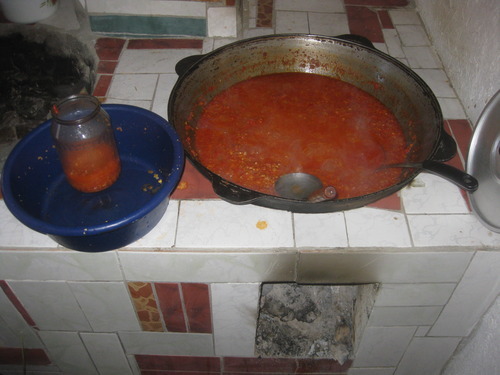
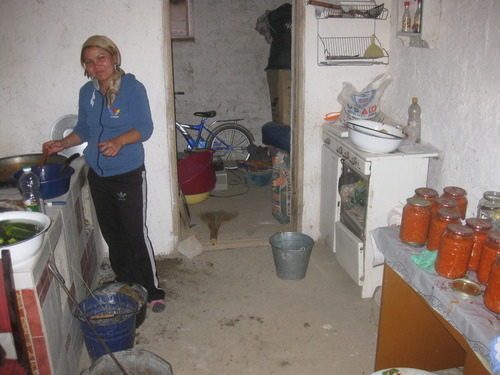
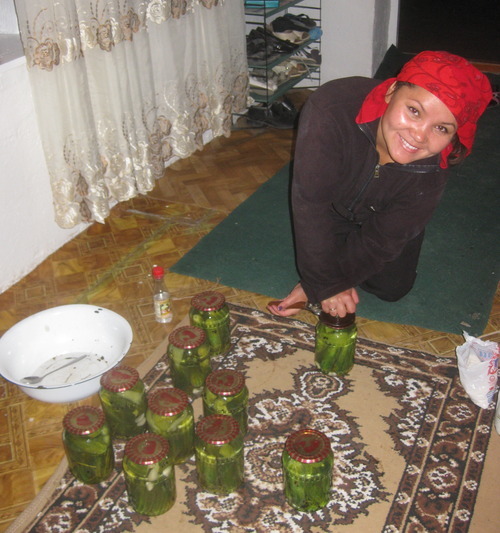
We ground tomatoes, peppers, carrots and garlic until their juices ran off the table and onto the floor. We chopped onions until no more tears could fall. We lit a fire and steamed the jars and simmered the sauce until we had 12 quarts of winter salad and 13 jars worth of pickles. The canned vegetable stuff I got. The pickles were just too simple to comprehend. All you do is put some cucumbers and some dill in a jar, pour in a spoon of sugar and a spoon of salt and a spoon of concentrated vinegar, fill with water and then seal. That’s it. The only thing left to do is wait. It’s one of the most disappointing lessons I’ve learned in the Peace Corps.

It’s now May and all my pickles are gone. My last two jars I shared with the ladies who came to our village English teaching methodology training we hosted. The other jars had served me well over the winter, in those desperately cold and God-forsaken months where the closest available thing to a vegetable was the sole of my shoe that was falling off. (It needed more dill.)

Peace Corps—you opened this kid’s eyes to all kinds of wonder and amazement, but did you really have to steal one from me?

And then I put on my favorite movie soundtrack, Happy Gilmore, and Pilot takes me home…..

“Oh oh oh it’s magic!!! You know….never believe it’s not so!….”

image

image

image

image

Exercising is apparently good for you

I would say about 90% of the people in the world today are better runners than me. And that’s counting the little tiny infants born this morning. Yeah—that would include you Kaylin. (Eight pound jerk.) Oh, hey, heh, congratulations Steve and Jess!

Last week was the first time in almost four years I exercised 5 days in a row, and I’m enjoying all sorts of benefits not least of which is the super-human ability to poop on consecutive days.

I was inspired by the women of Kyrgyzstan through a health training held last year. (The inspiration had a long incubation period.) I didn’t attend the training myself because, well, they were requiring participants to move and stuff, but I heard those ladies did well. Having made the mistake in the first place of showing up, many were required to jog in a little 5K and several of them did it in healed sandals and you know I wasn’t going to be shown up by that. I just happen to be able to shimmy and shake all up and down the catwalk in stilettos thank you very much.

Along with my previous mentioned feats of awesomeness gained from moving my feet slightly faster than normal, here is a list of other benefits I have observed: (Beat these ladies…)

  • I can now touch my toes (one leg at a time. Let’s not get crazy here.)
  • More people are talking to me when I leave my house (Yes, “Hey! Where are you going?!” still counts.)
  • It’s forcing me to drink more water.
  • (And on a related note) I’m getting more quality alone time in the outhouse.
  • Increased appetite has encouraged me to cook. Anything at all. (Also my bread recipe has begun to be secretly copied by the housewives. Ask Nazgul if you don’t believe me.)
  • It’s a good excuse to wear figure revealing pants in public. (Damn, does my butt look good.)
  • The world seems more bearable. (Note the word “seems.”)
  • It doubles as a fantastic new procrastination device.

All selfie photo attempts of me running ironically turned out blurry so I leave you with a pre-running shot while I was seeing the doctor in Bishkek. (Always consult your doctor before beginning any new exercise routine.)

This is actually part of a new experiment Peace Corps is doing to create a fleet of “Ironman Volunteers.” This new breed won’t ever need to sleep and can run all day, literally, on a diet of sheep butt and borsok alone. But—(clasps mouth)—I’ve said too much.

‘Foreign’ is a word we use for things we don’t understand

Almost everything I’ve ever read about Kyrgyzstan has made it seem so foreign. And why not, I suppose; it fits the definition fairly well of being something other than one’s own, and from a general western perspective it is strange and unfamiliar. However, I think this label gets applied more often because so few know even the first thing about this place. How often do we call Australia a foreign country? When an undergrad goes “Down Under” does she proclaim to Facebook she is “off to a foreign land”? No. She just says she’s going to Australia.

Kyrgyzstan’s really not that strange, once you get to know it. That’s the whole point of travel, or it should be anyway—that we go places for understanding and not to draw lines in the sand between what’s “us” and what’s “them.”

This week I’ve been going through the book Shadow of the Silk Road by Colin Thubron. In his book he states he is traveling again through Central Asia for understanding, yet I can’t keep from being shocked by how foreign he makes everything sound through his verbose description. I would assume it’s my problem as the reader since he certainly is introducing a lot of new things. Except…I live here. Take a look at Thubron’s rendering of a meal in Kochkor, Kyrgyzstan, my backyard:

“An hour later I descended the hill to the tent. The lamb’s intestines were swimming in a bowl, and its bloodstained pelt curled on the floor. Twenty men had assembled to feast. They settled in a famished circle, squatting or cross-legged in their hefty boots, I in the place of honour. Their mouths gaped black or flashed gold in hard, burnished faces. Soon they were engorging minced lamb in pudding-like fistfuls, scouring their plates with work-blunted hands, while noodles dribbled from their lips like the whiskers of so many cuttlefish. Their cups filled up with tea, then vodka. They wrenched and gnawed on the bones, picked them white, discarded them, and sucked in the last gravy with a  noise like emptying bathwater. Then they dispersed without a word, or slept.”

If I were writing this part of the journey I would say, “And then we had dinner.” Because that’s what we eat: sheep and noodles. That’s what’s available here and people sit on the floor because no one wants to drag a wooden table and 20 chairs up to a yurt in the mountain. The name of this meal was left out as well: besh barmak which means “five fingers” and gives a pretty good indication that it is to be eaten with the hand and not a fork and knife.

But it’s not as sexy or fun to say, “And then we ate.” No one’s going to pay you to write a travel book that sounds just like life at home.

 Emerging from hibernation, the Minnesotans squint into the sunlight 

So, to show just how funny and ridiculous it can be, let’s take a look at how a Kyrgyz travel writer might describe a typical meal in say, suburban Minnesota, a la Colin Thubron:

An hour later I mounted the steps to the dining hall. The pig’s rump was screeching in a pan, it’s dried out skin flaked in a bag upon the elevated counter. A man with a woman and several offspring were gathered to feast. They stormed the table, some sitting in plastic butt-shaped booths to extend their reach. I was forced to sit at the end of the table, closest to the door, in shame. Their mouths shone ungodly white with teeth bleached by chemicals, their faces occasionally rubbed by the roughage of a felled tree. Soon they were slamming back gallons of milk and stabbing pig stomach in fits of fury, drowning the torn flesh with an acrid, vinegary brown sludge, while milk dripped from the children’s mustachioed faces. Their cups filled with a bubbling and frothing sickly sweet liquid, and food was soon replaced with an even sweeter dense cocoa based goo procured from a searing hot oven not two meters from where they lapped at their utensils like flint on steel. Then they dispersed with cries of sorrow as the opening scenes of prime time television had inadvertently passed away.

When first making contact, it’s ok to revel in the peculiarities and laugh at what’s so strikingly different than what you have known. It’s fun to read someone who says, “I went somewhere no one’s heard of. It was crazy!” These experiences are unique and different. But don’t leave it at that. Find in your travels people who are like you—people trying to not be bested by life’s challenges, trying to find a bit of rest from a day’s toil, trying to turn a dollar to support a family. Find in your travels the things that make us all the same—shared meals, the enjoyment of a good story, and the desire for justice and hope and a shot at making a life for ourselves in this crazy world.

Bread tastes better when you bake it yourself

One of the great benefits of living with a host family is having food. It’s an even greater benefit for the volunteer who lives far from any kind of substantial food market and so doesn’t have to be responsible for the slaughtering for all his own meals.

Despite our hitherto “I-live-here-you-feed-me” agreement, my host parents took a trip to the big city for a few days so it was up to my 16-year-old brother and me to cook food and generally fend for ourselves. How the whole house didn’t descend into Lord of the Flies was a miracle, and counted up there was the fact that dinner appeared on the table at regular intervals. It didn’t even resemble a raw pig on a stake, most of the time.

imageA Peace Corps volunteer’s last supper. No pork on this table.

I’m a fairly good cook when I feel like cooking, namely when starvation is the other option, and I follow a mean recipe. There’s something about making bread, however, that a recipe doesn’t tell you and that’s the secret ingredient of love. You have to romance the dough, with a sweet-water bath and full body massage with oil.

The bread I tried to make that day, however, wasn’t feelin’ the love. I got a slap on the face in the form of ten little hockey pucks of hardened flour. Being, again, the only option between us and starvation, I took a bite. My host brother took off for the neighbor’s.

She cut me deep, that bread, (no, I mean literally—she was really hard) and it was a long time until I had the confidence to put myself on the line for another.

I got the chance some months later now living on my own. This time I wasn’t going to fail and laid it on thick with the charm, sweets and tush patting. How she could have turned out to be a spoiled little fruit cake is impossible to tell, and I’m sure there was no connection. Anyway, I ended up passing her off on a friend who was apparently more desperate than I.

If love can be reduced to a fortune cookie, and I think we can all agree that it can, the third time is the charm and the secret is in the second rise. You let her think the romance is on, then you introduce that walnut seed of doubt, working it in then finishing with a redeeming spin of honey. If my first bread was a date at McDonald’s, this one was a full day at the spa followed by dinner at something French sounding.

I don’t think I have to tell you what the best part of that date was though. That bread hung around for breakfast, if you know what I mean.

Bread just tastes better when you make it yourself. (And I think now is a good time to drop the love metaphors.) It’s enjoying something that you labored over and saw through from inception ‘til the delicious end. And even if that end was bitter, it’s still something to know that you did it yourself.

Lesson learned. Now I wonder if the host ‘rents still have a room available.