kyrgyzstan

Sample budget for teacher trainings in Kyrgyzstan

A fellow third-year volunteer Luke and I gave a brief session last month at our All-Volunteer conference talking about teacher training logistics. The session included a sample budget of what to expect to spend on a 1-2 day training for area teachers. I’m including the budget below for anyone interested in implementing trainings in Kyrgyzstan as an idea of where to get started and what kinds of things may be needed to run a training.

A training can be done for as little or as much money as you like. It’s possible to hold a 1 or 2 session training at your school for no cost other than a bit of chalk and the teachers’ time. However, if you’re going to host a multiple session training, it’s usually a good idea to provide a few materials that will assist in the success of the training.

Below is a sample budget of what things you may want to include in a training for 15 participants. Not every training must include all elements, for example most local trainings are held without renting a hotel for the participants, or without paying for teachers’ transportation costs.

There will be other necessary items, for example a teapot, tables, chairs, etc. but this budget assumes these items will be available to be used for free wherever the training is held.

Item Cost (Som) (Dollars) Units Total Cost (Som) (Dollars) Who funds
Training Items
Notebook 20-25 .40-.50 15 300-375 6.00-7.50 G, CC*
Pen 7-15 .15-.30 15 105-225 2.10-4.50 G, CC
Folder 25-40 .50-.80 15 375-600 7.50-12.00 G, CC
Certificates 15-20 .30-.40 15 225-300 4.50-6.00 G, CC
Flip Chart 200-250 4.00-5.00 1 200-250 4.00-5.00 G, V, CC
Markers 5-10 .10-.20 10 50-100 1.00-2.00 G, V, CC
Handouts 3-4 .6-.8 150 (pages) 450-600 9.00-12.00 G, V, CC
Total 1705-2450 $34.00-50.00
Coffee Break / Lunch Items
Chai 90-100 1.80-2.00 1 (box) 90-100 1.80-2.00 CC, G, V
Coffee 90-100 1.80-2.00 1 90-100 1.80-2.00 CC, G, V
Sugar 30-40 .60-.80 .5 kilo 30-40 .60-.80 CC, G, V
Cookies 150-250 3.00-5.00 2 kg 300-500 6.00-10.00 CC, G, V
Lunch 100-200 2.00-4.00 18 (with trainers) 1800-3600 36.00-72.00 G, CC
Salary for Cooks 250-300 5.00-6.00 2 (2 people, 1 day) 500-600 10.00-12.00 G, CC
Total 2810-4940 $56.00-100.00
Transportation
Travel per trainee 50-100 1.00-2.00 30 (local travel, both ways) 1500-3000 30.00-60.00 CC, G
Venue
Training Room 1000 20.00 1 (day) 1000 20.00 CC, G
Hotel ? ? 2-3 nights ? ? G
Other
Translator 500-1000 $10.00-20.00 1 (day) 500-1000 10.00-20.00 CC, G
Total Costs(without hotel) 7515-12390 $150.00-250.00

*G = Grant, V = Volunteer, CC = Community Contribution

These are suggestions of funding sources based on volunteer experiences in the past. The volunteer is not required to spend any of their own funds for trainings beyond their own transportation (grants don’t cover volunteer travel). You may find however that you will spend some money here and there for various items like a thank you gift, some additional snacks for lunch or other materials needed for the training like scissors, etc.

Teacher trainings are great for a number of reasons. They allow teachers the opportunity to meet with other teachers to discuss relevant issues, they provide opportunities for professional development and they help improve the quality of instruction provided for students.

Trainings are also relatively inexpensive and can have a high probability of passing when submitted as grant requests. Trainings have a higher chance of being accepted if they also include a follow up process for participants. This can be follow-up observations by you or your counterpart, submitted lesson plans or a number of other ideas. Make sure to include in your budget any costs incurred through follow up, whether that is travel money for your counterpart to go observe teachers or money for another chai break if you are meeting with teachers.

Work is not a wolf

“Makal” in the Kyrgyz language means “proverb.” Kyrgyz is full of wonderful and puzzling little proverbs – some that match common proverbs often heard in English and some that are real head scratchers. Most Mondays I’ll post one of the more fun ones for you. Let’s see if we can’t make some of these commonplace in America by the time I get back!

Жумуш карышкыр эмес

Jumush karyshkyr emes

“Work is not a wolf”

True to itself and unfortunately quite wholly precedential, there was school today. We were supposed to have the day off. It was planned a week ago or more that all the teachers would use this day to have their required medical check-ups. Well, the hospital in town called last night at 9:00pm to say, “It’s impossible.”

For what reason and how it happened at the last minute I have no idea. I didn’t find out until I woke up at 7:00 and was having breakfast with my host mother who was rushing about getting ready for her first class at 7:30. A bit later I called my counterpart and she was getting ready to head to school as well but added that many teachers didn’t know yet that they had to go to school today and since all the kids were expecting the day off, probably almost none of them would show up. The teachers needed to work on curriculum planning anyway, she said, so it was ok.

I needed to be at home. Not only do I like being at home and lazing about, and especially when I’m told to and have been expecting to do just that for the previous week, but I had promised my host father I would help some with “buckin’ hay.”

I found quickly that I should have gone to school.

These bales of hay were friggin’ heavy. Like, I don’t know, around a million pounds. It didn’t help that the head of the pitchfork kept falling off when I tried to lift the bale up over my head to toss it on the roof of the sheep shack where my host dad was stacking them in neat rows. I couldn’t exactly lift them over my head anyway, and so I would use my knee as a fulcrum, sink the pitchfork handle in the ground, then kind of lift with my shoulder and half hoist half shove the bale onto the low roof.

IMG_1191Upwards is the least fun direction to move stuff

My host dad, always quick with a proverb, must have seen me teetering on the edge of giving up and said in that 66-year-old buckin’ hay voice, “Work is not a wolf. It’s not something to run away from.” My head, already bent from lifting million pound bales of hay with my neck sunk a little lower. How was I going to survive this? We were maybe 8 or 9 bales in on a 100 bale stack.

Work smarter, not harder, Luther. That’s right, I can come up with idioms too, you know.

I built a little series of steps up to the roof out of bales of hay. Then I went and got my host brother.

With the three of us, one carrying a bale, one lifting it on the roof and one stacking it, the work was finished in a little over an hour. The work didn’t turn out to be too much of a wolf, though my hands and arms did look like I’d been mauled by one. Next time I’ll face that wolf with gloves and hopefully, a little more courage and grit.

—-

Edit: Later in the afternoon as I was headed to school I learned that the hospital had changed its mind and so the teachers all left to go get their health screenings. This led to more yard work and further blistered hands. My host father did give me an “atta-boy” though so I suppose the wolf has been scared off, hopefully for good.

Without difficulties, there’s no reason to live

“Makal” in the Kyrgyz language means “proverb.” Kyrgyz is full of wonderful and puzzling little proverbs – some that match common proverbs often heard in English and some that are real head scratchers. Most Mondays I’ll post one of the more fun ones for you. Let’s see if we can’t make some of these commonplace in America by the time I get back!

Жизнь без трудности проживать не стоит

Кыйынчылыксыз жашоону жашап кереги жок

Without difficulties, there’s no reason to live

In this version of Makal Monday, we find ourselves in the middle of a Russian idiomatic saying. Russian culture has had indelible influence on present day Kyrgyzstan, and many of the truisms uttered in Kyrgyz have their origin in the Russian language.

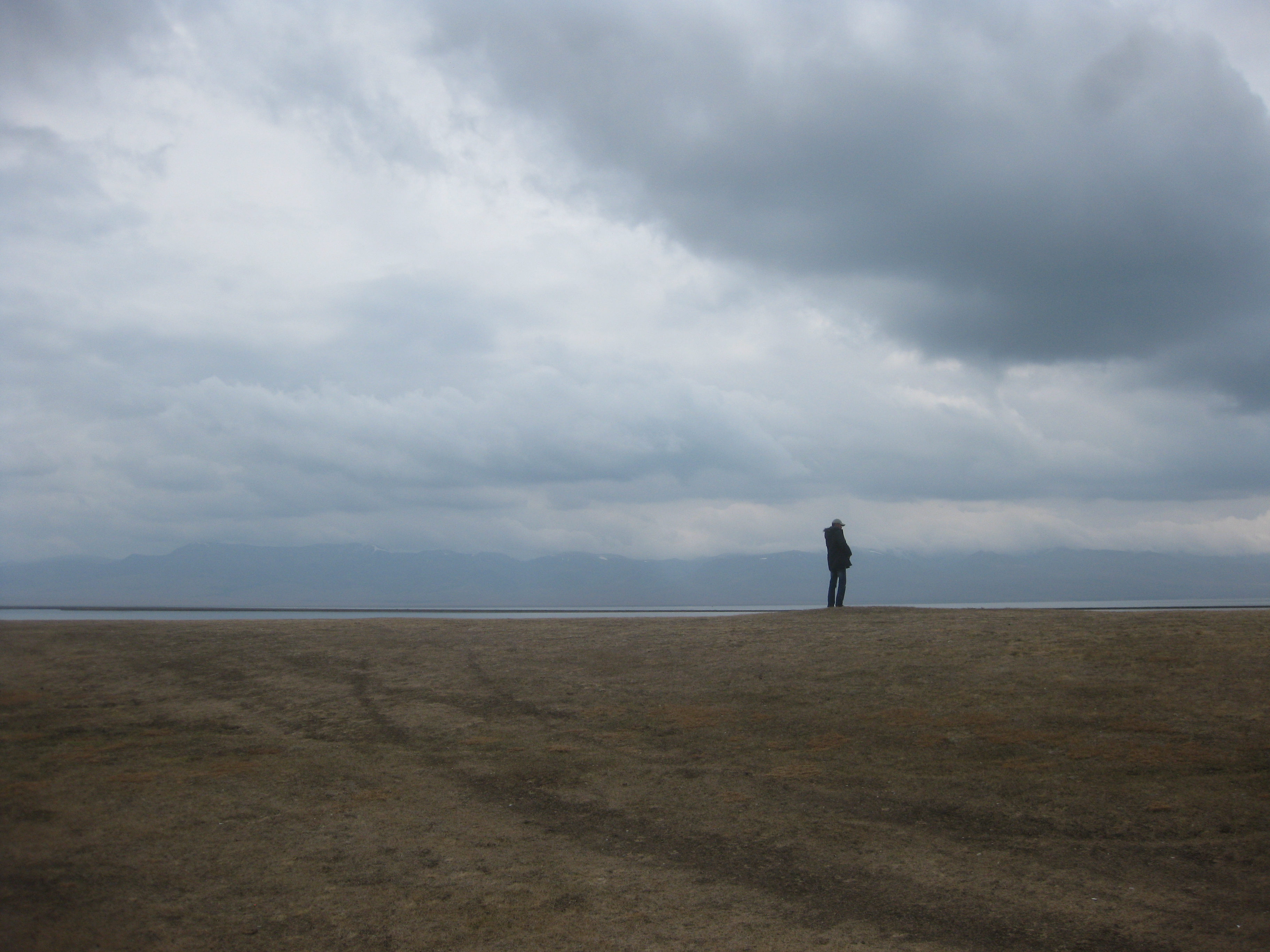
My friend Maksat is yet another king of the proverbial turn and can match almost any circumstance to an image rich phrase. After spending 4 days and 5 nights with him up by the mountain lake Song Kol selling our souvenir Chuko Bones, I too found myself waxing poetic.

Our sales trip didn’t turn out to be the raging success Maksat had hoped. Dreaming of being able to pay off his car with a few short days of selling out of a tent, our long stretches of waiting in between customers gave him plenty of opportunity to reflect on life and just what it means to be going through it. What does it mean to struggle? What is resiliency? What have I learned? What did my father used to say? Where is it all going?

IMG_9655Standing over it all

Maksat’s had his share of difficulties. He lost his father while an undergrad and had to quit school to come home and take care of his mother and household. Shortly after his brother-in-law passed away and so he took on the added stress of helping support his sister who had two children and a third on the way. Because of the cultural duties of the funeral, they had to slaughter many of their animals further adding financial stress. In honor of his father, who had been a math teacher, Maksat enrolled in a long-distance learning program to obtain his teaching certificate and step into his father’s old position. But a teacher’s pay is meager and so Maksat’s been diligently searching for other forms of income.

“The hardship is good in some ways,” Maksat says, “You’ve got something to fight against, a problem to solve, a reason to keep on living.”

Maksat is torn in so many directions—should he try to find work abroad? If yes, where? How much does he want to push against the grueling application processes? How about getting set up with some credit and a new herd of animals? After all, he had scratched out a year and a half long plan of buying and selling cows. Would it be worth it? Or he could go back to school to pursue a PhD in mathematics and work at a university. And what about this Chuko Bones company? Could he make a go of it? Start exporting? Expand into other products?

Maybe it’s his mathematical mind that causes him to search for the proof that life is good and life has meaning. Or maybe he’s just trying to find the most logical path through it all.

During our conversations I chided him a bit on a few of his kemchilikter, or shortcomings. Why didn’t he just choose a path? He had “too many irons in the fire” (he liked that one), was putting “all of his eggs in one basket” (that one not so much), and somehow simultaneously.

IMG_9642Keeping us alive through the protestations of our gasoline heater was certainly one of Maksat’s good traits
We talked about “knocking on doors” and seeing which would open. I told him that sometimes though you just have to put your shoulder to one and push until it gives.

Maybe it’s that I see myself in that place of decision. Here Maksat had an especially good thought: “When you have a difficult decision to make, it’s not the decision that’s problematic. It’s the problem. Your difficulties stem from the problem you’ve found yourself in and making a decision is the way out.” Yet for me, I’m choosing between so many good options rather than trying to figure out how to get out. I’m not sure if that’s supposed to make it easier or harder.

Maybe it’s that we’re blessed by our difficulties. That the lessons we learn by going through them and emerging on the other side enrich our lives in ways we never could have imagined. Maybe it’s the fight that cures us, refining us as in a fire. Maybe that’s the answer, that through it all we find our purpose.

IMG_9673

Things I’ve discovered about Kyrgyzstan

Part II of ‘Things I’ve discovered about America.’

Мекениңдин кадыры башка жакта билинет

“The value of your homeland is known once you’re in another place”

As a foreigner living in Kyrgyzstan, I’m asked all the time what I like about it. It’s a regular part of introductory conversations. Some people are just looking for the typical answers like, “it’s nice” or “it’s pretty” or “the food is…edible.” But others really want to hear your opinion. It’s not normal for foreigners to live in Kyrgyzstan outside of the capital, Bishkek, for any extended period of time.

The westerners who do venture forth usually do so in government registered vehicles with tinted windows and fly through the villages, staying not much longer than the time required to tick a box on their grant checklist or shake a few hands.

It’s not always their choice—they have loftier goals than the common Peace Corps Volunteer since most are busy doing great things at the national level. Yet, there are so many aspects of a place that can’t be experienced until you dive in and stay awhile.

IMG_5603Hanging out with Grandpa, watching TV

The fly-by rule is also true of many natives. There are Kyrgyzstanis who wouldn’t spend 2 weeks outside of Bishkek much less 2 years. It’s hard for them to believe why someone would put themselves through that kind of “ordeal” for the sake of “peace and friendship.”

Some believe we’re operating under ulterior motives beyond our work at schools, village health committees and organizations. Add to it the decades of being conditioned for suspicion, and you can understand why some people seem a bit incredulous that we would give up 2 years of our lives to live in tiny villages without the comforts of showers or coffee shops or broadband internet or whatever else it is that Americans spend all their time on.

In truth the question of what I like about Kyrgyzstan does make me a bit introspective. Why am I in Kyrgyzstan? Why did I re-up for a third year? What is it exactly that I like about the country?

So here it is, a working list. Maybe I should call this Part I: What I’ve discovered about Kyrgyzstan:

  1. I miss the Kyrgyz language. It is fun and exciting to see the world through the lens, or in this case filter I guess, of another language. Specifically I miss saying, “God willing.” There’s this deference towards a higher calling on life that I miss being reminded of.
  2. Friends. I’m not ready to leave and I’m thankful for another year with them.IMG_0265
  3. The way you can always catch a ride, if you’re willing to expend a little patience. Since I don’t have my own car in Kyrgyzstan, I have to rely on public transportation. Oh wait—there is no public transportation out in the regions. So you rely on people going the same direction as you. It’s usually fun, and if not, there’s always a story to tell.IMG_0242
  4. The incredible potential. Kyrgyzstan is a battle ground for good development and in the last decade or so businesses and organizations have been springing up like the wildflowers that cover the mountains. I have a few ideas floating around for how to maybe stick around after Peace Corps.
  5. Working with my hands. I never made the time for this in the states.IMG_7419
  6. There’s an entire set of history, pop-culture, local lore, friends, systems and a myriad of interests that’s only accessible within the Kyrgyz language and within the borders of the country. It’s an incredible notion that there are all these totally different places in the world waiting to be explored.
  7. Kyrgyz proverbs. There are hundreds. You’ll keep hearing about these from me.
  8. Akmoor. She’s a lot of fun to be with and I miss her!
  9. Joking around with friends and being ridiculous.
  10. Maksym. It’s this naturally carbonated, non-alcoholic drink made from wheat, corn and barley and is sublime. You can buy it from little stands all over the capital, and many people in the villages make it in their homes. It’s a summer drink and will keep you strong, healthy and I suppose hydrated. It’s delicious!Luther Shoro
  11. The benefit of a community that knows each other and has each other’s back. In small communities you have to put up with the gossip and the fact that you can’t even make a dash to the outhouse anonymously, but the trade-offs are huge: you find a group of people that look out for each other, never let someone be alone and pitch in wherever help is needed. A sense of belonging.
  12. Vodka being the cause of, and cure for, all of life’s problems.
  13. Komuz music. The komuz is a 3-stringed lute like instrument. The sound is lovely and quite unique. While its tone is not like a violin, the komuz is comparable in the fact that it takes a lot of practice to make it sound beautiful. I purchased a cheap $30 one and have so far proved to be quite the talented hack, so I enjoy listening to people like these guys play instead.
  14. Canning delicious pickles and winter salads.
  15. Students who make you feel like a superstar. IMG_6346
  16. Extremely long meals involving many courses.
  17. Bishkek! The capital is also the “true Kyrgyzstan” because it exists there. It’s my opinion that the difference between village culture and city culture is bigger than the difference between America and Kyrgyzstan in general. (Think about rural life America vs. City life America and all the ways we contrast those.) The capital is where a lot of cool things are happening in education, health and business and there are a lot of opportunities for volunteers. Bishkek is also a good place to come to take a long, hot shower, have a drink and use the internet. 🙂

—–

What else would you like to know about Kyrgyzstan? Send me any questions and I’ll answer them in future posts!