Kyrgyzstan

Preparing the sheep head


Cooking up some sheep for dinner is one of the things that Kyrgyz do best. I would say mutton, but really it’s just sheep. A big pot of sheep. You get used to it after a while, and it even starts to taste pretty good. I especially enjoy it when the power goes out and we’re eating in the dark.

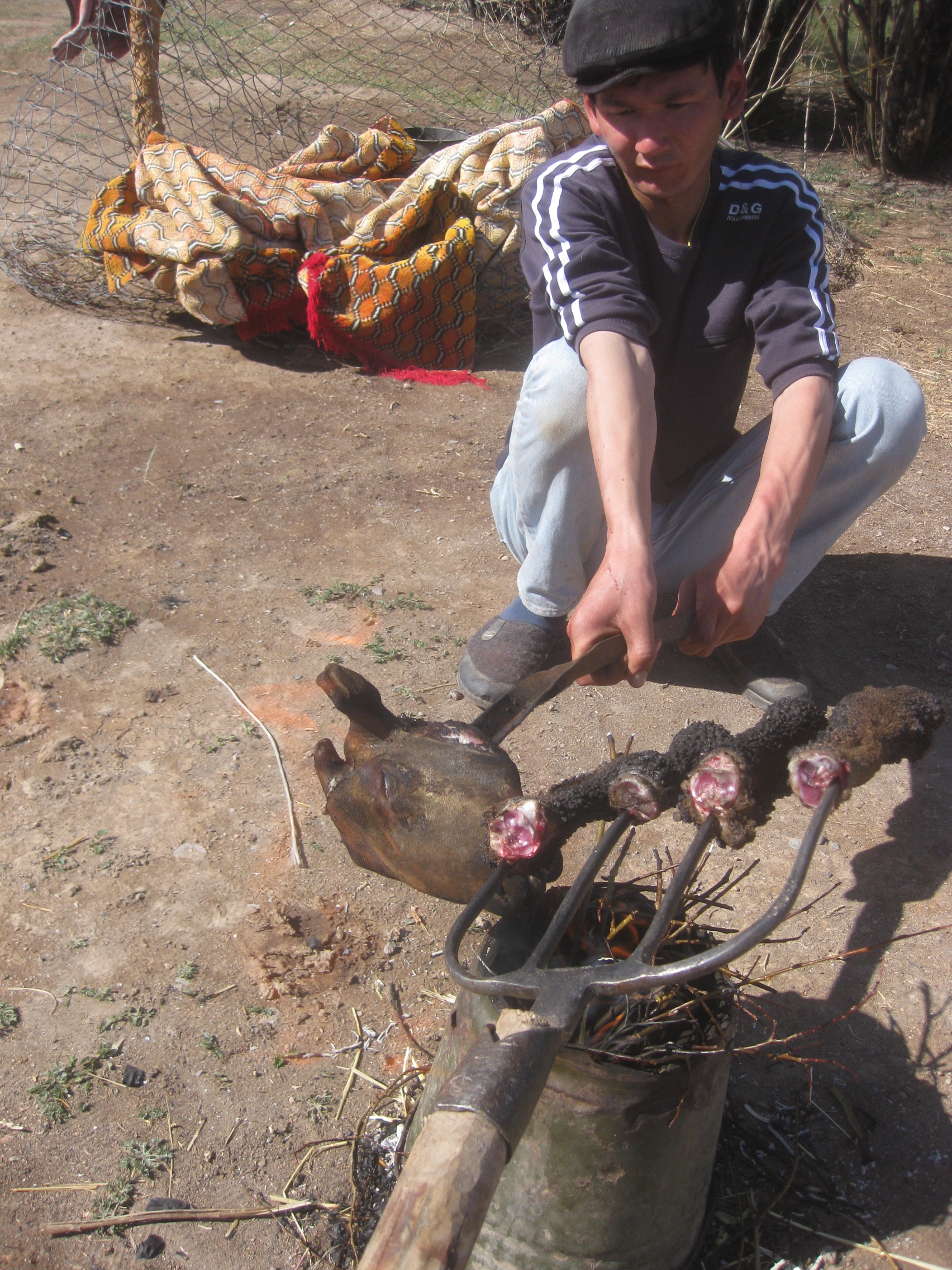
Today we’re looking specifically at the sheep head (and legs). This is shortly after the cutting-the-head-off step which I thought I would spare all of you, and immediately following the neighbor-who-came-over-and-sliced-off-a-little-bit-of-the-raw-head-fat-for-tasting-to-see-if-it-was-any-good step. (I’m not entirely sure that one is standard.)

Yes, it’s a bit gruesome, but that’s what makes it fun, right? …right?
IMG_9562

This is step one. Maksat took a break from lighting a fire inside of a bottomless, upturned bucket to snap this photo. The bucket acts as a kind of a makeshift blowtorch. Firing sessions are swapped in and out for the scraping of the burnt hair off the skin with a knife. After the firing comes the boiling.

IMG_9560

Here Maksat is preparing the “torch.”

IMG_9565

We had to keep yelling “white rabbit!” and hopping around the fire to keep out of the smoke of the shifting winds.

IMG_9566

The head’s getting pretty close to done, but there’s still some scraping to do on the legs.

IMG_8733

Now for some serious scrubbing with a rag and hot water. I think I might need to brush his teeth too. Next step, the boiling pot.


How to write (and teach) the five-paragraph essay

For a student to participate in the western world of academics, it is essential they know the basics of the 5-paragraph essay. Organizing thoughts into an outline and then putting them into this formula is a specific skill that must be taught and practiced for students to master.

It is even more important to have a strong command of this form for students who want to apply for study abroad programs or work in Europe or the United States. I wrote this lesson plan while helping students prepare for the Future Leaders Exchange (FLEX) exam so they could have a better shot at becoming one of the amazing 60 or so students from Kyrgyzstan who spend an academic year at a US high school.

The following is a lesson plan for introducing and practicing the basics of the 5-paragraph essay. As always, it should be modified to meet the specific needs of your students.

Lesson Plan – The 5-paragraph Essay

Objectives: Students will be able to write a 200-250 word essay using 5-paragraph form to include 1) An attention grabbing introduction 2) A thesis listing 3 reasons 3) 3 paragraphs with 3 reasons being the topic sentences 4) A conclusion that restates the introduction using different words.

  1. Give students a straight-forward topic, like, “My favorite singer” or “Why I want to go to America.”
  2. Brainstorm and list many reasons why they like this particular singer, or why they want to go to America. Emphasize specific reasons.
  3. Have students complete the following chart to help them with the form and reasons. “My favorite singer is __Avril Lavigne__ because 1) __she is edgy__ 2) __she doesn’t take crap from anyone__ 3) __when I play her music all the cute girls gather around__”
  4. Explain the word “detail” (story, statistic, example, anecdote, supporting information) and brainstorm together a couple details for one of the reasons.
  5. Write the outline above on the board and have students copy into their notebooks.
  6. Provide a sample essay. Students must: a) Identify and underline the thesis; b) Number the reasons within the thesis; c) Number and underline the reasons in the topic sentences; and d)Number the reasons in the conclusion. Go over these one at a time and elicit answers from students. If students need help, have them work in pairs or small groups before providing answers.
  7. Students complete an outline for the sample essay.
  8. Students check their partners’ outline and match it against the elements in the example.
  9. Students write a practice essay. (For homework.)

Lesson notes: Learning to write essays using the 5-paragraph technique takes lots of practice. Students should have many opportunities to sit down with the teacher one-on-one to discuss outlines and critique writing tasks. I have found this lesson to be more successful if you first spend lots of time only writing outlines. Slowly build on thesis, reasons, details, introduction, conclusion and transitions. It helps to assign a topic every lesson (or day) and then the next day working in pairs, students can critique each others’ essays underlining and labeling the elements of the 5-paragraph essay. Lastly, please, for the love of learning, and all that is good and bright in the world, add your own personality and above all, humor to your teaching. Just like how our essays should be interesting in order to be memorable, the more enjoyable your lesson, the more the students will get out of it.

Topic ideas to assign as homework:

  • Describe a time you were a leader and give examples.
  • If I were a banana, I would…
  • If I don’t like my host mother’s food, I will…
  • You are home alone and you accidentally break the coffee table. What do you do?
  • The three most important people are…

For the FLEX test particularly, it’s necessary to stress to students the importance of being original, unique, and outgoing while showing a flavor of critical-thinking in their writing. FLEX recruiters are going to read a billion of these essays and students need to stand out to have a shot at a year in America.

5-paragraph essay outline

Topic: XYZ

Introduction:

  • Be interesting!
  • Be unique! The reader should remember this.
  • 2-3 sentences

Thesis:

  • Write the topic and give your opinion using 3 reasons.
  • “I think XYZ is good because 1)… 2)… 3)… ”

Body:

  • 3 paragraphs (3-5 sentences each)
  • Reason 1
    • Detail (example, story, anecdote, statistic)
    • Detail
  • Reason 2
    • Detail
    • Detail
  • Reason 3
    • Detail
    • Detail

Conclusion:

  • Write the introduction and thesis again using different words
  • “In conclusion, you can see that XYZ is very good because…”

Sample 5-paragraph essay

Topic: What will you do when you get back from the United States?

Studying in America will be an amazing experience, but I will also be very excited to come home. Of course I will miss my family. But I also am excited to meet my friends and tell them all about America! When I come back from the United states I will help lead an American Culture club, show videos of high school life and help Access students.

Leading an American Culture club will teach students about new things. I want to share new music and lead a hip-hop dance club. I went to many dances at my school in America and it was so fun! My dance group in America wants to keep in touch with us and we will record videos and send them to each other.

I took many videos of my high school in America. I want to show my school their cafeteria, their classrooms and the gymnasium. I know we can make some changes to our school to make it even better.

Access students learn American culture, but they don’t have a chance to visit, so I will help teach Access students English through American culture lessons. We will listen to songs and write letters to students in America. It is a good chance to learn English from native speakers!

After I come back from America I will be so happy to see my family and friends again! But I know I will miss my place in the United States too. I will be able to keep in touch with my friends in America and teach my friends new things by leading clubs, showing videos and helping with Access.


What ideas do you have for teaching the 5-paragraph essay? Write your suggestions below in the comments!

Sample budget for teacher trainings in Kyrgyzstan

A fellow third-year volunteer Luke and I gave a brief session last month at our All-Volunteer conference talking about teacher training logistics. The session included a sample budget of what to expect to spend on a 1-2 day training for area teachers. I’m including the budget below for anyone interested in implementing trainings in Kyrgyzstan as an idea of where to get started and what kinds of things may be needed to run a training.

A training can be done for as little or as much money as you like. It’s possible to hold a 1 or 2 session training at your school for no cost other than a bit of chalk and the teachers’ time. However, if you’re going to host a multiple session training, it’s usually a good idea to provide a few materials that will assist in the success of the training.

Below is a sample budget of what things you may want to include in a training for 15 participants. Not every training must include all elements, for example most local trainings are held without renting a hotel for the participants, or without paying for teachers’ transportation costs.

There will be other necessary items, for example a teapot, tables, chairs, etc. but this budget assumes these items will be available to be used for free wherever the training is held.

Item Cost (Som) (Dollars) Units Total Cost (Som) (Dollars) Who funds
Training Items
Notebook 20-25 .40-.50 15 300-375 6.00-7.50 G, CC*
Pen 7-15 .15-.30 15 105-225 2.10-4.50 G, CC
Folder 25-40 .50-.80 15 375-600 7.50-12.00 G, CC
Certificates 15-20 .30-.40 15 225-300 4.50-6.00 G, CC
Flip Chart 200-250 4.00-5.00 1 200-250 4.00-5.00 G, V, CC
Markers 5-10 .10-.20 10 50-100 1.00-2.00 G, V, CC
Handouts 3-4 .6-.8 150 (pages) 450-600 9.00-12.00 G, V, CC
Total 1705-2450 $34.00-50.00
Coffee Break / Lunch Items
Chai 90-100 1.80-2.00 1 (box) 90-100 1.80-2.00 CC, G, V
Coffee 90-100 1.80-2.00 1 90-100 1.80-2.00 CC, G, V
Sugar 30-40 .60-.80 .5 kilo 30-40 .60-.80 CC, G, V
Cookies 150-250 3.00-5.00 2 kg 300-500 6.00-10.00 CC, G, V
Lunch 100-200 2.00-4.00 18 (with trainers) 1800-3600 36.00-72.00 G, CC
Salary for Cooks 250-300 5.00-6.00 2 (2 people, 1 day) 500-600 10.00-12.00 G, CC
Total 2810-4940 $56.00-100.00
Transportation
Travel per trainee 50-100 1.00-2.00 30 (local travel, both ways) 1500-3000 30.00-60.00 CC, G
Venue
Training Room 1000 20.00 1 (day) 1000 20.00 CC, G
Hotel ? ? 2-3 nights ? ? G
Other
Translator 500-1000 $10.00-20.00 1 (day) 500-1000 10.00-20.00 CC, G
Total Costs(without hotel) 7515-12390 $150.00-250.00

*G = Grant, V = Volunteer, CC = Community Contribution

These are suggestions of funding sources based on volunteer experiences in the past. The volunteer is not required to spend any of their own funds for trainings beyond their own transportation (grants don’t cover volunteer travel). You may find however that you will spend some money here and there for various items like a thank you gift, some additional snacks for lunch or other materials needed for the training like scissors, etc.

Teacher trainings are great for a number of reasons. They allow teachers the opportunity to meet with other teachers to discuss relevant issues, they provide opportunities for professional development and they help improve the quality of instruction provided for students.

Trainings are also relatively inexpensive and can have a high probability of passing when submitted as grant requests. Trainings have a higher chance of being accepted if they also include a follow up process for participants. This can be follow-up observations by you or your counterpart, submitted lesson plans or a number of other ideas. Make sure to include in your budget any costs incurred through follow up, whether that is travel money for your counterpart to go observe teachers or money for another chai break if you are meeting with teachers.

Work is not a wolf

“Makal” in the Kyrgyz language means “proverb.” Kyrgyz is full of wonderful and puzzling little proverbs – some that match common proverbs often heard in English and some that are real head scratchers. Most Mondays I’ll post one of the more fun ones for you. Let’s see if we can’t make some of these commonplace in America by the time I get back!

Жумуш карышкыр эмес

Jumush karyshkyr emes

“Work is not a wolf”

True to itself and unfortunately quite wholly precedential, there was school today. We were supposed to have the day off. It was planned a week ago or more that all the teachers would use this day to have their required medical check-ups. Well, the hospital in town called last night at 9:00pm to say, “It’s impossible.”

For what reason and how it happened at the last minute I have no idea. I didn’t find out until I woke up at 7:00 and was having breakfast with my host mother who was rushing about getting ready for her first class at 7:30. A bit later I called my counterpart and she was getting ready to head to school as well but added that many teachers didn’t know yet that they had to go to school today and since all the kids were expecting the day off, probably almost none of them would show up. The teachers needed to work on curriculum planning anyway, she said, so it was ok.

I needed to be at home. Not only do I like being at home and lazing about, and especially when I’m told to and have been expecting to do just that for the previous week, but I had promised my host father I would help some with “buckin’ hay.”

I found quickly that I should have gone to school.

These bales of hay were friggin’ heavy. Like, I don’t know, around a million pounds. It didn’t help that the head of the pitchfork kept falling off when I tried to lift the bale up over my head to toss it on the roof of the sheep shack where my host dad was stacking them in neat rows. I couldn’t exactly lift them over my head anyway, and so I would use my knee as a fulcrum, sink the pitchfork handle in the ground, then kind of lift with my shoulder and half hoist half shove the bale onto the low roof.

IMG_1191Upwards is the least fun direction to move stuff

My host dad, always quick with a proverb, must have seen me teetering on the edge of giving up and said in that 66-year-old buckin’ hay voice, “Work is not a wolf. It’s not something to run away from.” My head, already bent from lifting million pound bales of hay with my neck sunk a little lower. How was I going to survive this? We were maybe 8 or 9 bales in on a 100 bale stack.

Work smarter, not harder, Luther. That’s right, I can come up with idioms too, you know.

I built a little series of steps up to the roof out of bales of hay. Then I went and got my host brother.

With the three of us, one carrying a bale, one lifting it on the roof and one stacking it, the work was finished in a little over an hour. The work didn’t turn out to be too much of a wolf, though my hands and arms did look like I’d been mauled by one. Next time I’ll face that wolf with gloves and hopefully, a little more courage and grit.

—-

Edit: Later in the afternoon as I was headed to school I learned that the hospital had changed its mind and so the teachers all left to go get their health screenings. This led to more yard work and further blistered hands. My host father did give me an “atta-boy” though so I suppose the wolf has been scared off, hopefully for good.

A task from God

Everyone needs a purpose. A cause to champion. A journey to undertake. A reason to wake up in the morning. This week, mine happens to be feeding sheep.

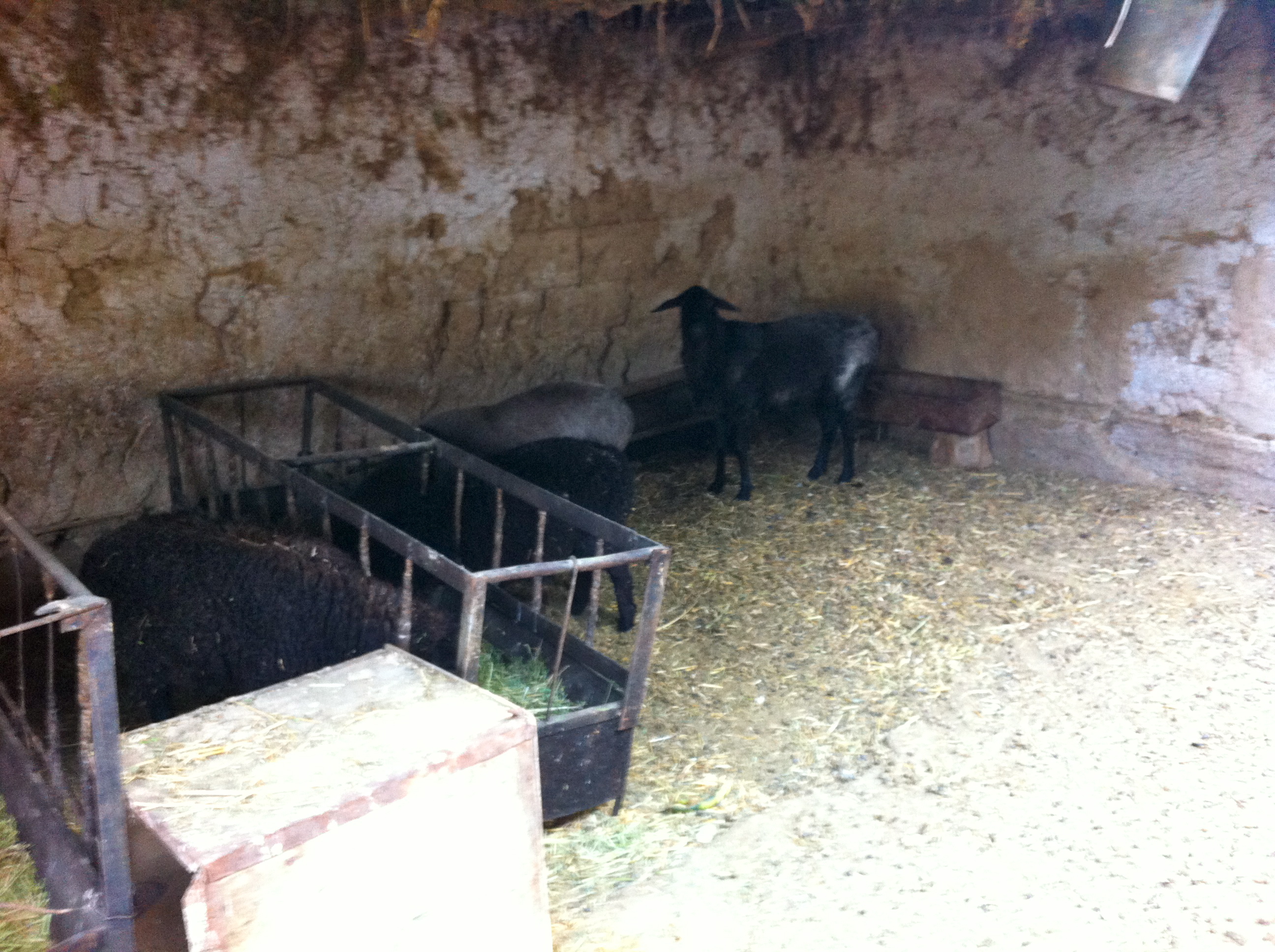
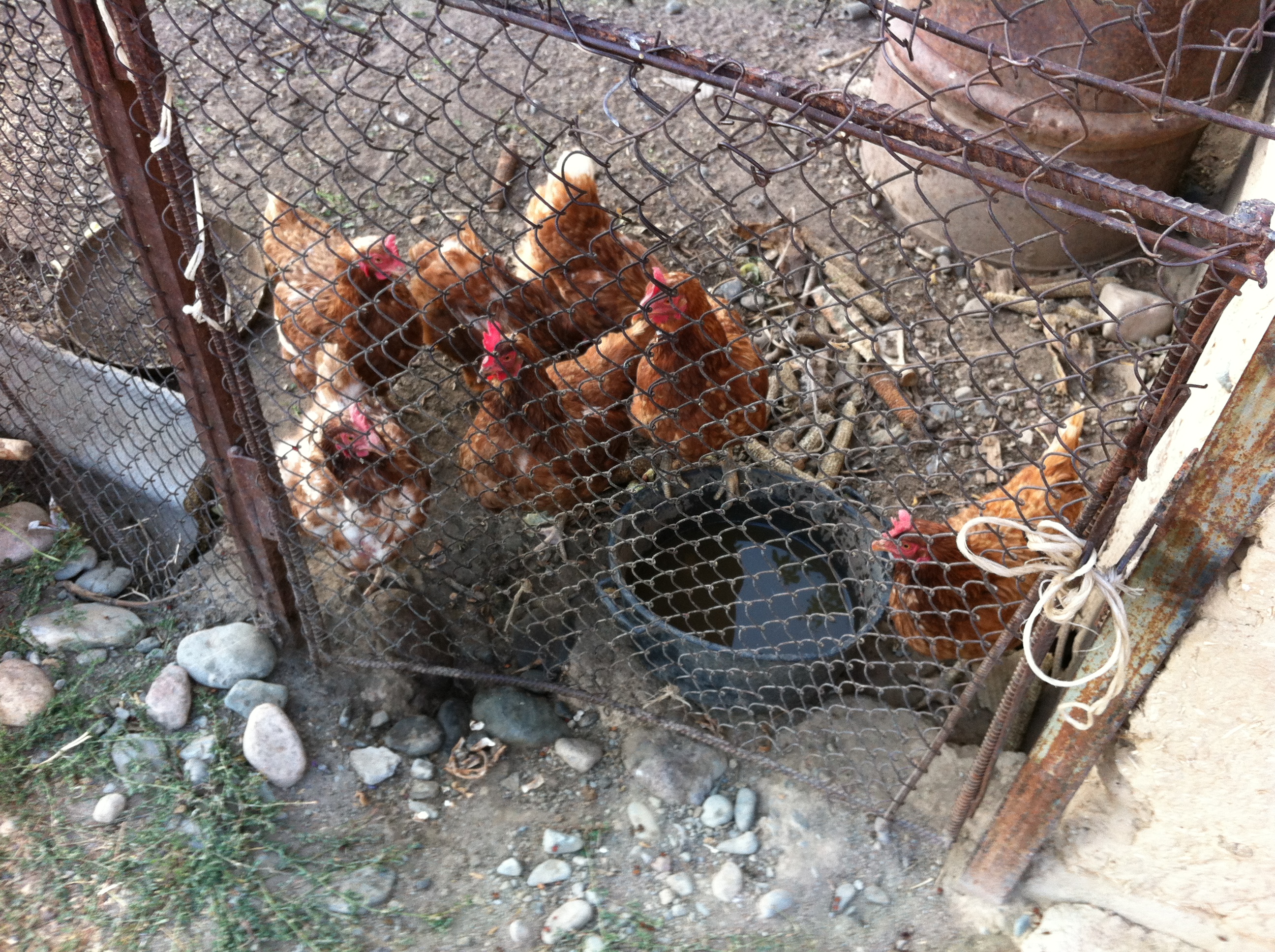
Through two years of living in villages I had never once been responsible for any animal—save chasing two wanderers from the flock back down a hilltop—and now that I’d come to the “big city center” the lives of four sheep and five chickens had been suddenly thrust into my hands.

Living here at the “Doctor’s house” with running water, a washing machine and 3G internet, I pictured a life of privilege, a life of ease. There was going to be none of this getting-my-hands-dirty stuff.

So it was I found myself, not two steps through our gate having returned from a mini-vacation on the golden shores of the mountain lake Issyk-Kul, wandering back to the sheep pen in my flip-flops.

My host dad, or Ata, was taking the family that afternoon for a week of wedding parties in the capital and it was going to be my task to look after the animals. He started immediately into the details—how many grams of jem a typical sheep ate per day, how full to fill the water trough, where the extra chicken feed was kept. I pulled out my notebook and started furiously writing so as not to mistakenly forget something and end up with a dead $100 bill on my hands.

We made our way over to the grass pile and a home-made grass chopping table. Operated with your right hand as you pushed the grass through with your left, it was essentially an enormous paper cutter where you could lop off your own hand before you realized what was happening. I took small condolence in the fact that I would be operating this thing at a groggy hour and made note to boil coffee before emerging into the morning air.

IMG_1146

“Do you know why I like you, Luther?”

The question came abruptly as I was chopping the grass.

“Huh?” I answered, wondering if I had heard the question right.

“Do you know why I like you?”

“Uh, no, why?” I stopped cutting.

“You’re like my son. You’re my uulum. You know I had a son—he was your age, born in 1983. He died though. And now you’ve come to our home.” I saw a single line of water fall from the corner of his eye.

I nodded somberly, trying to find the right words to say. They had told me the story before, during one of my first days here in June. It happened three years ago. Their son had become ill suddenly and the doctors didn’t know what to do. He had been flown to Moscow, but the respiratory illness had taken hold and nothing could be done. He left behind a wife and a daughter he would never meet—his wife was pregnant.

Now their daughter-in-law and grandchild live in Bishkek but they don’t get to see them often. Not having remarried, she spends most of her time with her parents.

“Do you think about him every day?” I asked stiltedly, hoping I had phrased it respectfully.

“Of course. Of course.”

I looked down and fidgeted with the chopping table.

“You’ve been tasked by God—taking care of these animals,” he said.

I tried to swallow the lump that was forming in my own throat and continued chopping.

After a moment he added, “And don’t chop your fingers off. We don’t need any of that.”

We moved on to the chicken coop and Ata pointed to where the chickens laid their eggs. There was a single one waiting to be placed—unwashed—in our refrigerator.

IMG_1037

My family took off later that afternoon and I had a quiet house to myself. In the evening I slid into my now muck covered flip-flops and trudged back out to the pen. The sheep sprinted in circles to clear away from this new force in their midst, vacillating wildly between distrust and the animal instinct of an empty belly.

Poking its head out into the light, a thickly brown sheep hobbled up to the feeding trough. I gasped in horror as I saw my God-given task’s leg dangling loosely from the knee. I immediately called my host mother—the only one to whom I felt I could break the news—and was told not to worry. It had been sick. I texted my brother thinking maybe she hadn’t understood my fervent Kyrgyz—butu syndy!—but he replied back that yes, the lamb’s leg had broken a few days before.

I felt awful. I didn’t know what the procedure was for a broken leg—was this what we did? Just leave it until it fell off? Or was the lamb to be the next sacrifice to our pantry? Could you even properly serve a sheep with a broken leg? And what about it’s own misery? And if not for the sheep’s sake, then maybe would the adrenaline surging through its muscles make it taste strange? These wonderings washed through me as I watched the pitiful thing struggle on its three legs.

“The world is broken,” I thought.

And I thought about God’s glory and the mystery of his sovereignty over all things. Of how his greatness shines forth in the handful of barley scattered on the ground, of chickens scratching the earth and eggs hidden among the grass. Of God’s knowledge of the broken leg and how much more he cares for his two-legged sheep, wandering upright on the earth. How we too are wayward and sprint erratically, choosing between his glory and our own.

Here I was, placed in responsibility over one, tiny little sliver of the world and I already felt the weight of it, pushing down between my shoulder blades, seeping into my heart, a heart still beating three years beyond my brother’s. I wondered if this is not a tiny bit of how God feels for his earth, his heart beating for the world, his own body broken for it, his blood spilled out over the same earth that we, his little creatures, tread.